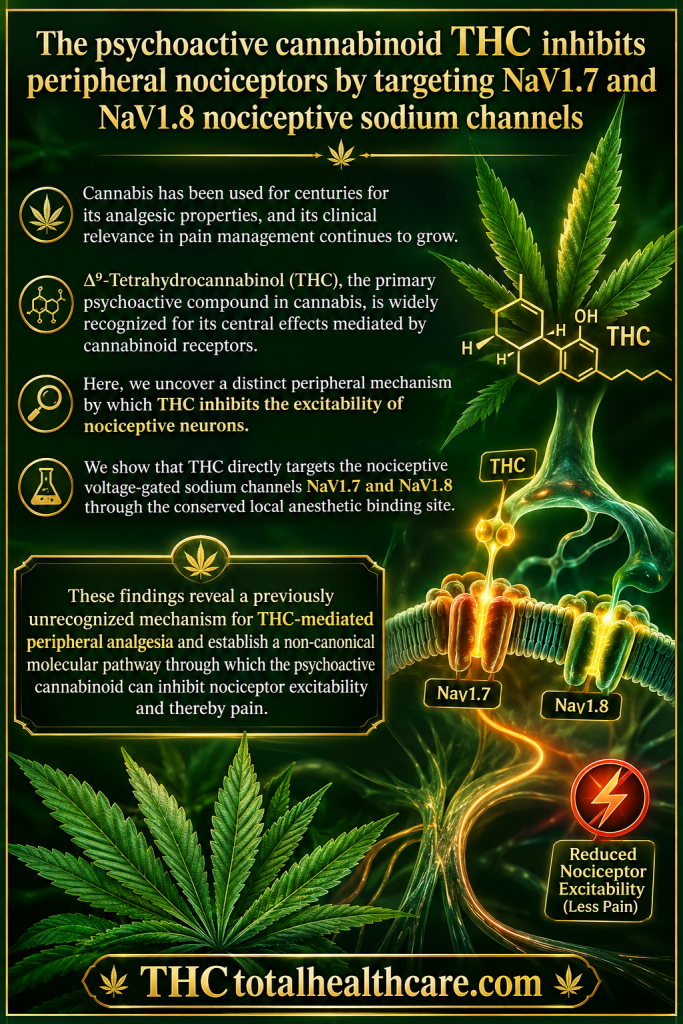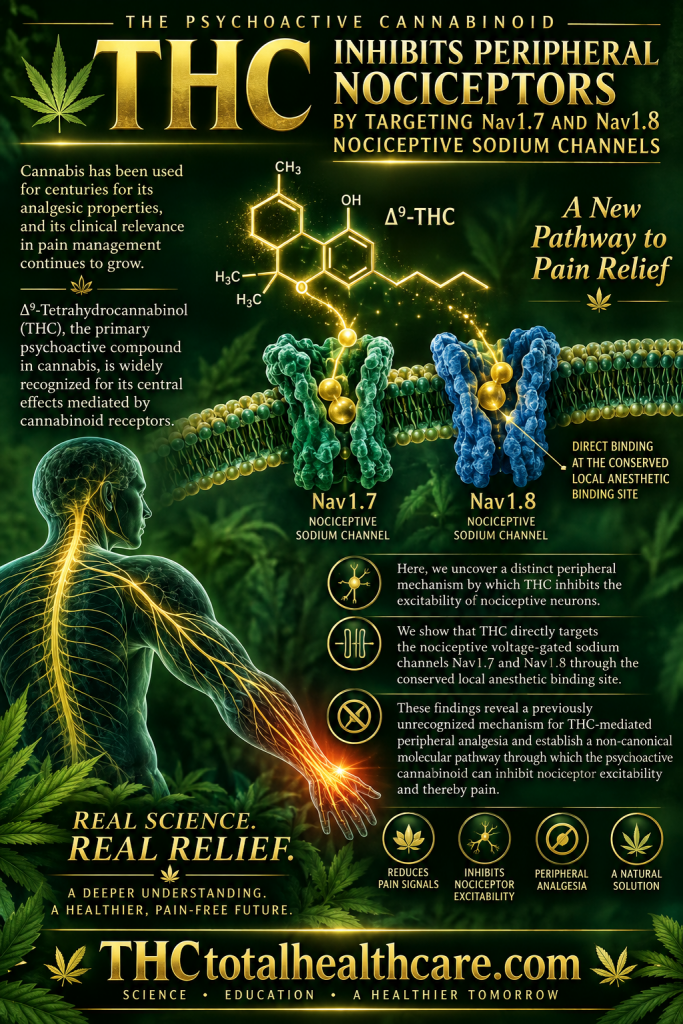
“Δ⁹-Tetrahydrocannabinol (THC), the primary psychoactive compound in cannabis, is widely recognized for its central effects mediated by cannabinoid receptors. Here, we uncover a distinct peripheral mechanism by which THC inhibits the excitability of nociceptive neurons.
We show that THC directly targets the nociceptive voltage-gated sodium channels NaV1.7 and NaV1.8 through the conserved local anesthetic binding site. This interaction reduces sodium currents and suppresses action potential generation in peripheral sensory neurons.
Our findings demonstrate that, beyond its central psychoactivity, THC exerts direct peripheral nociceptor inhibition via modulation of NaV1.7 and NaV1.8, offering new insight into cannabinoid-based analgesia independent of cannabinoid receptor signaling.”
https://pubmed.ncbi.nlm.nih.gov/41565997

“Cannabis has been used for centuries for its analgesic properties, and its clinical relevance in pain management continues to grow.”
“These findings reveal a previously unrecognized mechanism for THC-mediated peripheral analgesia and establish a non-canonical molecular pathway through which the psychoactive cannabinoid can inhibit nociceptor excitability and thereby pain.”
https://www.nature.com/articles/s41386-026-02355-9