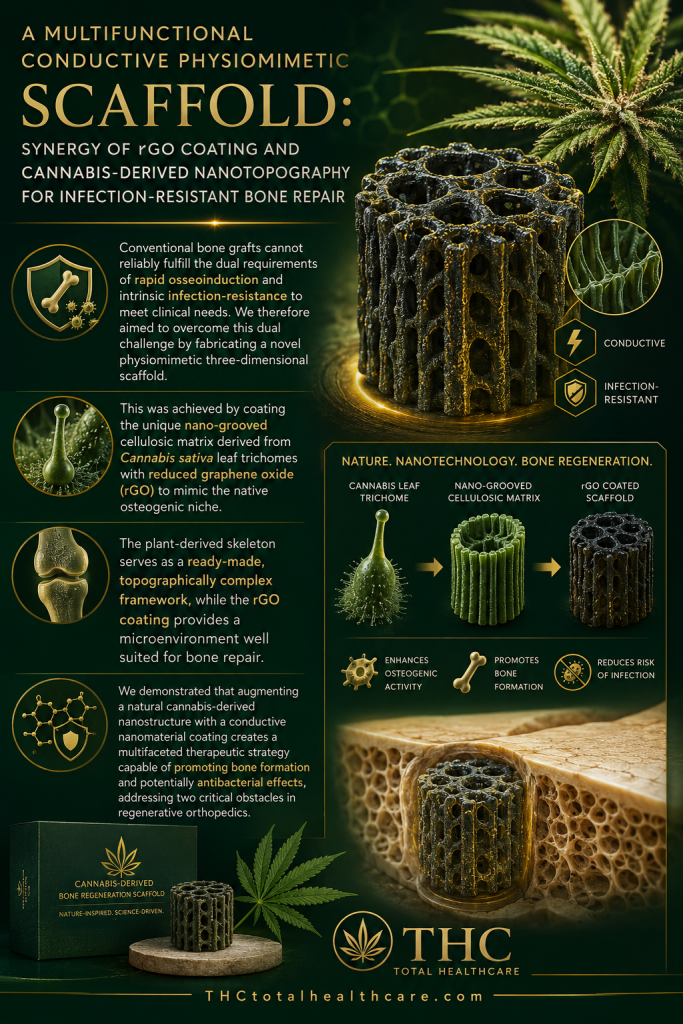
“Conventional bone grafts cannot reliably fulfill the dual requirements of rapid osseoinduction and intrinsic infection-resistance to meet clinical needs. We therefore aimed to overcome this dual challenge by fabricating a novel physiomimetic three-dimensional scaffold.
This was achieved by coating the unique nano-grooved cellulosic matrix derived from Cannabis sativa leaf trichomes with reduced graphene oxide (rGO) to mimic the native osteogenic niche.
The plant-derived skeleton serves as a ready-made, topographically complex framework, while the rGO coating provides a microenvironment well suited for bone repair. Comprehensive characterization verified a measurable surface energy, hydrophilicity, roughness, and proper conductivity due to rGO coating. Moreover, in vitro examination confirmed that rGO biofunctionalization synergized with the innate nano-topography, dynamically accelerated the osteogenic differentiation of human adipose-derived stem cells. An upregulated expression of key bone markers, COL1A1, RUNX2, and OPN, sustained alkaline phosphatase activity, and augmented deposition of collagen and mineralized matrix exhibited the potential of the proposed approach for efficient osteal regeneration. An equally important finding was the scaffold’s inherent antibacterial property against Gram-positive and Gram-negative pathogens.
We demonstrated that augmenting a natural cannabis-derived nanostructure with a conductive nanomaterial coating creates a multifaceted therapeutic strategy capable of promoting bone formation and potentially antibacterial effects, addressing two critical obstacles in regenerative orthopedics.”
https://pubmed.ncbi.nlm.nih.gov/41958836

“In conclusion, the rGO-functionalized cannabis-derived scaffold offers a multifaceted therapeutic route toward bone repair, while bioinspired microenvironment is not only structurally supportive but also biologically instructive and inherently protective against microbial threats.”