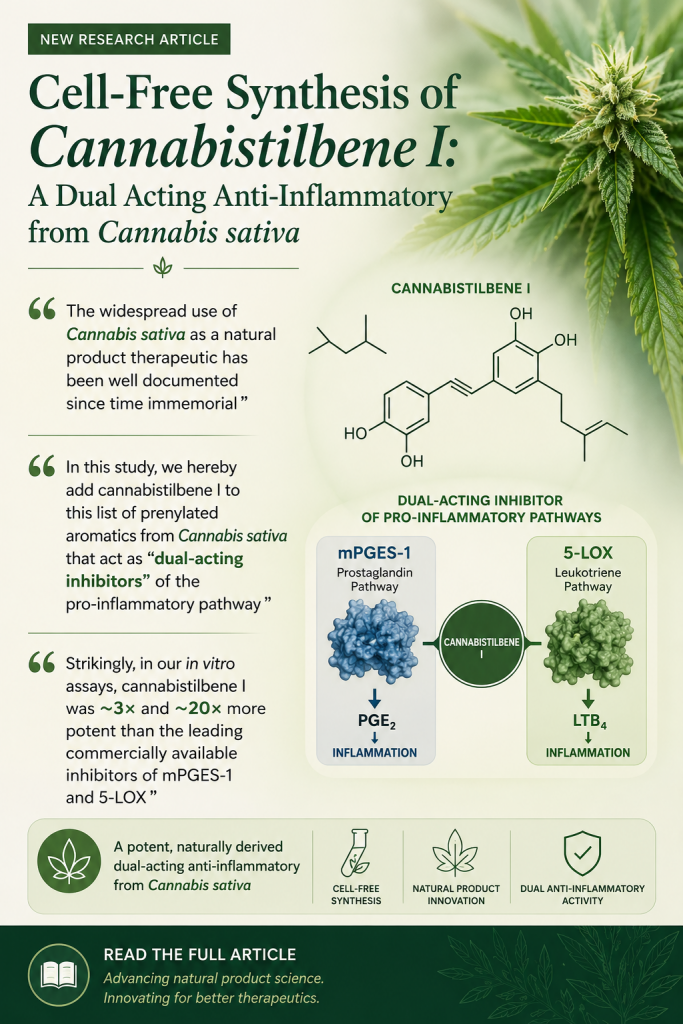
Cannabis sativa contains bioactive compounds far beyond cannabinoids, including stilbenes with promising anti-inflammatory activity. In this study, researchers used a cell-free biosynthesis system to produce cannabistilbene I and found that it acted on two distinct inflammatory pathways, giving the compound a dual mechanism of action. The findings highlight cannabistilbene I as a promising cannabis-derived anti-inflammatory molecule while also demonstrating a scalable biotechnology approach for producing rare plant compounds for future therapeutic development.
“Despite the potential of Cannabis bibenzyls to remedy acute and chronic inflammation, their relative scarcity, in planta, has hindered applications for them in mainstream therapeutic efforts.
Here, we describe the biocatalytic synthesis of cannabistilbene I (1), a prototypical Cannabis bibenzyl, and demonstrate its utility as an anti-inflammatory agent.
A Cannabis O-methyltransferase (CsOMT1) was first identified that catalyzes the 3-hydroxymethylation of dihydroresveratrol (2) to produce pinobistilbene (3). Structural characterization of CsOMT1 revealed that the substrate-binding pocket requires the ethyl bridge on 2 to twist with a dihedral angle of -110°, thereby explaining why less flexible aromatics such as stilbenes serve as poor enzymatic substrates.
Next, a prenyltransferase (CloQ) from the Gram-positive bacterium Streptomyces was shown to prenylate the 3′-position of the B-ring on 3 into 1. Using these two enzymes, a cell-free method was then developed to synthesize 1 and the compound was shown to inhibit both microsomal prostaglandin E2 synthase-1 and 5-lipoxygenase enzyme activity, in vitro, more effectively than the leading commercially available inhibitors.
Together, these results establish a platform for producing cannabistilbene I (1) that circumvents the challenges of traditional “chemical synthesis”, and which is amenable to produce similar value-added compounds that are not easily accessible from nature.”
https://pubmed.ncbi.nlm.nih.gov/42139234
“The widespread use of Cannabis sativa as a natural product therapeutic has been well documented since time immemorial.”
“In this study, we hereby add cannabistilbene I (1) to this list of prenylated aromatics from C. sativa that act as “dual-acting inhibitors” of the pro-inflammatory pathway. Strikingly, in our in vitro assays, cannabistilbene I (1) was ∼3× and ∼20× more potent than the leading commercially available inhibitors of mPGES-1 and 5-LOX, respectively.”
https://pubs.acs.org/doi/10.1021/acs.jnatprod.6c00318