
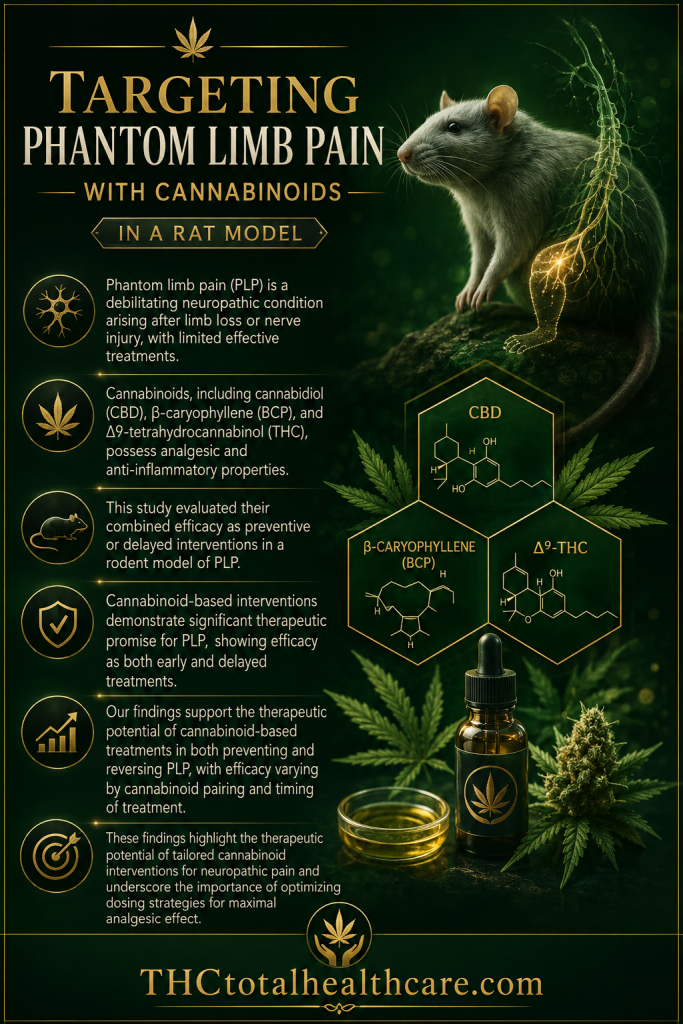
Phantom limb pain can be severe and difficult to treat because the pain persists even after the affected limb is gone. In this preclinical study, researchers tested cannabinoids in a rat model of phantom limb pain and found meaningful reductions in pain-related behaviors. The results suggest that cannabinoid signaling can modify the abnormal nerve activity involved in post-amputation pain, supporting the potential of cannabinoids as a new approach for managing phantom limb pain and other forms of neuropathic pain.
“Introduction: Phantom limb pain (PLP) is a debilitating neuropathic condition arising after limb loss or nerve injury, with limited effective treatments. Cannabinoids, including cannabidiol (CBD), β-caryophyllene (BCP), and Δ9-tetrahydrocannabinol (THC), possess analgesic and anti-inflammatory properties. This study evaluated their combined efficacy as preventive or delayed interventions in a rodent model of PLP.
Methods: To model PLP, a chronic constriction injury was used to mimic pre-amputation pain, followed by formalin-induced localized inflammation and complete sciatic nerve transection to simulate extremity amputation. Cannabinoid treatments (CBD/BCP/THC, CBD/BCP, or THC) or vehicle control were administered either preemptively on the day of axotomy (prevention paradigm) or after the emergence of pain behaviors (reversal paradigm). Progression of pain behaviors were assessed over a 72-day period, and modulation of spinal cytokine levels, glial reactivity, and GABAergic signaling was evaluated.
Results: Preemptive THC or CBD/BCP reduced PLP onset and severity, while the full combination was less effective. In contrast, with delayed treatment, CBD/BCP and the CBD/BCP/THC combination were most effective in mitigating PLP. Pain reduction was correlated with restoration of spinal GABAergic inhibition. All cannabinoid treatments decreased microglial and astrocyte reactivity and shifted cytokines toward an anti-inflammatory state.
Conclusion: Cannabinoid-based interventions demonstrate significant therapeutic promise for PLP, showing efficacy as both early and delayed treatments. Findings suggest that THC may exert greater therapeutic effects when administered pre-emptively, while CBD and BCP may offer greater therapeutic advantages in established pain states. These findings highlight the therapeutic potential of tailored cannabinoid interventions for neuropathic pain and underscore the importance of optimizing dosing strategies for maximal analgesic effect.”
https://pubmed.ncbi.nlm.nih.gov/42267080
“Cannabis contains a complex mixture of cannabinoids, terpenes, and flavonoids that have demonstrated therapeutic potential in a variety of pathologies and conditions. Their anti-inflammatory, analgesic, and antioxidant activities are believed to play a central role in mediating pain relief.”
“Our findings support the therapeutic potential of cannabinoid-based treatments in both preventing and reversing PLP, with efficacy varying by cannabinoid pairing and timing of treatment.
Together, these results underscore the therapeutic promise of cannabinoid-based treatments while highlighting the need to carefully consider how specific compounds and dosing strategies interact in different stages of pain.”
https://karger.com/mca/article/9/1/92/946968/Targeting-Phantom-Limb-Pain-with-Cannabinoids-in-a