
Autistic adults often experience overlapping problems such as anxiety, sleep disturbance, and reduced quality of life, yet treatment options for these associated symptoms can be limited. This UK Medical Cannabis Registry analysis examined patient-reported outcomes following treatment with prescribed cannabis-based medicines in people with autism spectrum disorder. Participants reported improvements across several measures of general health, anxiety, sleep, and quality of life over follow-up, while adverse events were also documented. The findings support further controlled research into cannabis-based medicines for symptoms commonly associated with autism.
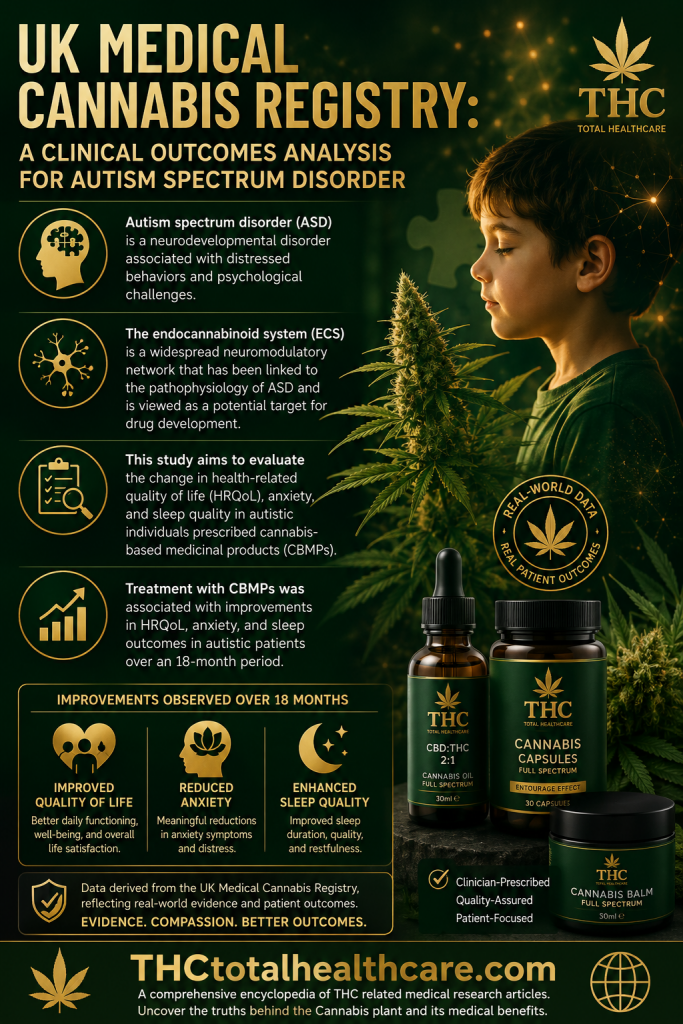
“Introduction: Autism spectrum disorder (ASD) is a neurodevelopmental disorder associated with distressed behaviors and psychological challenges. This study aims to evaluate the change in health-related quality of life (HRQoL), anxiety, and sleep quality in autistic individuals prescribed cannabis-based medicinal products (CBMPs).
Method: This observational case series analyzed data from the UK Medical Cannabis Registry on autistic adults treated with CBMPs. Demographic and clinical data were collected at baseline, with patient-reported outcome measures assessed up to 18 months. Primary outcomes included changes in anxiety (GAD-7), sleep quality (SQS), and HRQoL (EQ-5D-5L). Secondary outcomes included the incidence of adverse events. Statistical significance was indicated by p < 0.050.
Results: One-hundred and thirty individuals met the inclusion criteria. GAD-7 (p < 0.001) and SQS (p < 0.001) scores improved from baseline to 18 months. EQ-5D-5L index values showed improvement from baseline (0.43 ± 0.30) to 18 months (0.51 ± 0.32, p < 0.001), and PGIC scores increased from 1 month (5.43 ± 1.49) to 18 months (5.65 ± 1.32, p = 0.013). Twenty-five participants (19.23%) reported a total of 232 (178.46%) adverse events, with most being mild (n = 88; 67.69%) or moderate (n = 99; 76.15%).
Conclusion: Treatment with CBMPs was associated with improvements in HRQoL, anxiety, and sleep outcomes in autistic patients over an 18-month period. Given the absence of a control group, these findings represent associations rather than proven treatment effects. Further high-quality randomized controlled trials are needed to confirm the long-term efficacy and safety of CBMPs in ASD.”
https://pubmed.ncbi.nlm.nih.gov/42387975
“The endocannabinoid system (ECS) is a widespread neuromodulatory network that has been linked to the pathophysiology of ASD and is viewed as a potential target for drug development.”
“This observational study suggests that CBMP initiation in autistic adults is associated with improvements in HRQoL, anxiety, and sleep quality over 18 months. There was a favorable safety profile, with 80.77% of patients not reporting any adverse events.”