
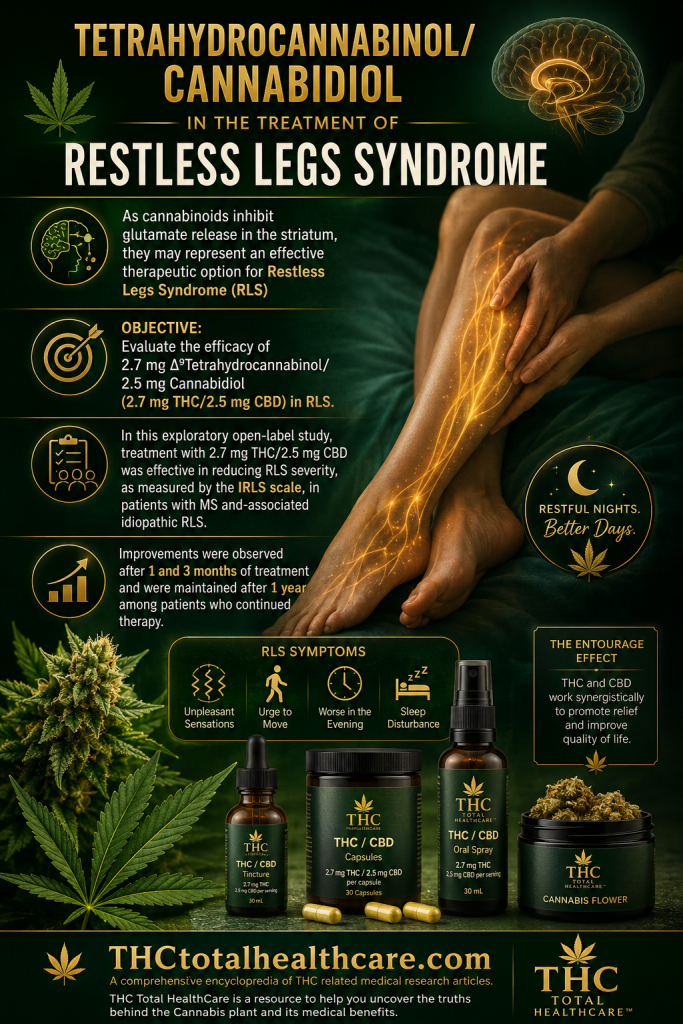
Restless legs syndrome can severely disrupt sleep and quality of life, and some patients continue to experience symptoms despite standard treatments. This report examines the use of THC and CBD in patients with restless legs syndrome, highlighting cases in which cannabis-based treatment was associated with marked symptom relief and improved sleep. The findings suggest that cannabinoids may deserve further study as a potential option for patients whose symptoms remain difficult to control with conventional therapy.
“Background: Dopamine agonists were previously considered the first-line treatment for Restless Legs Syndrome (RLS); however, α2δ ligands are now recommended to prevent augmentation. As cannabinoids inhibit glutamate release in the striatum, they may represent an effective therapeutic option for RLS.
Objective: Evaluate the efficacy of 2.7 mg Δ9Tetrahyedrocannabinol/2.5 mg Cannabidiol (2.7mgTHC/2.5mgCBD) in RLS.
Methods: This is an exploratory, prospective, 3-month open-label trial. At baseline, patients underwent blood testing, respiratory polygraphy, and a 14-day actigraphy. Treatment was initiated at baseline, with dose titration at week 4 if required. The Expanded Disability Status Scale (EDSS), Epworth Sleepiness Scale (ESS), International Restless Legs Syndrome Rating Scale (IRLS), Modified Ashworth Scale, and EQ-5D were assessed at baseline and at weeks 4 and 12. The 14-day actigraphy was repeated at week 12. The primary endpoint was improvement in IRLS scores. Sleep parameters were evaluated as secondary endpoints. Primary end point: improvement in IRLS. Sleep parameters were secondary end points.
Results: Eighteen patients with RLS were included, of whom 16 had multiple sclerosis (MS). The cohort comprised 55.5% women, with a mean age of 51.87 years, a median EDSS score of 2, and a mean Ashworth score of 1 ± 1.19. Median iron metabolism parameters were within the normal range. At baseline, patients exhibited low daytime sleepiness (ESS: 10.63 ± 3.46) and severe RLS (IRLS: 22.44 ± 8.77). Mean sleep efficiency (SE) was 83.64 ± 6.03%, sleep latency (SL) was 26.71 ± 18.64 min, and wake after sleep onset (WASO) was 40.29 ± 10.03 min. IRLS scores improved significantly after both 1 month and 3 months of treatment (p < 0.001). WASO was significantly reduced (p = 0.015), whereas no significant changes were observed in SL or SE. After 1 year, 66.66% of patients remained on treatment and continued to show sustained improvement in IRLS scores (p = 0.000).
Conclusions: In this exploratory open-label study, treatment with 2.7 mg THC/2.5 mg CBD was effective in reducing RLS severity, as measured by the IRLS scale, in patients with MS and-associated idiopathic RLS. Improvements were observed after 1 and 3 months of treatment and were maintained after 1 year among patients who continued therapy.”
https://pubmed.ncbi.nlm.nih.gov/42387200
https://link.springer.com/article/10.1007/s00415-026-13975-y