
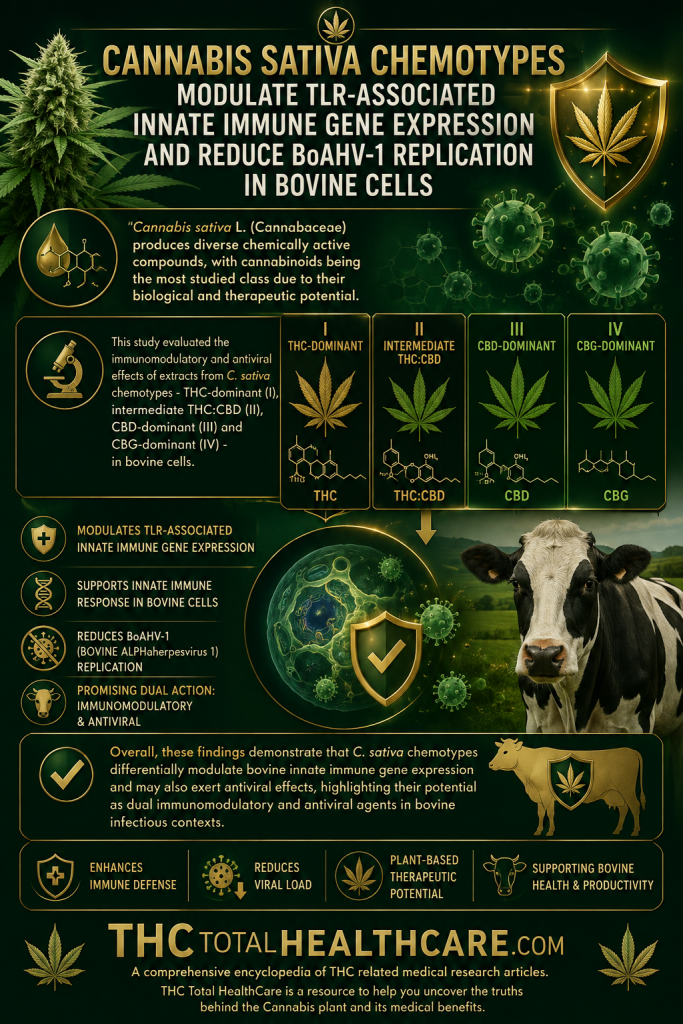
Cannabis compounds may influence antiviral defenses as well as inflammation. In bovine cells infected with bovine alphaherpesvirus 1, selected Cannabis sativa chemotypes altered TLR-associated innate immune gene expression and reduced viral replication, suggesting that cannabis-derived compounds may have broader immunomodulatory and antiviral potential worth further investigation.
“Cannabis sativa L. produces a wide range of bioactive metabolites, including phytocannabinoids such as tetrahydrocannabinol (THC), cannabidiol (CBD) and cannabigerol (CBG), which exhibit antiviral activity and modulate innate immune responses through Toll-like receptors (TLRs), particularly TLR4 and TLR7. The cross-regulation between cannabinoids and TLRs can influence the production of cytokines and antimicrobial peptides.
Given their key role in orchestrating innate immunity, particularly inflammatory responses and antiviral activity, understanding these processes in bovine immune cells is essential.
This study evaluated the immunomodulatory and antiviral effects of extracts from C. sativa chemotypes – THC-dominant (I), intermediate THC:CBD (II), CBD-dominant (III) and CBG-dominant (IV) – in bovine cells.
In peripheral blood mononuclear cells, chemotype I induced an enhanced inflammatory response, increasing TLR4 and BMAP28 transcription and pro-inflammatory cytokine expression at both transcriptional and protein levels. Similarly, chemotype IV promoted a pro-inflammatory profile characterised by increased TLR4, BMAP28 and IFNβ expression, as well as elevated TNFα protein levels.
In contrast, chemotypes II and III elicited anti-inflammatory effects. Chemotype III decreased TLR4, TLR7, BMAP28, TNFα and IFNβ transcription, although IFNγ protein levels increased. Chemotype II produced a comparable, although less pronounced, anti-inflammatory pattern, reducing TLR4, TLR7, TNFα and IFNβ while increasing BMAP28. Additionally, chemotypes II, III, and IV exhibited antiviral activity in BoAHV-1-infected MDBK cells, significantly reducing viral titres at 48 h post-infection.
Overall, these findings demonstrate that C. sativa chemotypes differentially modulate bovine innate immune gene expression and may also exert antiviral effects, highlighting their potential as dual immunomodulatory and antiviral agents in bovine infectious contexts.”
https://pubmed.ncbi.nlm.nih.gov/42561569
“Cannabis sativa L. (Cannabaceae) produces diverse chemically active compounds, with cannabinoids being the most studied class due to their biological and therapeutic potential.”
https://www.sciencedirect.com/science/article/abs/pii/S0161589026001768?via%3Dihub