
Cannabinoids are increasingly being studied for their potential to protect retinal cells from damage, but their effects may depend heavily on the balance between THC and CBD.
This study examined different THC-to-CBD ratios in models of retinal disease, assessing both neuroprotective effects in the eye and potential cardiovascular toxicity. The results suggest that cannabinoid composition can significantly influence both therapeutic benefit and safety.
The findings highlight the importance of studying specific THC/CBD ratios rather than treating all cannabinoid formulations as biologically equivalent.
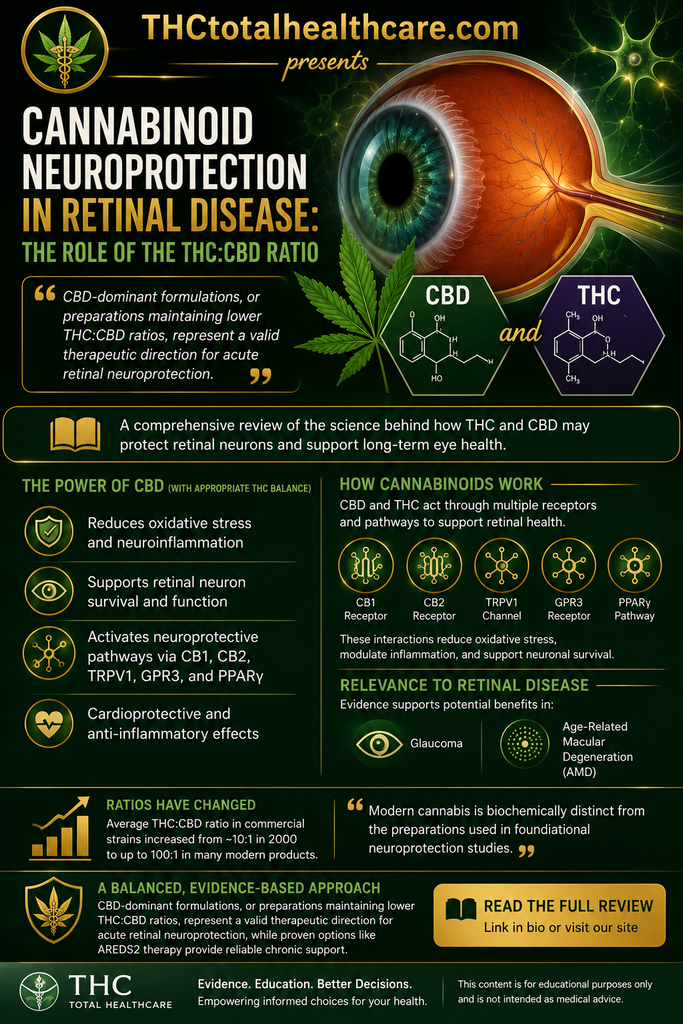
“Cannabinoids, compounds acting on the endocannabinoid system (ECS) and the broader endocannabinoidome, have demonstrated promising neuroprotective effects in retinal neurodegenerative diseases including glaucoma and age-related macular degeneration (AMD).
This review evaluates the evidence for cannabinoid receptor expression and function in the retina, the capacity of cannabinoids to reduce oxidative stress and neuroinflammation, and outcomes in preclinical disease models.
Cannabidiol (CBD) and Δ9-tetrahydrocannabinol (THC) act through cannabinoid receptors 1 and 2 (CB1 and CB2) receptors, as well as non-canonical pathways including transient receptor potential cation channel subfamily V member 1 (TRPV1), G-protein coupled receptor 3 (GPR3), peroxisome proliferator-activated receptor gamma (PPARγ), to confer neuroprotective benefits.
Critically, previously identified neuroprotective effects of cannabis may be substantially masked or reversed by the dramatically rising THC:CBD ratio in commercial strains, which has increased from approximately 10:1 in 2000 to 100:1 in many contemporary products.
This shift means that modern cannabis is biochemically distinct from the preparations used in foundational neuroprotection studies.
CBD-dominant formulations, or preparations maintaining lower THC:CBD ratios, represent a valid therapeutic direction for acute retinal neuroprotection, while the proven safety and efficacy of vitamins such as Age-Related Eye Disease Study 2 (AREDS2) therapy provide a reliable chronic neuroprotective strategy.
While the biological plausibility and animal evidence for CBD/THC protection is good, human trials are needed to validate any use in retinal diseases.”
https://www.academia.edu/3071-4087/2/3/10.20935/AcadNeurosci8479