
Cannabis sativa contains a diverse mixture of phytochemicals that may also be useful in the development of antimicrobial materials.
In this study, researchers used extracts from different cannabis chemovars to guide the green synthesis of silver nanoparticles and examined how differences in plant chemistry influenced nanoparticle formation and biological activity.
The resulting nanoparticles showed antimicrobial potential, highlighting how cannabis-derived compounds may serve as natural reducing and stabilizing agents in the development of new bioactive nanomaterials.
“The phytochemical variability in Cannabis sativa L. chemovars represents an underexplored factor in environmentally sustainable nanomaterial production.
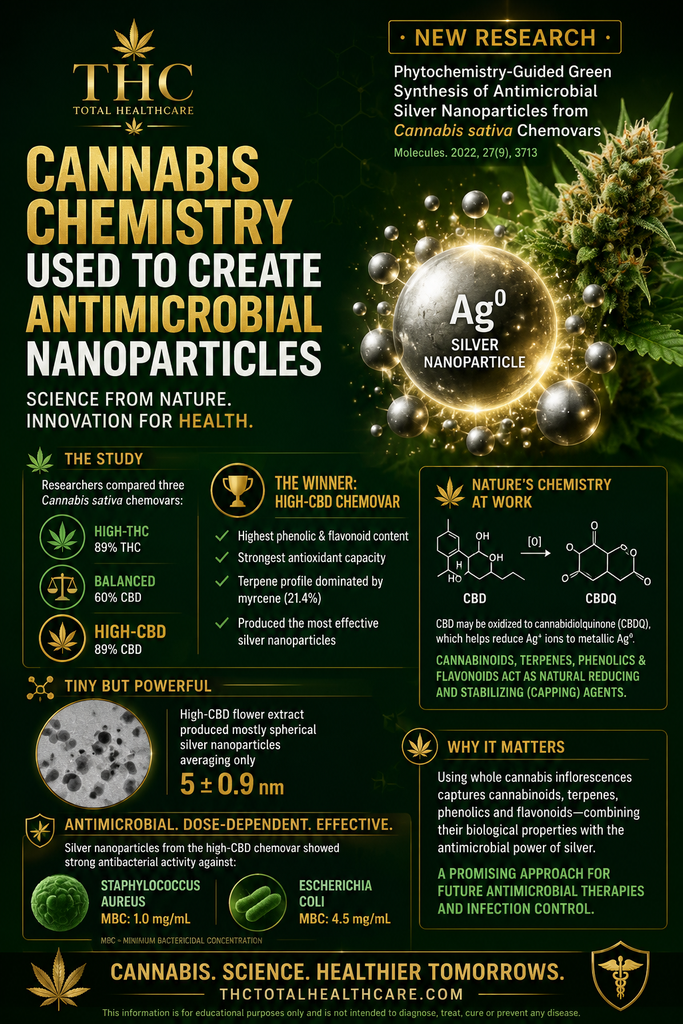
In this study, three distinct chemovars, (i) High-Δ9-Tetrahydrocannabinol (THC) (89% THC), (ii) Balanced (60% Cannabidiol (CBD)), and (iii) High-CBD (89% CBD), were comparatively evaluated to determine their suitability for the green synthesis of silver nanoparticles (AgNPs).
Ethanolic inflorescence extracts were used to recover bioactive secondary metabolites; among them, the High-CBD extract exhibited the highest total phenolic (3.34 mg gallic acid equivalent/g) and flavonoid (29.49 mg quercetine equivalent/g) contents, together with superior antioxidant capacity (53.16% 2,2-diphenyl-1-picrylhydrazyl free radical (DPPH) inhibition), indicating enhanced redox potential for nanoparticle formation. The terpene profile of High-CBD showed a dominance of myrcene (21.4%), contributing to the stabilization of the system.
Using the High-CBD extract, predominantly spherical nanoparticles of 5 ± 0.9 nm were synthesized and confirmed by UV-vis, EDS, and TEM. The biogenic AgNPs demonstrated significant dose-dependent antibacterial activity, with minimum bactericidal concentration (MBC) of 1.0 mg/mL against Staphylococcus aureus and 4.5 mg/mL against Escherichia coli.
These findings highlight the critical role of chemovar-dependent phytochemical composition and support a phytochemistry-guided approach for developing silver nanoparticles with potential biomedical applications.”
https://pubmed.ncbi.nlm.nih.gov/42123299
“This approach pursues to emphasize the relevance of full-spectrum compositions in cannabis extracts, particularly considering the reported ‘entourage effect’, where synergistic interactions among metabolites may enhance biological activity.”
“As a recognized medicinal plant, utilizing these inflorescence-derived compounds imparts an intrinsic therapeutic ‘added value’ to the nanoparticles.”
“By leveraging the synergistic potential between the plant’s bioactive constituents … and the antimicrobial silver core, this method offers an enhanced potential for biomedical applications compared to traditional chemical synthesis.”
“The successful synthesis of small, stable, and biologically active silver nanoparticles using the High-CBD extract underscores the potential of phytochemistry-guided strategies in advancing green nanotechnology for biomedical applications.”
https://www.mdpi.com/1422-0067/27/9/3713