
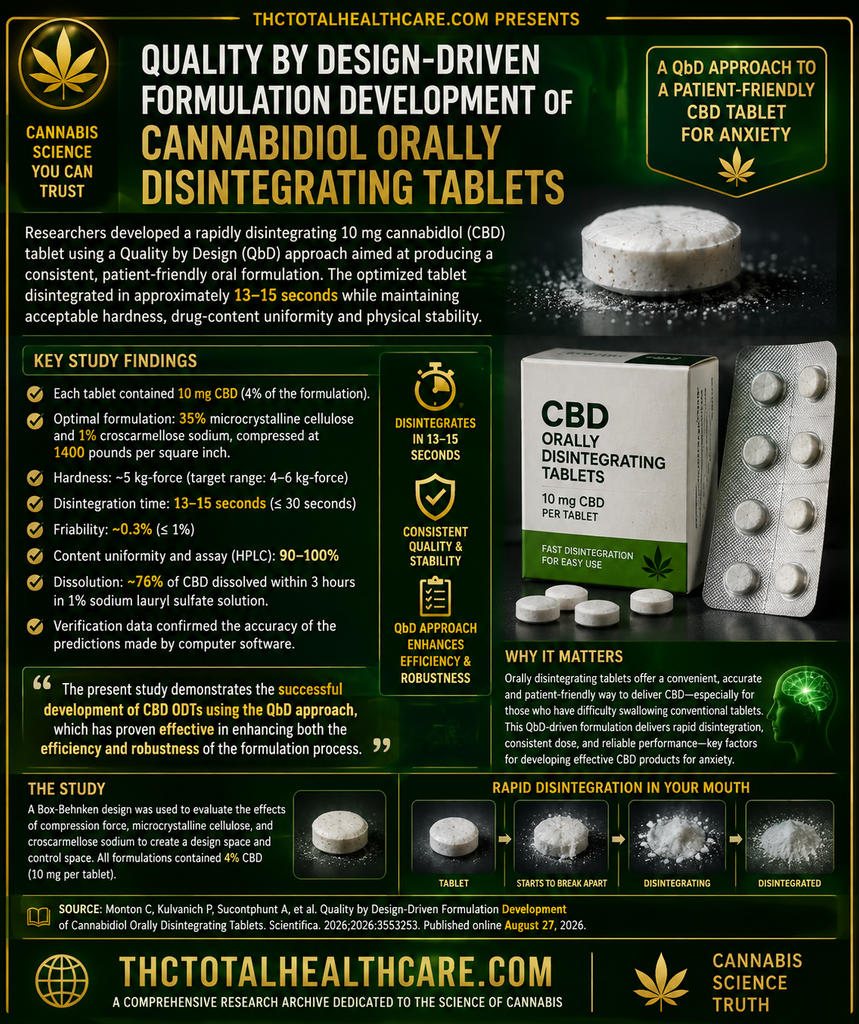
Orally disintegrating tablets may offer a more convenient way to deliver cannabidiol, particularly for people who have difficulty swallowing conventional pills. In this study, researchers used a Quality by Design approach to optimize a CBD tablet formulation for rapid disintegration, dose consistency, and reliable pharmaceutical performance.
“The development of cannabidiol (CBD) orally disintegrating tablets (ODTs) is effective in treating anxiety in a patient-friendly manner. The application of Quality by Design (QbD) enhances the efficiency and robustness of the pharmaceutical development of CBD ODTs.
The objective of this work was to develop a formulation for CBD ODTs using a QbD-driven approach. Quality target product profile, critical quality attributes, and an initial risk assessment were identified and evaluated. Subsequently, a Box-Behnken design was employed to analyze the effects of varied compression force, the quantity of microcrystalline cellulose, and the quantity of croscarmellose sodium to create a design space and control space.
Results indicated that the design and control spaces produced tablets with hardness ranging from 4 to 6 kg-force, a disintegration time (DT) ≤ 30 s, and a friability ≤ 1%. All formulations contained 4% CBD (or 10 mg per tablet). The optimal formulation consisted of 35% microcrystalline cellulose and 1% croscarmellose sodium and was compressed at 1400 pounds per square inch.
This formulation exhibited a hardness of approximately 5 kg-force, a DT of 13-15 s, and a friability of approximately 0.3%. Verification data confirmed the accuracy of the predictions made by computer software. The content uniformity and assay determined using validated high-performance liquid chromatography ranged between 90% and 100%. CBD was released from the CBD ODT in 1% sodium lauryl sulfate solution, with approximately 76% dissolved within 3 h in the dissolution study.
In conclusion, the QbD-driven approach successfully facilitated the formulation development of CBD ODTs with the desired properties for the treatment of anxiety in a patient-friendly manner.”
https://pubmed.ncbi.nlm.nih.gov/42662497
“The present study demonstrates the successful development of CBD ODTs using the QbD approach, which has proven effective in enhancing both the efficiency and robustness of the formulation process.
Overall, this study demonstrates the successful implementation of a QbD-driven strategy for laboratory-scale formulation development and optimization of CBD ODTs.
The findings contribute to pharmaceutical development efforts involving cannabinoid-based formulations and may provide useful guidance for future studies related to scale-up, stability evaluation, and in vivo performance.
https://onlinelibrary.wiley.com/doi/10.1155/sci5/3553253