
Cannabidiol (CBD) is a naturally occurring cannabinoid found in the Cannabis sativa plant.
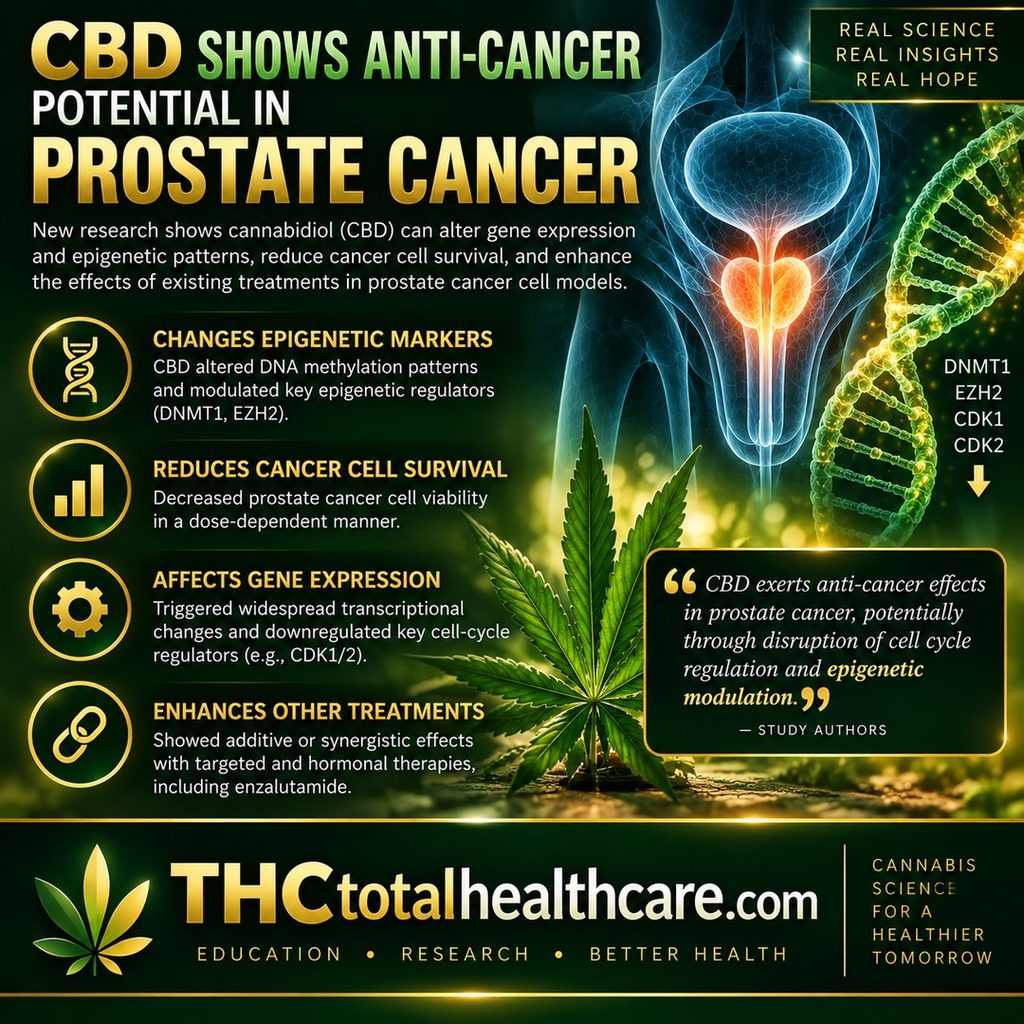
New research suggests CBD may interfere with prostate cancer through several biological pathways, including changes in gene expression and the epigenome. In laboratory prostate cancer cell models, CBD reduced cell viability in a dose-dependent manner, altered DNA methylation patterns, affected the expression of epigenetic regulators including DNMT1 and EZH2, and downregulated important cell-cycle regulators such as CDK1 and CDK2.
Researchers also reported additive or synergistic effects when CBD was combined with targeted and hormonal cancer therapies, including enzalutamide. The findings suggest CBD’s anticancer activity in prostate cancer may involve disruption of cell-cycle regulation and epigenetic modulation, supporting further investigation of CBD both alone and in combination with established treatments.
“Background: Cannabidiol (CBD) shows promising anti-cancer effects, including reducing proliferation and migration and inducing cell death. However, its impact on cancer gene regulation and epigenetic mechanisms remains poorly understood, particularly in prostate cancer, a disease characterised by widespread epigenetic alterations.
Purpose: This study investigated whether CBD exerts anti-cancer effects in prostate cancer by modulating cell viability, gene expression, and the epigenome and whether it enhances the efficacy of targeted and hormonal agents.
Study design/methods: Prostate cancer cell lines (DU145, PC3, LNCaP) were treated with varying concentrations of CBD, Talazoparib, GSK126 and enzalutamide. Cell viability was assessed by MTT. Transcriptomic changes were analysed by RNAseq and qRT-PCR, and epigenetic effects were evaluated by the Infinium MethylationEpic V2.0 BeadChip array. Analysis of total 5mC and expression/activity of EZH2 were assessed by ELIZA and Western blot respectively.
Results: Epigenetically, CBD altered methylation patterns in LNCaP cells, while modulating DNMT1 and EZH2 expression across models. However, EZH2 catalytic activity was unchanged. CBD induced widespread transcriptional changes, particularly in LNCaP cells, with enrichment of cell cycle pathways and downregulation of key regulators (e.g., CDK1/2). CBD reduced cell viability in a dose-dependent manner, showing additive or synergistic effects with both targeted and hormonal therapies.
Conclusion: CBD exerts anti-cancer effects in prostate cancer, potentially through disruption of cell cycle regulation and epigenetic modulation. These findings support its potential as a therapeutic agent, particularly in combination with targeted treatments.”
https://pubmed.ncbi.nlm.nih.gov/42691574
“Cannabidiol (CBD) is one of the best known and abundant phytocannabinoids. Numerous studies have demonstrated CBD’s anti-cancer effects, detailing its ability to inhibit cancer cell growth, proliferation, invasion, and migration in vitro, and reduce tumour volume in vivo.”
“To our knowledge, this study provides the first systematic characterisation of CBD’s effects on the prostate cancer epigenome, addressing a significant gap given the disease’s strong epigenetic basis.“
http://linkinghub.elsevier.com/retrieve/pii/S0753332226009273