Chronic immune activation remains an important challenge in HIV, even when viral replication is well controlled. In this study, cannabis use among people with HIV was associated with an anti-inflammatory immunometabolic profile in monocyte-derived macrophages, including changes in inflammatory signaling and cellular metabolism. The findings suggest that cannabis exposure may shift macrophages toward a less inflammatory state, providing a possible biological explanation for some of the lower inflammatory markers observed in cannabis-using people with HIV.
“Chronic neuroinflammation is associated with comorbidities in people with HIV (PWH) on antiretroviral therapy (ART).
While cannabis use is associated with reduced neuroinflammation and neurocognitive impairment (NCI) in PWH, the underlying mechanisms are unknown.
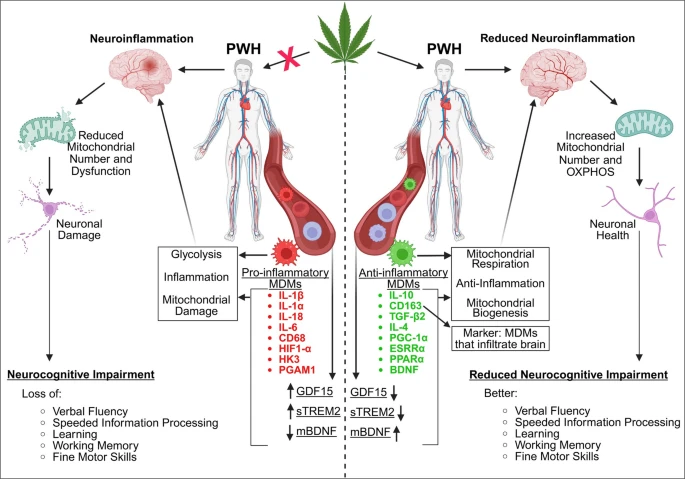
To address this gap in knowledge, we analyzed monocyte-derived macrophages (MDMs) from a cohort of 50 PWH and 33 people without HIV (mean age: 61.9 years), categorized by frequency of cannabis use (naïve/low, moderate, daily). We performed immunocytochemistry, RNA sequencing, and qPCR on MDMs and quantified related biomarkers in donor plasma.
In this cohort study, daily cannabis use in PWH was associated with less global neurocognitive deficits, and with an anti-inflammatory immunometabolic-phenotype in MDMs characterized by (1) a metabolic shift from glycolysis to oxidative phosphorylation, (2) higher mitochondrial numbers, (3) altered cytokine profiles (pro-inflammatory downregulation, anti-inflammatory upregulation), and (4) higher brain-derived neurotrophic factor (BDNF) expression. These cellular changes were corroborated by a plasma biomarker profile in PWH including (1) lower levels of growth differentiation factor 15 and soluble triggering receptor expressed on myeloid cells 2, and (2) higher mature BDNF/precursor BDNF ratios that correlated with better cognition.
Thus, cannabis use may mitigate NCI in PWH by immunometabolically reprogramming MDM function towards an anti-inflammatory and neuroprotective state.”
https://pubmed.ncbi.nlm.nih.gov/41998680
“Cannabis use by people with HIV (PWH) is associated with neuroprotective and anti-inflammatory effects”
https://link.springer.com/article/10.1186/s12974-026-03779-2