Chronic THC exposure modulates behavioral outcomes and endocannabinoid signaling in HIV-1 Tg26 mice in a sex-dependent manner

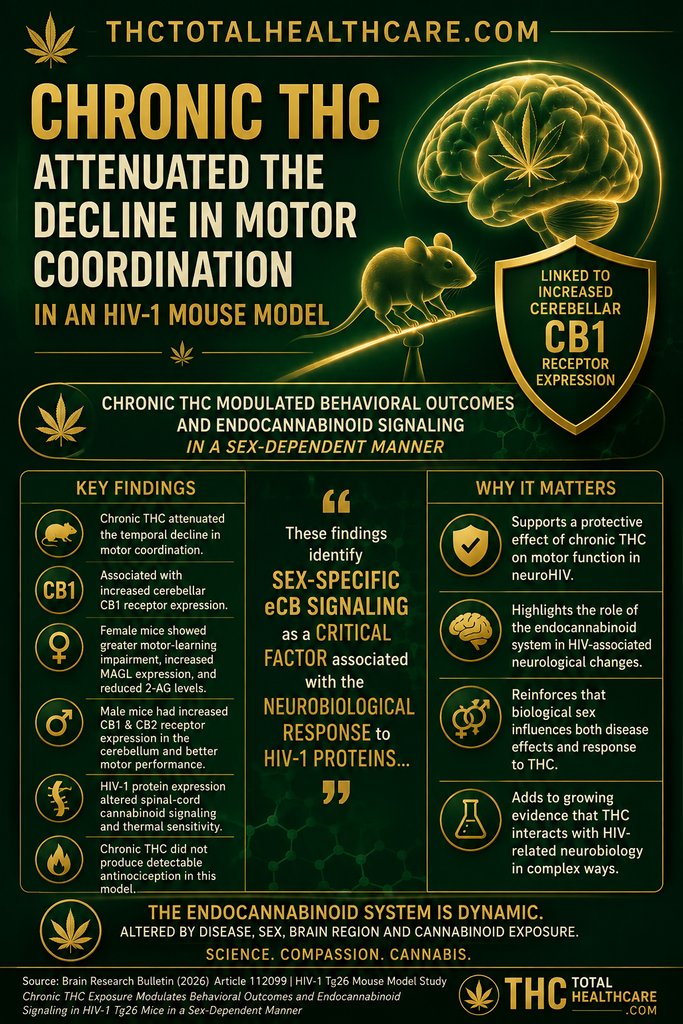
Researchers examined how chronic THC exposure affects behavior and endocannabinoid signaling in an HIV-1 mouse model.

Chronic THC helped attenuate the decline in motor coordination and was associated with increased CB1 receptor expression in the cerebellum. The study also found major sex-dependent differences, with female and male mice showing different patterns of motor impairment and endocannabinoid signaling.

THC did not produce detectable pain-relieving effects in this model, but the findings suggest that chronic THC can influence HIV-related neurological changes through the endocannabinoid system.

Overall, the study highlights the complex relationship between THC, HIV-associated neurological dysfunction, and biological sex.

“While combined antiretroviral therapy (cART) has transitioned HIV-1 into a manageable chronic condition, it fails to eradicate latent viral reservoirs in the central nervous system (CNS) that drive persistent neuroinflammation and synaptodendritic injury. Consequently, people living with human immunodeficiency virus type-1 (HIV-1) often utilize cannabis to manage neurological symptoms, yet the long-term impact of exogenous cannabinoids on the HIV-1-burdened brain remains poorly understood.

In this study, we utilized the HIV-1 Tg26 mouse model to evaluate how chronic Δ9-tetrahydrocannabinol (THC, 3mg/kg) exposure influences motor coordination, thermal nociception, and endocannabinoid (eCB) signaling in the context of constitutive viral protein expression.

Our results demonstrate that HIV-1 viral protein expression was associated with impaired acquisition of cerebellum-dependent motor learning in a sex-dependent manner. This deficit was primarily driven by females and coincided with altered markers of eCB plasticity, characterized by elevated monoacylglycerol lipase (MAGL) expression and a depletion of 2-arachidonoylglycerol (2-AG). Conversely, males exhibit increased cerebellar CB1R and CB2R expression, which paralleled preserved rotarod performance. In the spinal cord, viral protein expression was associated with thermal hyposensitivity and a reduction in 2-AG and cannabinoid receptor levels, a pattern consistent with HIV-1-associated alterations in sensory processing circuits.

While chronic THC failed to produce detectable antinociceptive effects, consistent with spinal CB1R downregulation, it successfully attenuated the temporal decline of motor coordination with upregulating cerebellar CB1R. Data from a separate acute THC cohort demonstrated detectable THC and metabolite concentrations in plasma and cortex, while also revealing sex- and genotype-dependent differences in these measures.

Together, these findings identify sex-specific eCB signaling as a critical factor associated with the neurobiological response to HIV-1 proteins and provide a biological framework for understanding sex-dependent variability in cannabinoid efficacy.”

https://pubmed.ncbi.nlm.nih.gov/42660238

“Collectively, these results provide a biological framework for understanding sex-dependent variability in cannabinoid responses and support the inclusion of sex as a key factor in the development of cannabinoid-based adjunct therapies for chronic neuroinflammatory conditions.”

https://www.sciencedirect.com/science/article/pii/S0361923026003862?via%3Dihub

Impact of cannabis use on white matter hyperintensities in adults with and without chronic HIV disease

People living with HIV can develop changes in the brain’s white matter even when the virus is well controlled with antiretroviral therapy, raising questions about whether cannabis use adds to that neurological burden.

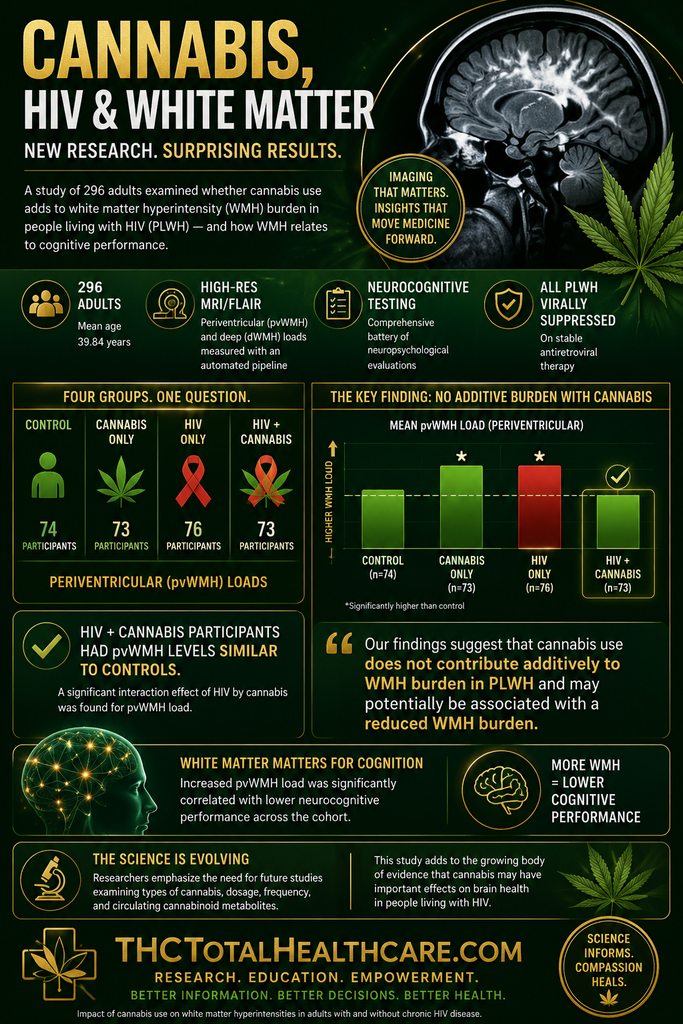
In this study of 296 adults with and without HIV and cannabis use, researchers used MRI imaging to examine white matter hyperintensities and their relationship to neurocognitive function.

The findings help clarify whether cannabis use independently contributes to these brain changes or meaningfully alters their impact in people living with chronic HIV.

“White matter hyperintensities (WMH) are prevalent among people living with HIV (PLWH), even with sustained viral suppression on antiretroviral therapy. This study investigated whether cannabis use contributes to additional WMH load among PLWH and its association to neurocognitive function.

A total of 296 adult participants, stratified by HIV and cannabis status (74 control, 73 cannabis-only, 76 HIV-only and 73 HIV+cannabis) were enrolled. High resolution anatomical MRI and fluid-attenuated inversion recovery (FLAIR) images were collected, along with a battery of neuropsychological tests. Periventricular (pvWMH) and deep (dWMH) WMH loads were quantified using an automated pipeline. Statistical tests were employed to examine the main and interaction effects of HIV and cannabis use on WMH, and to explore the association of WMH loads with neuropsychological performance. The cohort had a mean age of 39.84 years, and all PLWH had sustained viral suppression.

pvWMH loads were higher in the cannabis-only and HIV-only groups compared to controls. A significant interaction effect of HIV by cannabis was found for pvWMH load, such that participants with co-occurring HIV and cannabis use had similar pvWMH load compared to controls. In addition, increased pvWMH load significantly correlated with lower cognitive performance.

Our findings suggest that cannabis use does not contribute additively to WMH burden in PLWH and may potentially be associated with a reduced WMH burden. However, future work is warranted to substantiate this finding, particularly with respect to type and levels of circulating cannabinoid metabolites.”

https://pubmed.ncbi.nlm.nih.gov/42658415

https://link.springer.com/article/10.1007/s13365-026-01338-2


Δ9-Tetrahydrocannabinol (THC) and Cannabidiol (CBD) Diminish CD16+ Monocyte-Induced Astrocyte Inflammation, while THC Uniquely Inhibits Monocyte Chemotaxis Independent of HIV Status

Neuroinflammation is an important contributor to HIV-associated neurocognitive disorders, in part because inflammatory monocytes can migrate into the brain and activate astrocytes. In this laboratory study, both THC and CBD reduced the production of several inflammatory mediators—including IL-6, IL-8, and MCP-1—during interactions between CD16+ monocytes and astrocytes. THC showed an additional effect not observed with CBD: it suppressed monocyte migration, including the heightened migration seen in cells from people with HIV. The findings suggest that THC, and to a lesser extent CBD, may influence multiple immune mechanisms involved in HIV-associated neuroinflammation and warrant further investigation as potential therapeutic targets.

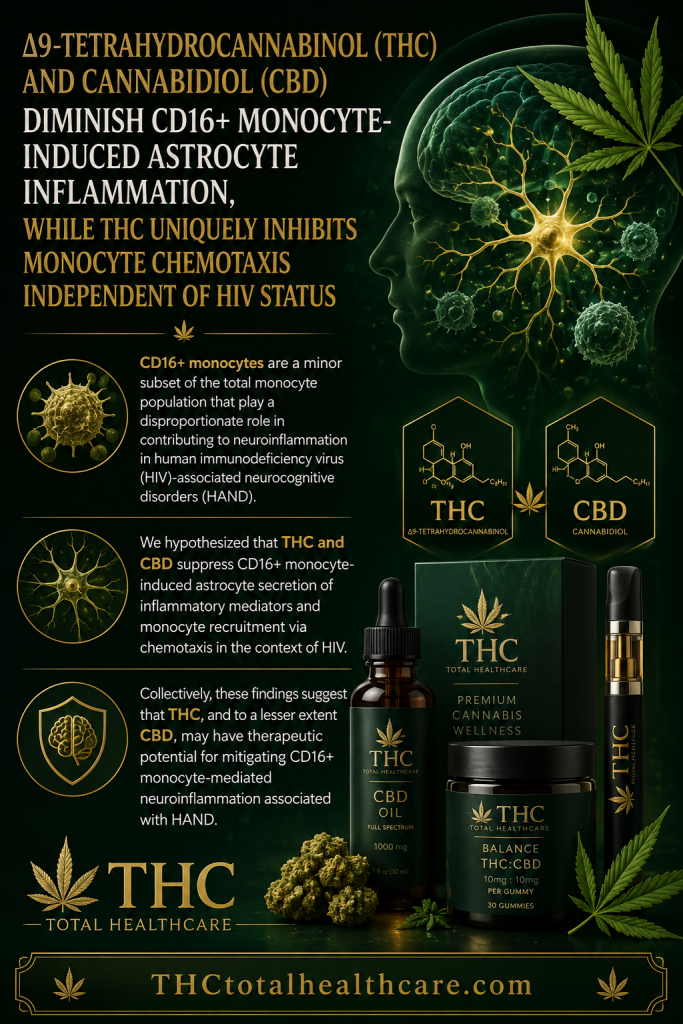
“CD16+ monocytes are a minor subset of the total monocyte population that play a disproportionate role in contributing to neuroinflammation in human immunodeficiency virus (HIV)-associated neurocognitive disorders (HAND).

This has been evidenced by the enhanced transmigration of CD16+ monocytes into the brain compared to their CD16 counterpart. CD16+ monocytes can be activated by HIV ssRNAs through toll-like receptors (TLR) 7 and TLR8, and subsequently interact with brain-resident cells, including astrocytes. Previous studies from our laboratory identified monocyte-derived IL-1ß as an inducing cytokine for astrocyte-derived neuroinflammatory factors.

Despite cannabis use among the HIV community, the mechanisms by which immune-modulating cannabinoids, Δ9-tetrahydrocannabinol (THC) and cannabidiol (CBD), alter human immune responses in the context of HAND-associated neuroinflammation remain elusive.

We hypothesized that THC and CBD suppress CD16+ monocyte-induced astrocyte secretion of inflammatory mediators and monocyte recruitment via chemotaxis in the context of HIV.

Results from this study show that THC and CBD impair CD16+ monocyte IL-1ß-mediated astrocyte production of IL-6, IL-8, and MCP-1 when these two cell types are cocultured in the presence of TLR7 or TLR8 stimulation. Additionally, monocytes from HIV+ subjects exhibited enhanced migration compared to monocytes from HIV- subjects, which was suppressed by THC treatment but not by CBD. The effects on migration were associated with reduced cellular expression of polymerized actin and high-affinity conformation integrin receptors.

Collectively, these findings suggest that THC, and to a lesser extent CBD, may have therapeutic potential for mitigating CD16+ monocyte-mediated neuroinflammation associated with HAND.”

https://pubmed.ncbi.nlm.nih.gov/42400870

“Taken together, this study provides evidence to support that THC, and to a lesser extent CBD, exert anti-inflammatory effects on CD16+ monocyte-mediated inflammatory and migratory responses that may be associated with HAND.”

https://link.springer.com/article/10.1007/s11481-026-10300-2


Inflammasome formation and interleukin-1β secretion are reduced in peripheral blood monocytes from HIV+ cannabis users

Chronic inflammation remains a major challenge in HIV even when the virus itself is controlled, and overactive innate immune signaling can contribute to long-term complications. In this human-cell study, monocytes from HIV-positive cannabis users released significantly less IL-1β than those from HIV-positive nonusers, with levels comparable to HIV-negative participants. Both THC and CBD also reduced inflammasome formation and IL-1β secretion in a concentration-dependent manner, while THC produced a stronger reduction in caspase-1 activity. The findings support the possibility that cannabinoids may help regulate HIV-associated systemic inflammation by suppressing key inflammatory pathways.

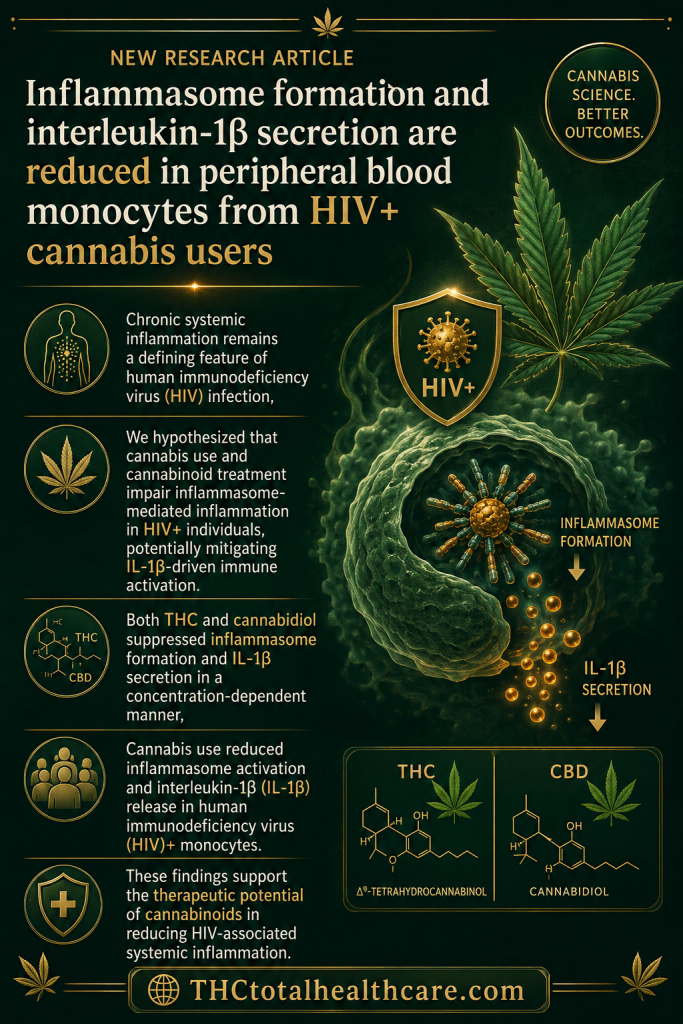
“Chronic systemic inflammation remains a defining feature of human immunodeficiency virus (HIV) infection, partly driven by the translocation of microbial-derived products, including toll-like receptor 4 agonist lipopolysaccharide, from the gut, which is a well established HIV reservoir. These products activate peripheral blood monocytes, leading to the secretion of proinflammatory cytokines, particularly interleukin-1β (IL-1β), which exacerbates systemic inflammation.

Cannabis and its bioactive constituents, Δ9-tetrahydrocannabinol (THC) and cannabidiol, exhibit immune-modulating properties, yet their effects on innate immune pathways in HIV remain poorly defined. Here, we investigated the impact of cannabis use and individual cannabinoids, THC and cannabidiol, on toll-like receptor 4-induced ASC-incorporating inflammasome activation, IL-1β secretion, and caspase-1 activity in monocytes derived from HIV-negative and HIV-positive individuals. We hypothesized that cannabis use and cannabinoid treatment impair inflammasome-mediated inflammation in HIV+ individuals, potentially mitigating IL-1β-driven immune activation.

Our results show that inflammasome formation was reduced in both HIV+ marijuana (cannabis use status, MJ)- and HIV+MJ+ (MJ: cannabis use) derived monocytes compared with HIV- derived monocytes. Despite this, HIV+MJ- monocytes secreted more IL-1β than HIV- monocytes, whereas HIV+MJ+ monocytes secreted IL-1β at levels comparable to those of HIV- cells.

Both THC and cannabidiol suppressed inflammasome formation and IL-1β secretion in a concentration-dependent manner, with THC producing a greater magnitude of reduction in caspase-1 activity in HIV- monocytes. Cannabis use by HIV+ individuals lowered IL-1β secretion by peripheral blood monocytes compared with that of non-cannabis-using HIV+ donors, implicating an inhibitory role in immune activation.

These findings support the therapeutic potential of cannabinoids in reducing HIV-associated systemic inflammation.

SIGNIFICANCE STATEMENT: Cannabis use reduced inflammasome activation and interleukin-1β (IL-1β) release in human immunodeficiency virus (HIV)+ monocytes. HIV+ cannabis users showed IL-1β levels comparable to HIV- individuals, whereas HIV+ cannabis nonusers displayed elevated levels of IL-1β secretion. The combination of reduced ASC-incorporating inflammasome formation but elevated IL-1β in HIV+ nonusers suggests involvement of noncanonical IL-1β maturation pathways.”

https://pubmed.ncbi.nlm.nih.gov/42320431

“Collectively, these findings highlight a complex role for cannabinoids in modulating innate immune responses. The suppression of IL-1β via reduced inflammasome formation and caspase-1 activity, without direct enzymatic inhibition, suggests that cannabinoids may have therapeutic utility for regulating inflammation, particularly in chronic and systemic inflammation incurred by HIV.”

https://jpet.aspetjournals.org/article/S0022-3565(26)01151-1/fulltext


Cannabidiol prevents mucosal HIV-1 transmission by targeting Langerhans cells, dendritic cells, macrophages and T-cells

Cannabidiol may have antiviral effects that extend to the earliest stages of HIV transmission. In this study, CBD reduced mucosal HIV-1 transmission by acting on several immune-cell populations involved in viral entry and spread, including Langerhans cells, dendritic cells, macrophages, and T cells. The findings suggest that CBD can interfere with multiple cellular pathways that HIV exploits during initial infection, highlighting a potentially important role for cannabinoid-based strategies in HIV prevention research.

“HIV-1 transmission depends on the structure and immune cell composition of mucosal epithelia. Transmission mechanisms involve direct infection of CD4+ T-cells or macrophages, and indirect viral transfer to CD4+ T-cells from Langerhans cells (LCs) or dendritic cells (DCs). LCs-mediated HIV-1 transfer is inhibited by the neuropeptide calcitonin gene-related peptide (CGRP), due to upstream activation in LCs of the transient receptor potential vanilloid 1 (TRPV1) ion channel.

Herein, we investigated the potential anti-HIV-1roles of cannabidiol (CBD), the non-psychoactive compound in marijuana, which has well-described immunosuppressive functions and principally activates TRPV1 over its cognate CB1 and CB2 receptors.

We found that via TRPV1 activation, CBDinhibitsin-vitroinfection of mucosal HIV-1 cellular targets. Specifically, CBD inhibits macrophages HIV-1 direct infection, and CD4+ T-cells HIV-1 direct infection or upon viral transfer from LCsand DCs. Moreover, inhibition of macrophages infection and LCs-mediated HIV-1 transfer involves secreted CGRP.Importantly,

CBD also blocks early events of HIV-1 transmission ex-vivo in human inner foreskin tissues, namely formation of epidermal LC-T-cell conjugates and resulting CD4+ T-cells infection.

Altogether, CBD inhibits infection of all HIV-1 cellular targets, and commercial CBD products might be repositioned as novel HIV-1 pre-exposure prophylaxis, namely ‘CBD PrEP’.”

https://pubmed.ncbi.nlm.nih.gov/42014233

“Bases on our results, we propose an alternative that we coin as ‘CBD PrEP’. This would consist of the repositioning of commercially available CBD-containing products as novel microbicides for the purpose of clinical HIV-1 prevention.”

https://www.mucosalimmunology.org/article/S1933-0219(26)00030-9/fulltext

Cannabis Use and the Risk of Incident Venous Thromboembolism Among People With HIV: A Longitudinal Cohort Study in the United States

People living with HIV already face an elevated risk of venous thromboembolism, making it important to understand whether cannabis use adds to that risk. In this longitudinal U.S. cohort study, cannabis use was not associated with an increased incidence of venous thromboembolism among people with HIV. The findings provide reassuring real-world evidence that cannabis use did not appear to add measurable clotting risk in this population and help clarify an important cardiovascular safety question in HIV care.

“People with HIV (PWH) are at an increased risk of venous thromboembolism (VTE), and cannabis use is common in this population. However, evidence of cannabis impact on VTE risk has been conflicting and not well evaluated in PWH.

Using data from five Centers for AIDS Research Network of Integrated Clinical Systems sites (2009-2020), we assessed the association between cannabis use and VTE risk.

Among 13,646 PWH, 30% reported current cannabis use. In adjusted Cox models, neither former (adjusted hazard ratio [aHR] 0.78, 95% confidence interval (CI) 0.57-1.07) nor current (aHR 0.74, 95% CI 0.51-1.06) cannabis use showed a significant increase in VTE incidence compared with never use. Additionally, no dose-dependent relationship was observed between cannabis use frequency and VTE.

Among PWH, cannabis use does not appear to be associated with an elevated risk of VTE.

Further research is needed to elucidate the relationship between cannabis and VTE risk in this population.”

https://pubmed.ncbi.nlm.nih.gov/42017672

https://journals.lww.com/janac/abstract/9900/cannabis_use_and_the_risk_of_incident_venous.255.aspx

Cannabis use by people with HIV is associated with an anti-inflammatory immunometabolic phenotype in monocyte-derived macrophages

Chronic immune activation remains an important challenge in HIV, even when viral replication is well controlled. In this study, cannabis use among people with HIV was associated with an anti-inflammatory immunometabolic profile in monocyte-derived macrophages, including changes in inflammatory signaling and cellular metabolism. The findings suggest that cannabis exposure may shift macrophages toward a less inflammatory state, providing a possible biological explanation for some of the lower inflammatory markers observed in cannabis-using people with HIV.

“Chronic neuroinflammation is associated with comorbidities in people with HIV (PWH) on antiretroviral therapy (ART).

While cannabis use is associated with reduced neuroinflammation and neurocognitive impairment (NCI) in PWH, the underlying mechanisms are unknown. 

To address this gap in knowledge, we analyzed monocyte-derived macrophages (MDMs) from a cohort of 50 PWH and 33 people without HIV (mean age: 61.9 years), categorized by frequency of cannabis use (naïve/low, moderate, daily). We performed immunocytochemistry, RNA sequencing, and qPCR on MDMs and quantified related biomarkers in donor plasma.

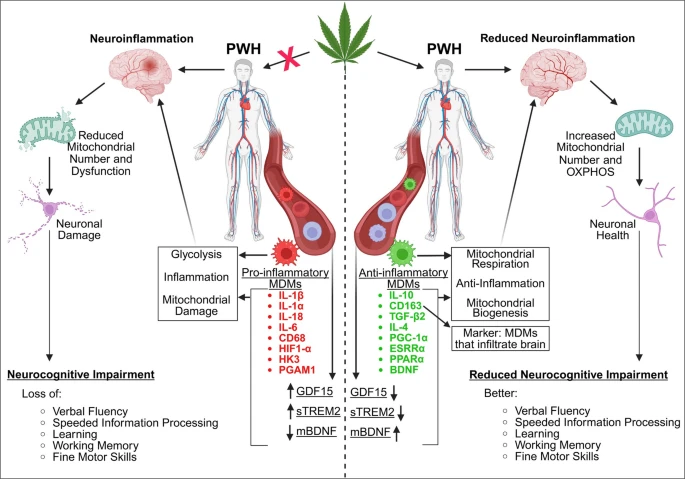
In this cohort study, daily cannabis use in PWH was associated with less global neurocognitive deficits, and with an anti-inflammatory immunometabolic-phenotype in MDMs characterized by (1) a metabolic shift from glycolysis to oxidative phosphorylation, (2) higher mitochondrial numbers, (3) altered cytokine profiles (pro-inflammatory downregulation, anti-inflammatory upregulation), and (4) higher brain-derived neurotrophic factor (BDNF) expression. These cellular changes were corroborated by a plasma biomarker profile in PWH including (1) lower levels of growth differentiation factor 15 and soluble triggering receptor expressed on myeloid cells 2, and (2) higher mature BDNF/precursor BDNF ratios that correlated with better cognition.

Thus, cannabis use may mitigate NCI in PWH by immunometabolically reprogramming MDM function towards an anti-inflammatory and neuroprotective state.”

https://pubmed.ncbi.nlm.nih.gov/41998680

“Cannabis use by people with HIV (PWH) is associated with neuroprotective and anti-inflammatory effects”

https://link.springer.com/article/10.1186/s12974-026-03779-2

Safety and Tolerability of Low-Dose Full-Spectrum Cannabidiol in Long-Term Virally Suppressed Adults with HIV: A Randomized Double-Blind Placebo-Controlled Trial

Introduction: People with long-term virologically suppressed HIV (PWH) experience chronic inflammation. Beneficial effects such as lower levels of inflammation were reported for cannabis-based medicine, but data on the safety of standardized low-dose full-spectrum cannabidiol (CBD) are limited.

Methods: This double-blind randomized placebo-controlled trial (NCT05306249) included 80 ART-treated PWH with undetectable viremia (median time on efficient ART 14 years, median age 54 years), encompassing 30% women. Participants received 1 mg/kg CBD oil twice daily (full-spectrum, tetrahydrocannabinol < 0.3%) or placebo for 12 weeks plus a 4-week follow-up. Primary trial end-point (autophagy gene expression) will be described elsewhere; here we evaluate the treatment impact on prespecified safety outcomes such as hemodynamic with electrocardiograms, HIV immunovirological parameters, and comprehensive assessments of liver and kidney functions, performed using standard blood tests. Mixed-effects models adjusted for baseline age, sex, body mass index, CD4 count and duration of viral suppression assessed longitudinal changes.

Results: Of 80 randomized participants, 35 PWH in CBD and 37 in placebo groups completed week 12. No clinically meaningful differences emerged in creatinine, aminotransferases (alanine aminotransferase, aspartate aminotransferase), or conjugated bilirubin. Total bilirubin decreased in the CBD arm vs placebo (mixed effect model considering time, group and time*group, adjusted for covariates, p = 0.046). In exploratory sex-stratified analysis, a significant difference starting at week 12 (-8.0 bpm [95% CI: -15.6; -0.4], p = 0.0425) and persisting at week 16 (-7.9 bpm [95% CI: -14.6; -1.3], p = 0.0191) evidences a lower heart rate in men belonging to the CBD group compared with the placebo group; no change in females. There was no change in plasma viral load, cell-associated HIV-DNA levels, and CD4/CD8 ratio.

Discussion: Low-dose full-spectrum GMP-certified CBD was well tolerated over 12 weeks in virally suppressed people with HIV. Observed reductions in total bilirubin and male heart rate are exploratory and warrant confirmation in adequately powered trials incorporating inflammatory biomarkers and pharmacokinetics.”

https://pubmed.ncbi.nlm.nih.gov/41934259

https://journals.sagepub.com/doi/10.1177/25785125261439014

Cannabis Use by People with HIV is Associated with an Anti-Inflammatory Immunometabolic Phenotype in Monocyte-Derived Macrophages

“Chronic neuroinflammation is associated with comorbidities in people with HIV (PWH) on antiretroviral therapy (ART). While cannabis use is associated with reduced neuroinflammation and neurocognitive impairment (NCI) in PWH, the underlying mechanisms are unknown.

To address this gap in knowledge, we analyzed monocyte-derived macrophages (MDMs) from a cohort of 50 PWH and 33 people without HIV (mean age: 61.9 years), categorized by frequency of cannabis use (naïve/low, moderate, daily). We performed immunocytochemistry, RNA sequencing, and qPCR on MDMs and quantified related biomarkers in donor plasma.

In this cohort study, daily cannabis use in PWH was associated with less global neurocognitive deficits, and with an anti-inflammatory immunometabolic-phenotype in MDMs characterized by (1) a metabolic shift from glycolysis to oxidative phosphorylation, (2) higher mitochondrial numbers, (3) altered cytokine profiles (pro-inflammatory downregulation, anti-inflammatory upregulation), and (4) higher brain-derived neurotrophic factor (BDNF) expression.

These cellular changes were corroborated by a plasma biomarker profile in PWH including (1) lower levels of growth differentiation factor 15 and soluble triggering receptor expressed on myeloid cells 2, and (2) higher mature BDNF/precursor BDNF ratios that correlated with better cognition.

Thus, cannabis use may mitigate NCI in PWH by immunometabolically reprogramming MDM function towards an anti-inflammatory and neuroprotective state.”

https://pubmed.ncbi.nlm.nih.gov/41867844

https://www.biorxiv.org/content/10.64898/2026.03.04.709579v1

Motor-Related Neural Dynamics are Modulated by Regular Cannabis Use Among People with HIV

“Recent work has shown that people with HIV (PWH) exhibit deficits in cognitive control and altered brain responses in the underlying cortical networks, and that regular cannabis use has a normalizing effect on these neural responses.

However, the impact of regular cannabis use on the neural oscillatory dynamics underlying motor control deficits in PWH remains less understood. Herein, 102 control cannabis users, control nonusers, PWH who regularly use cannabis, and PWH who do not use cannabis performed a motor control task with and without interference during high-density magnetoencephalography.

The resulting neural dynamics were examined using whole-brain, voxel-wise statistical analyses that examined the impact of HIV status, cannabis use, and their interaction on the neural oscillations serving motor control, spontaneous activity during the baseline period, and neurobehavioral relationships.

Our key findings revealed cannabis-by-HIV group interactions in oscillatory gamma within the prefrontal cortices, higher-order motor areas, and other regions, with the non-using PWH typically exhibiting the strongest gamma interference responses. Cannabis-by-HIV interactions were also found for oscillatory beta in the dorsal premotor cortex. Spontaneous gamma during the baseline was elevated in PWH and suppressed in cannabis users in all regions exhibiting interaction effects and the left primary motor cortex, with spontaneous levels being correlated with behavioral performance.

These findings suggest that regular cannabis use has a normalizing effect on the neural oscillations serving motor control and the abnormally elevated spontaneous gamma activity that has been widely replicated in PWH, which may suggest that cannabis has at least some therapeutic utility in PWH.”

https://pubmed.ncbi.nlm.nih.gov/40473990

“The current study found evidence of multiple novel interactions between cannabis use and HIV status in beta and gamma interference responses across a broad network of brain regions. Further, these findings corroborate multiple recent studies showing elevated spontaneous gamma activity in PWH, and that regular cannabis use is associated with a marked suppression in such spontaneous activity.”

https://link.springer.com/article/10.1007/s11481-025-10219-0