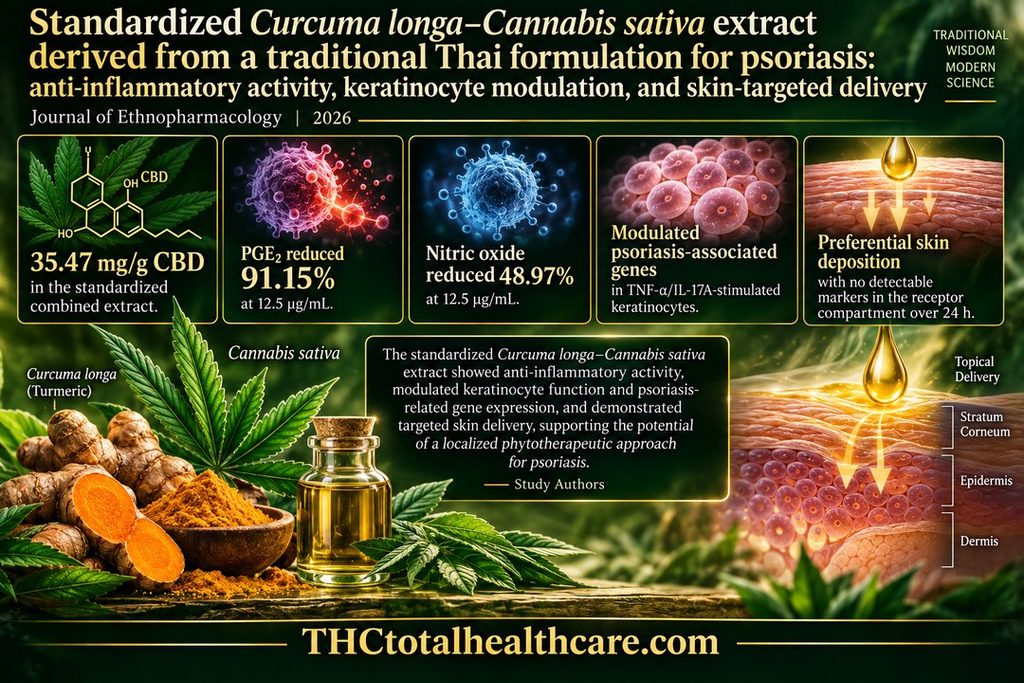
A new study tested a standardized combination of Curcuma longa (turmeric) and Cannabis sativa derived from a traditional Thai topical formulation for psoriasis. The combined extract contained curcuminoids, ar-turmerone and cannabidiol, including 35.47 mg/g CBD, and was evaluated for anti-inflammatory activity, effects on psoriasis-related keratinocytes and its ability to remain concentrated in the skin.
At 12.5 µg/mL, the combined extract reduced nitric oxide production by 48.97% and PGE₂ production by 91.15%. It also altered psoriasis-associated gene expression in TNF-α/IL-17A-stimulated keratinocytes, showing activity against several biological processes involved in psoriasis.
The skin-delivery experiments found strong deposition of the extract’s markers in the skin, with none detected in the receptor compartment during the 24-hour test. The authors concluded that the standardized turmeric–cannabis combination showed anti-inflammatory, psoriasis-relevant and skin-targeted activity supporting further development as a localized phytotherapeutic approach for psoriasis.
“Ethnopharmacological relevance: Curcuma longa rhizomes and Cannabis sativa leaves are traditionally combined in Thai topical remedies using cottonseed oil. However, the pharmacological basis and dermal delivery of this combination remain unclear.
Aim of the study: This study evaluated a standardized Thai CL-CS combined extract (CLCS) by integrating phytochemical characterization, psoriasis-relevant biological activities, and ex vivo skin deposition and permeation, with comparison to the single extracts.
Materials and methods: CLCS was standardized by validated HPLC using curcuminoids, ar-turmerone, and cannabidiol as markers. Anti-inflammatory activity was evaluated in RAW264.7 macrophages, while psoriasis-relevant activity was assessed in TNF-α/IL-17A-stimulated HaCaT keratinocytes. Skin deposition and permeation were evaluated using porcine ear skin and Franz diffusion cells.
Results: CLCS contained bisdemethoxycurcumin (18.79 ± 1.54 mg/g), demethoxycurcumin (12.89 ± 1.02 mg/g), curcumin (22.12 ± 1.62 mg/g), ar-turmerone (75.35 ± 3.94 mg/g), and cannabidiol (35.47 ± 2.39 mg/g). IC50 values were 41.22 ± 1.70 and 22.91 ± 0.51 μg/mL in HaCaT and RAW264.7 cells, respectively. At 12.5 μg/mL, CLCS inhibited NO and PGE2 production by 48.97 ± 0.88% and 91.15 ± 3.66%, respectively, and modulated psoriasis-associated genes. Cottonseed oil containing 20% DG achieved the highest skin deposition of BCM, DCM, and CM, with no detectable markers in the receptor compartment over 24 h.
Conclusions: Standardized CLCS exhibited anti-inflammatory and psoriasis-relevant activities and preferential skin deposition, supporting its potential as a localized phytotherapeutic approach for psoriasis.”
https://pubmed.ncbi.nlm.nih.gov/42772617
“The present study provides an integrated chemical, biological, and skin-targeted delivery evaluation of a standardized CLCS co-extract derived from a traditional Thai topical formulation. The extract was successfully standardized by its characteristic bioactive constituents derived from both botanical components. CLCS demonstrated anti-inflammatory and psoriasis-relevant biological activities”
https://www.sciencedirect.com/science/article/abs/pii/S0378874126012833?via%3Dihub