Δ9-Tetrahydrocannabinol treatment impairs CD8+ T cell differentiation into interferon gamma-competent CD45RO+ cells

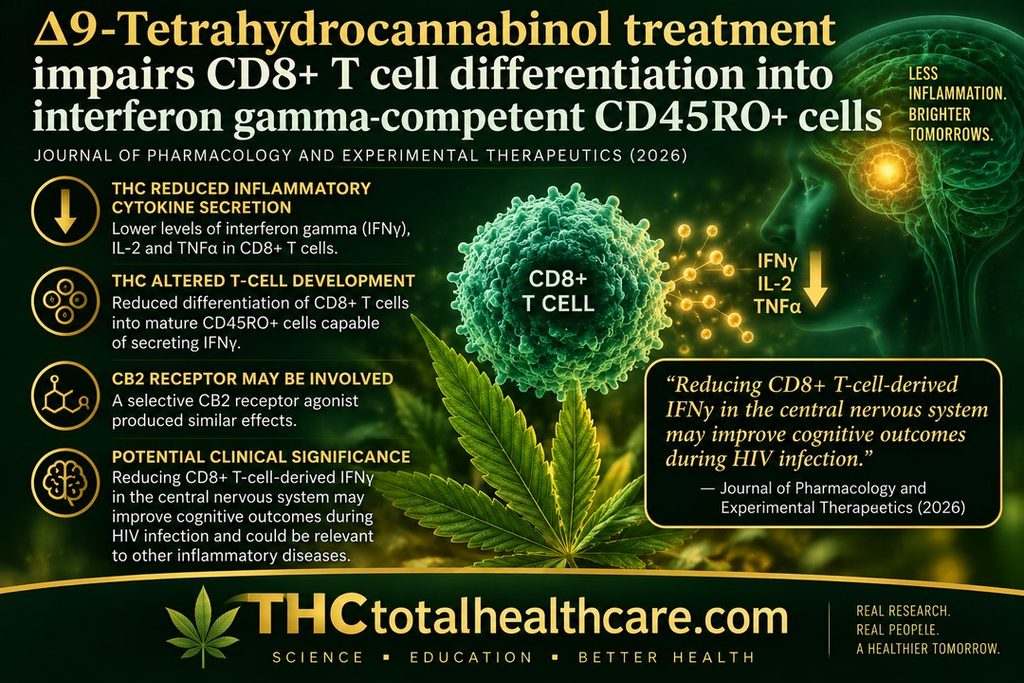
New research published in The Journal of Pharmacology and Experimental Therapeutics shows that Δ9-tetrahydrocannabinol (THC) can alter the development of CD8+ T cells involved in inflammatory immune responses. Researchers found that THC reduced secretion of interferon gamma (IFNγ), interleukin-2 (IL-2), and tumor necrosis factor alpha (TNFα), three signaling molecules involved in immune activation and inflammation.

Rather than simply preventing cells from producing IFNγ, THC appeared to change how the T cells developed. THC reduced the differentiation of CD8+ T cells into mature CD45RO+ cells capable of secreting IFNγ. A selective CB2 receptor agonist produced similar effects, suggesting that activation of the cannabinoid CB2 receptor may play an important role in THC’s immune-modulating activity.

The researchers examined these effects partly because IFNγ-producing CD8+ T cells contribute to persistent neuroinflammation associated with HIV-associated neurocognitive disorders. They concluded that reducing CD8+ T-cell-derived IFNγ in the central nervous system may potentially improve cognitive outcomes during HIV infection, while noting that the findings may also have relevance to other inflammatory diseases involving IFNγ-producing CD8+ T cells.

“Chronic human immunodeficiency virus (HIV) infection results in a persistent state of neuroinflammation, even with combined antiretroviral therapy. Neuroinflammation contributes to pathology termed HIV-associated neurocognitive disorder, which is exacerbated by interferon gamma (IFNγ)-producing CD8+ T cells in the central nervous system.

Many people living with HIV self-report using Cannabis sativa to mitigate symptoms of chronic infection and side effects of treatment. C. sativa is composed of various phytocannabinoids, including Δ9-tetrahydrocannbinol (THC), which possesses immune-modulating properties.

This study aims to determine whether C. sativa use by people living with HIV, and specifically THC, affects IFNγ secretion by CD8+ T cells.

We found that HIV status does not influence T cell IFNγ responses, and C sativa use modestly reduces the average secretion of IFNγ by CD8+ T cells from HIV+ donors. Treatment of CD8+ T cells with THC and the selective cannabinoid receptor 2 agonist, JWH-015, reduced T-cell cytokine secretion, with THC eliciting greater suppression than cannabidiol.

These results suggest that THC treatment does not directly impair IFNγ gene expression or protein production, as determined by polymerase chain reaction and flow cytometry. However, THC treatment impaired CD8+ T cell differentiation into IFNγ-competent CD45RO+ cells.

These studies are of clinical relevance because reduction of CD8+ T-cell-derived IFNγ in the central nervous system may improve cognitive outcomes during HIV infection. Furthermore, these findings may be generalizable to other inflammatory diseases in which IFNγ-producing CD8+ T cells have been implicated.

SIGNIFICANCE STATEMENT: Δ9-Tetrahydrocannbinol (THC) treatment reduces CD8+ T cell interferon gamma (IFNγ) secretion isolated from HIV- and HIV+ individuals. THC and the selective cannabinoid receptor 2 agonist, JWH-015, both reduced CD8+ T cell secretion of IFNγ, interleukin 2, and tumor necrosis factor α, suggesting the involvement of cannabinoid receptor 2. Although THC treatment does not suppress IFNγ mRNA or protein levels, it reduces the number of IFNγ-secreting cells by impairing CD8+ T-cell differentiation into IFNγ-competent CD45RO+ cells.”

https://pubmed.ncbi.nlm.nih.gov/42748512

https://jpet.aspetjournals.org/article/S0022-3565(26)01210-3/abstract

Need this THC study explained? thcXplained.com

HIV Infections Cured With Cannabis a Real Possibility

“Researchers are looking into the use of THC (tetrahydrocannabinol), the active ingredient in marijuana, to help stop the spread of HIV infection.

Hundreds of marijuana researchers have reported that THC was able to pierce the RIV virus in monkeys. That particular virus is almost identical to the HIV virus found in humans, so this news is very encouraging.

The greatest drawbacks to this excellent news are the current laws preventing testing on human candidates.

With the changing of these restrictive laws, HIV infections have a great chance of being cured, with cannabis as a real possible player in the race to stop the disease.”

More: http://guardianlv.com/2014/02/hiv-infections-cured-with-cannabis-a-real-possibility/

Breaking News: Study Says Marijuana May Stop the Spread of HIV


“People with HIV (and other conditions) have used prescription marijuana to treat the side effects of medication, but a new study published in the journal AIDS Research and Human Retroviruses, recently showed that daily doses of may even help combat the disease.”

More: http://www.hivplusmag.com/research/2014/02/11/breaking-news-study-says-marijuana-may-stop-spread-hiv


Marijuana as a possible treatment for HIV and cancer

Marijuana

“There’s been some interesting research on using THC (tetrahydrocannabinol), the principal psychoactive drug in marijuana, to help fight HIV, and damage cancer cells in some leukemias and possibly malignant tumors.

…the possibility exists that information from both of these research studies may produce beneficial results in the treatment of HIV and cancer.”

More: http://americablog.com/2014/02/marijuana-treatment-hiv-cancer.html

Δ9-Tetrahydrocannabinol Treatment During Human Monocyte Differentiation Reduces Macrophage Susceptibility to HIV-1 Infection

“The major psychoactive component of marijuana, Δ9-tetrahydrocannabinol (THC), also acts to suppress inflammatory responses. Receptors for THC, CB1, CB2, and GPR55, are differentially expressed on multiple cell types including monocytes and macrophages, which are important modulators of inflammation in vivo and target cells for HIV-1 infection. Use of recreational and medicinal marijuana is increasing, but the consequences of marijuana exposure on HIV-1 infection are unclear. Ex vivo studies were designed to investigate effects on HIV-1 infection in macrophages exposed to THC during or following differentiation.

THC treatment of primary human monocytes during differentiation reduced HIV-1 infection…

THC treatment of monocytes during differentiation into MDMs suppresses HIV-1 infection. 
Ultimately, the mechanism of THC suppression of HIV-1 infection was traced to a reduction in cell surface HIV receptor (CD4, CCR5 and CXCR4) expression that diminished entry efficiency.”

http://www.ncbi.nlm.nih.gov/pmc/articles/PMC4019698/

Modulation of Gut-Specific Mechanisms by Chronic Δ9-THC Administration in Male Rhesus Macaques Infected with Simian Immunodeficiency Virus: A Systems Biology Analysis.

“Our studies have demonstrated that chronic Δ9-tetrahydrocannabinol (THC) administration results in a generalized attenuation of viral load and tissue inflammation in simian immunodeficiency virus (SIV)-infected male rhesus macaques…

Our results indicate that chronic THC treatment modulated duodenal T cell populations, favored a pro-Th2 cytokine balance, and decreased intestinal apoptosis.

These findings reveal novel mechanisms that may potentially contribute to cannabinoid-mediated disease modulation.”

http://www.ncbi.nlm.nih.gov/pubmed/24400995

“Previous studies from our laboratory have shown that chronic THC administration ameliorates SIV disease progression and significantly reduces the morbidity and mortality of male SIV-infected macaques… In summary, using a systems biology approach to understanding the impact of chronic cannabinoid treatment on gut-associated immunopathology, we identified relevant mechanisms that can potentially modulate disease progression. Our results suggest that gut immunomodulation through changes in gene expression, cytokine profiles, and immune cell populations could potentially contribute to chronic THC modulation of SIV disease progression. Moreover, they reveal novel mechanisms that may potentially contribute to decreased morbidity and mortality.”  http://www.ncbi.nlm.nih.gov/pmc/articles/PMC4046212/

Cannabinoid Receptor 2-Mediated Attenuation of CXCR4-Tropic HIV Infection in Primary CD4+ T Cells

“Agents that activate cannabinoid receptor pathways have been tested as treatments for cachexia, nausea or neuropathic pain in HIV-1/AIDS patients… Cannabinoid agonists activate the CB1R and CB2R cannabinoid receptors…

Cannabinoid agonists are currently under investigation for the treatment of AIDS-associated cachexia, nausea, and neuropathic pain. One such drug, dronabinol (Δ9-THC; Marinol®), has won Food and Drug Administration (FDA) approval for treatment of HIV-associated anorexia. Additionally, the prescription of smoked or ingested cannabis (marijuana) for treatment of AIDS-related symptoms has been approved…. Despite the use of cannabinoids by HIV/AIDS patients, few studies have investigated the impact of such drugs in regard to viral pathogenesis or immune regulation…

….Indeed, both smoked marijuana and dronabinol were reported to increase total CD4+ T cell number and naïve T cell number over a 21-day period. A decrease in viral load was also observed in these patients. Similarly, in SIV infected rhesus macaques, Δ9-THC exposure reduced viral load and CD4+ T cell depletion, significantly increasing animal survival over an 11 month period.

. Our findings suggest that CB2R activation in CD4+ T cells can inhibit actin reorganization and impair productive infection following cell-free or cell-associated viral acquisition of CXCR4-tropic HIV-1 in resting cells.

Therefore, the clinical use of CB2R agonists in the treatment of AIDS symptoms may also exert beneficial adjunctive antiviral effects against CXCR4-tropic viruses in late stages of HIV-1 infection.

Further study of cannabinoids and other neuroendocrine regulators that selectively modulate immune function may result in the discovery of new anti-viral drugs that can also mitigate AIDS-associated symptoms.”

Full text: http://www.ncbi.nlm.nih.gov/pmc/articles/PMC3309010/

Attenuation of HIV-1 replication in macrophages by cannabinoid receptor 2 agonists.

“Previous studies showed that activation of the CB2 can attenuate inflammatory responses and affect HIV-1 infectivity in T cells and microglia. Here, we report that CB2 agonists can also act as immunomodulators on HIV-1-infected macrophages.

   We speculate that these findings indicate that prevention of viral entry is not a central mechanism for CB2-mediated suppression in viral replication.

However, CB2 may affect the HIV-1 replication machinery.

Results from a single-round infection with the pseudotyped virus revealed a marked decrease in HIV-1 LTR activation by the CB2 ligands.

Together, these results indicate that CB2 may offer a means to limit HIV-1 infection in macrophages.”

http://www.ncbi.nlm.nih.gov/pubmed/23463725

Smoked Medicinal Cannabis for Neuropathic Pain in HIV: A Randomized, Crossover Clinical Trial.

“In 1999, a report of the United States Institute of Medicine recommended further investigations of the possible benefits of cannabis (marijuana) as a medicinal agent for a variety of conditions, including neuropathic pain due to HIV distal sensory polyneuropathy (DSPN). The most abundant active ingredient in cannabis, tetrahydro-cannabinol (THC), and its synthetic derivatives, produce effective analgesia in most animal models of pain. The antinociceptive effects of THC are mediated through cannabinoid receptors (CB1, CB2) in the central and peripheral nervous systems, which in turn interact with noradrenergic and κ-opioid systems in the spinal cord to modulate the perception of painful stimuli. The endogenous ligand of CB1, anandamide, itself is an effective antinociceptive agent. In open-label clinical trials and one recent controlled trial, medicinal cannabis has shown preliminary efficacy in relieving neuropathic pain.”

“We conducted a clinical trial to assess the impact of smoked cannabis on neuropathic pain in HIV. This was a phase II, double-blind, placebo-controlled, crossover trial of analgesia with smoked cannabis in HIV-associated distal sensory predominant polyneuropathy (DSPN).”

 “…pain relief was greater with cannabis than placebo…”

 “Smoked cannabis was generally well tolerated and effective when added to concomitant analgesic therapy in patients with medically refractory pain due to HIV DSPN.”

“Our findings suggest that cannabinoid therapy may be an effective option for pain relief in patients with medically intractable pain due to HIV-associated DSPN.”

http://www.ncbi.nlm.nih.gov/pmc/articles/PMC3066045/