
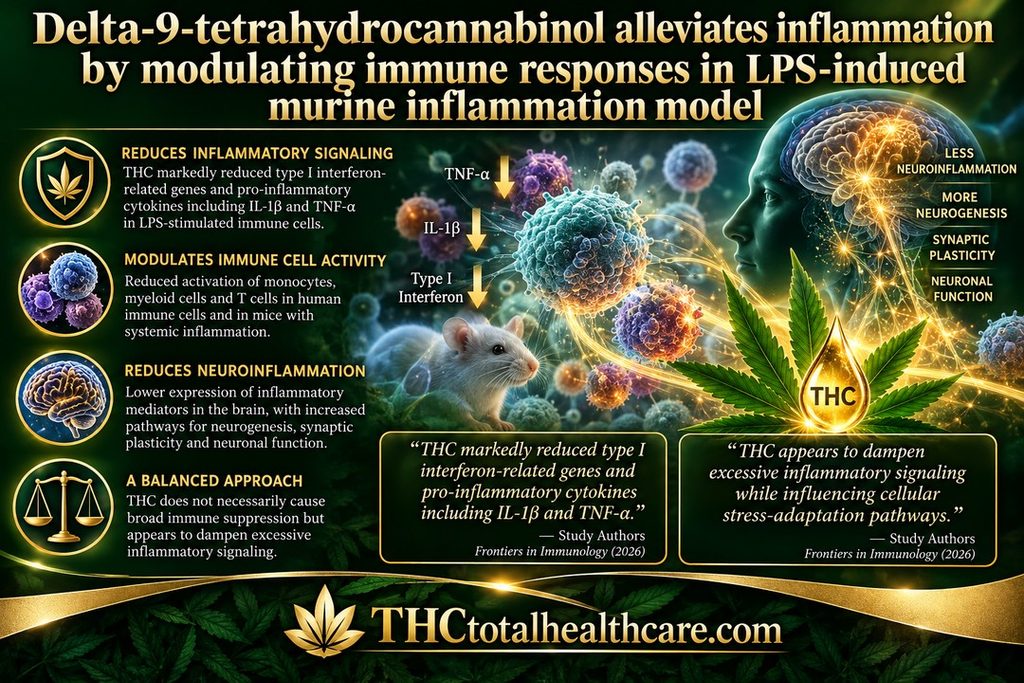
Delta-9-tetrahydrocannabinol alleviates inflammation by modulating immune responses in LPS-induced murine inflammation model

Delta-9-THC reduced inflammatory immune signaling across human immune cells and a mouse model of systemic inflammation. In LPS-stimulated cells, THC markedly suppressed type I interferon-related genes and pro-inflammatory cytokines including IL-1β and TNF-α, while also reducing immune-cell activation markers.

The effects extended beyond isolated cells. In mice exposed to systemic inflammation, THC reduced activation of splenic myeloid cells and T cells. Brain analysis also showed reduced neuroinflammatory signaling, including lower expression of inflammatory mediators, while pathways associated with neurogenesis, synaptic plasticity and neuronal function were enriched.

Importantly, the researchers describe THC’s effects as modulation rather than indiscriminate immune suppression, concluding that THC appears to dampen excessive inflammatory signaling while influencing cellular stress-adaptation pathways. They say these findings support further investigation of cannabinoid signaling in chronic inflammatory, neuroimmune and neurodegenerative disorders.

“Introduction: Δ9-Tetrahydrocannabinol (THC), the primary psychoactive component of cannabis, has been reported to modulate immune responses; however, its effects on complex innate immune signaling pathways and inflammation remain incompletely understood. Here, we investigated the immunomodulatory effects of THC on lipopolysaccharide (LPS)-induced inflammation across cellular and in vivo models.

Methods: We integrated transcriptomic, cellular, and in vivo approaches to characterize the effects of THC on innate immune activation. Human THP-1 monocytic cells were treated with THC in the presence or absence of LPS, followed by transcriptomic and gene expression analyses to evaluate inflammatory, type I interferon, unfolded protein response (UPR), and autophagy pathways. Findings were validated in primary human monocytes by assessing immune activation markers. The effects of chronic THC exposure were further evaluated in a murine model of systemic inflammation by examining splenic myeloid and T-cell activation. RNA sequencing of brain tissue was performed to assess the effects of THC on neuroinflammatory and neuronal pathways.

Results: THC induced a stress-adaptive transcriptional program in THP-1 cells, characterized by upregulation of genes associated with the UPR and autophagy pathways. In contrast, THC markedly suppressed LPS-induced type I interferon-stimulated genes (ISGs) and pro-inflammatory cytokines, including IL-1β and TNF-α. In primary human monocytes, THC significantly reduced the expression of activation markers CD80, CD83, and CD209. Consistent with these findings, chronic THC exposure attenuated the activation of splenic myeloid and T cells in mice subjected to systemic inflammation. Brain transcriptomic analysis further demonstrated reduced expression of neuroinflammatory pathways following THC exposure, accompanied by enrichment of pathways associated with neurogenesis and synaptic plasticity.

Discussion: Our findings demonstrate that THC exerts broad immunomodulatory effects characterized by suppression of inflammatory and type I interferon responses while promoting cellular stress-adaptation pathways. These effects were observed across human monocytic cells, primary monocytes, and peripheral immune populations in vivo, and were accompanied by reduced neuroinflammatory signaling and increased neuronal plasticity-associated pathways in the brain. Together, these findings provide mechanistic insight into the immunomodulatory actions of THC and support further investigation of cannabinoid signaling as a potential regulator of chronic inflammatory and neuroimmune disorders.”

https://pubmed.ncbi.nlm.nih.gov/42818626

“Chronic THC exposure reduces LPS-induced immune activation in vivo.”

https://www.frontiersin.org/journals/immunology/articles/10.3389/fimmu.2026.1856131/full

Need this THC study explained? thcXplained.com
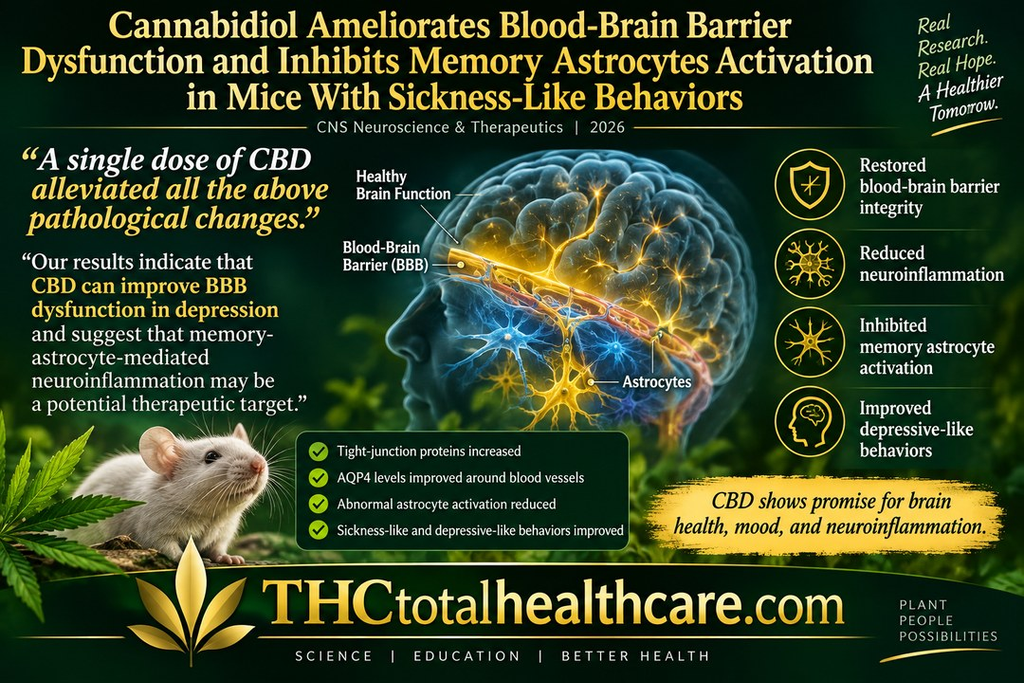
Cannabidiol Ameliorates Blood-Brain Barrier Dysfunction and Inhibits Memory Astrocytes Activation in Mice With Sickness-Like Behaviors

A new 2026 study published in CNS Neuroscience & Therapeutics found that cannabidiol (CBD) improved blood-brain barrier dysfunction, reduced neuroinflammation, and alleviated depressive-like behaviors in mice. The researchers found that sickness-like mice showed weakened blood-brain barrier integrity, reduced protective tight-junction proteins, abnormal astrocyte activation, and increased inflammation in the brain.

A single dose of CBD improved these changes, restoring important blood-brain barrier markers while reducing abnormal astrocyte activity and neuroinflammation. The researchers also identified a particularly interesting target called “memory astrocytes”—astrocytes that can respond more rapidly and strongly when exposed to a second inflammatory challenge.

The study found that CBD inhibited this memory-astrocyte-associated secondary inflammatory response, helping protect the blood-brain barrier and improve behavior. The researchers concluded that CBD may improve blood-brain barrier dysfunction associated with depression and identified memory-astrocyte-mediated neuroinflammation as a potential therapeutic target.

“Background: Blood-brain barrier (BBB) dysfunction has been increasingly implicated in the pathophysiology of depression; however, effective therapeutic strategies targeting this pathology remain limited. This study aimed to investigate the effect of cannabidiol (CBD) on improving depressive-like behaviors and BBB impairment, as well as its underlying mechanism.

Methods: Depressive-like behaviors in mice were assessed via exploratory and despair-like tests. BBB integrity was evaluated by examining tight junction protein expression in endothelial cells and AQP4 reduction from the perivascular membrane. Astrocyte activation and neuroinflammation were also measured. The therapeutic effects of a single CBD dose were examined.

Results: Mice with depressive-like phenotypes showed reduced exploratory behavior and increased despair-like behavior. In the BBB, the expression of tight junction proteins in endothelial cells was downregulated; in astrocytes, decreased AQP4 expression was observed, abnormal activation was enhanced, and neuroinflammation was elevated. A single dose of CBD alleviated all the above pathological changes. Further studies demonstrated that CBD exerted its effects by inhibiting memory astrocyte-associated secondary neuroinflammation, thereby alleviating depressive-like behaviors in mice with depressive-like phenotypes.

Conclusion: Experimental results show that CBD treatment can improve BBB dysfunction in depression and further indicates that targeted inhibition of memory astrocytes-mediated neuroinflammation may promote the treatment of depression.”

https://pubmed.ncbi.nlm.nih.gov/42747207

“Cannabidiol (CBD), a natural extract from cannabis, possesses multiple biological functions including cardioprotection, anti-inflammation, anti-cancer, anti-oxidation, and neuroprotection. Additionally, it plays indispensable roles in relieving depression and regulating BBB function]. CBD ameliorates depression by upregulating brain-derived neurotrophic factor, inhibiting neuroinflammation, alleviating oxidative stress, and modulating neurotransmitter transmission.”

https://onlinelibrary.wiley.com/doi/10.1002/cns.71168

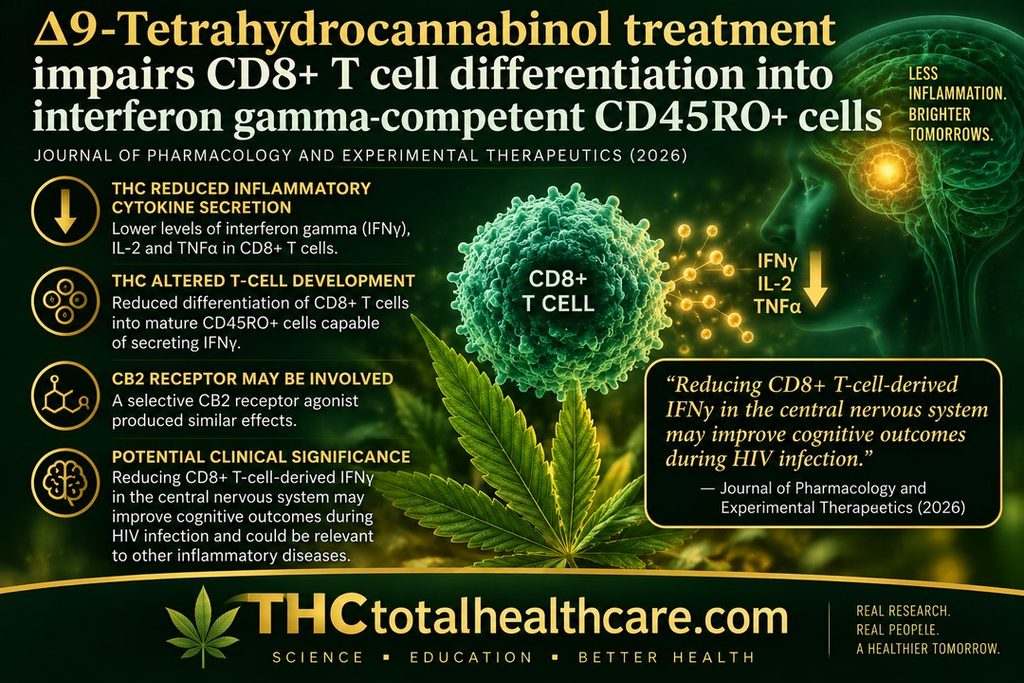
Δ9-Tetrahydrocannabinol treatment impairs CD8+ T cell differentiation into interferon gamma-competent CD45RO+ cells

New research published in The Journal of Pharmacology and Experimental Therapeutics shows that Δ9-tetrahydrocannabinol (THC) can alter the development of CD8+ T cells involved in inflammatory immune responses. Researchers found that THC reduced secretion of interferon gamma (IFNγ), interleukin-2 (IL-2), and tumor necrosis factor alpha (TNFα), three signaling molecules involved in immune activation and inflammation.

Rather than simply preventing cells from producing IFNγ, THC appeared to change how the T cells developed. THC reduced the differentiation of CD8+ T cells into mature CD45RO+ cells capable of secreting IFNγ. A selective CB2 receptor agonist produced similar effects, suggesting that activation of the cannabinoid CB2 receptor may play an important role in THC’s immune-modulating activity.

The researchers examined these effects partly because IFNγ-producing CD8+ T cells contribute to persistent neuroinflammation associated with HIV-associated neurocognitive disorders. They concluded that reducing CD8+ T-cell-derived IFNγ in the central nervous system may potentially improve cognitive outcomes during HIV infection, while noting that the findings may also have relevance to other inflammatory diseases involving IFNγ-producing CD8+ T cells.

“Chronic human immunodeficiency virus (HIV) infection results in a persistent state of neuroinflammation, even with combined antiretroviral therapy. Neuroinflammation contributes to pathology termed HIV-associated neurocognitive disorder, which is exacerbated by interferon gamma (IFNγ)-producing CD8+ T cells in the central nervous system.

Many people living with HIV self-report using Cannabis sativa to mitigate symptoms of chronic infection and side effects of treatment. C. sativa is composed of various phytocannabinoids, including Δ9-tetrahydrocannbinol (THC), which possesses immune-modulating properties.

This study aims to determine whether C. sativa use by people living with HIV, and specifically THC, affects IFNγ secretion by CD8+ T cells.

We found that HIV status does not influence T cell IFNγ responses, and C sativa use modestly reduces the average secretion of IFNγ by CD8+ T cells from HIV+ donors. Treatment of CD8+ T cells with THC and the selective cannabinoid receptor 2 agonist, JWH-015, reduced T-cell cytokine secretion, with THC eliciting greater suppression than cannabidiol.

These results suggest that THC treatment does not directly impair IFNγ gene expression or protein production, as determined by polymerase chain reaction and flow cytometry. However, THC treatment impaired CD8+ T cell differentiation into IFNγ-competent CD45RO+ cells.

These studies are of clinical relevance because reduction of CD8+ T-cell-derived IFNγ in the central nervous system may improve cognitive outcomes during HIV infection. Furthermore, these findings may be generalizable to other inflammatory diseases in which IFNγ-producing CD8+ T cells have been implicated.

SIGNIFICANCE STATEMENT: Δ9-Tetrahydrocannbinol (THC) treatment reduces CD8+ T cell interferon gamma (IFNγ) secretion isolated from HIV- and HIV+ individuals. THC and the selective cannabinoid receptor 2 agonist, JWH-015, both reduced CD8+ T cell secretion of IFNγ, interleukin 2, and tumor necrosis factor α, suggesting the involvement of cannabinoid receptor 2. Although THC treatment does not suppress IFNγ mRNA or protein levels, it reduces the number of IFNγ-secreting cells by impairing CD8+ T-cell differentiation into IFNγ-competent CD45RO+ cells.”

https://pubmed.ncbi.nlm.nih.gov/42748512

https://jpet.aspetjournals.org/article/S0022-3565(26)01210-3/abstract

Need this THC study explained? thcXplained.com
Therapeutic potential of cannabinoids in the treatment of neuroinflammation associated with Parkinson’s disease.

Abstract

“The cannabinoid system is represented by two principal receptor subtypes, termed CB1 and CB2, along with several endogenous ligands. In the central nervous system it is involved in several processes. CB1 receptors are mainly expressed by neurons and their activation is primarily implicated in psychotropic and motor effects of cannabinoids. CB2 receptors are expressed by glial cells and are thought to participate in regulation of neuroimmune reactions. This review aims to highlight several reported properties of cannabinoids that could be used to inhibit the adverse neuroinflammatory processes contributing to Parkinson’s disease and possibly other neurodegenerative disorders. These include anti-oxidant properties of phytocannabinoids and synthetic cannabinoids as well as hypothermic and antipyretic effects. However, cannabinoids may also trigger signaling cascades leading to impaired mitochondrial enzyme activity, reduced mitochondrial biogenesis, and increased oxidative stress, all of which could contribute to neurotoxicity. Therefore, further pharmacological studies are needed to allow rational design of new cannabinoid-based drugs lacking detrimental in vivo effects.”

http://www.ncbi.nlm.nih.gov/pubmed/21699489

Cannabinoids and innate immunity: taking a toll on neuroinflammation.

Abstract

“The biologically active components of cannabis have therapeutic potential in neuroinflammatory disorders due to their anti-inflammatory propensity. Cannabinoids influence immune function in both the peripheral and the central nervous system (CNS), and the components of the cannabinoid system, the cannabinoid receptors and their endogenous ligands (endocannabinoids), have been detected on immune cells as well as in brain glia. Neuroinflammation is the complex innate immune response of neural tissue to control infection and eliminate pathogens, and Toll-like receptors (TLRs), a major family of pattern recognition receptors (PRRs) that mediate innate immunity, have emerged as players in the neuroinflammatory processes underpinning various CNS diseases. This review will highlight evidence that cannabinoids interact with the immune system by impacting TLR-mediated signaling events, which may provide cues for devising novel therapeutic approaches for cannabinoid ligands.”

http://www.ncbi.nlm.nih.gov/pubmed/21479354

Role of CB1 cannabinoid receptors on GABAergic neurons in brain aging

“Brain aging is associated with cognitive decline that is accompanied by progressive neuroinflammatory changes. The endocannabinoid system (ECS) is involved in the regulation of glial activity and influences the progression of age-related learning and memory deficits.

Mice lacking the Cnr1 gene (Cnr1−/−), which encodes the cannabinoid receptor 1 (CB1), showed an accelerated age-dependent deficit in spatial learning accompanied by a loss of principal neurons in the hippocampus. The age-dependent decrease in neuronal numbers in Cnr1−/− mice was not related to decreased neurogenesis or to epileptic seizures. However, enhanced neuroinflammation characterized by an increased density of astrocytes and activated microglia as well as an enhanced expression of the inflammatory cytokine IL-6 during aging was present in the hippocampus of Cnr1−/− mice. The ongoing process of pyramidal cell degeneration and neuroinflammation can exacerbate each other and both contribute to the cognitive deficits. Deletion of CB1 receptors from the forebrain GABAergic, but not from the glutamatergic neurons, led to a similar neuronal loss and increased neuroinflammation in the hippocampus as observed in animals lacking CB1 receptors in all cells.

Our results suggest that CB1 receptor activity on hippocampal GABAergic neurons protects against age-dependent cognitive decline by reducing pyramidal cell degeneration and neuroinflammation.”

Regulatory Role of Cannabinoid Receptor 1 in Stress-Induced Excitotoxicity and Neuroinflammation

 “Exposure to stress elicits excitoxicity and neuroinflammation in the brain, contributing to cell death and damage in stress-related neurological and neuropsychiatric diseases. The endocannabinoid system is present in stress-responsive neural circuits and has been proposed as an endogenous neuroprotective system activated in some neuropathological scenarios to restore homeostasis. To elucidate the possible regulatory role of cannabinoid receptor 1 (CB1) in stress-induced excitotoxicity and neuroinflammation, both genetic and pharmacological approaches were used alternatively… These multifaceted neuroprotective effects suggest that CB1 activation could be a new therapeutic strategy against neurological/neuropsychiatric pathologies with HPA axis dysregulation and an excitotoxic/neuroinflammatory component in their pathophysiology.”

“Antiinflammatory Effects Elicited by CB1 Activation. Mechanisms Involved”

“In general, ECS has been proposed as an endogenous protective system against excessive inflammatory/immune responses in multiple CNS pathologies. Our following studies were aimed at clarifying the particular role of CB1 as a possible regulator of stress-induced inflammatory response.”

“In summary, the multifaceted neuroprotective effects described here suggest that CB1 activation is an attractive therapeutic strategy against diverse neuropsychiatric pathologies with HPA axis dysregulation and an excitotoxic/neuroinflammatory component in their pathophysiology.”

http://www.ncbi.nlm.nih.gov/pmc/articles/PMC3055736/

CNS immune surveillance and neuroinflammation: endocannabinoids keep control.

Abstract

“To avoid inflammatory escalation, the central nervous system (CNS) harbors an impressive arsenal of cellular and molecular mechanisms enabling strict control of immune reactions. We here summarize studies suggesting that the old paradigm of the “CNS immune privilege” is overly simplistic. The immune system is allowed to keep the CNS under surveillance, but in a strictly controlled, limited and well-regulated manner. The first line of defense lies outside the brain parenchyma to spare neuronal tissue from the detrimental effects of an inflammatory immune response. As a second line of defense neuroinflammation is unavoidable when pathogens infiltrate the brain or the CNS-immune-homeostasis fails. Inflammation in the CNS is often accompanied by divers brain pathologies. We here review recent strategies to maintain brain homeostasis and modulate neuroinflammation. We focus on Multiple Sclerosis as an example of a complex neuroinflammatory disease. In the past years, several in vitro, in vivo and clinical studies suggested that the endocannabinoid system participates crucially in the immune control and protection of the CNS. We discuss here the endocannabinoid system as a key regulator mechanism of the cross talk between brain and the immune system as well as its potential as a therapeutic target.”

http://www.ncbi.nlm.nih.gov/pubmed/18781977

Endocannabinoids in neuroimmunology and stress.

Abstract

“Two topics are presented in this review. In the first section, we review data regarding the effects of the endocannabinoids (eCBs) and cannabinoid receptors on neuroimmune function. The function of eCBs in the interaction between the immune system and the central nervous system (CNS) is of particular interest, since the CNS itself is a rich source of eCBs while being exquisitely sensitive to inflammation. There are several sites at which cannabinoids can influence neuroinflammation. Microglial cells express both CB receptors and make eCBs. Activation of CB receptors on these cells seems to promote migration and proliferation but to reduce activation to macrophages. In several neurodegenerative diseases, up-regulation of microglial CB2 receptors have been observed. It is our hypothesis that microglial CB receptor activity is anti-inflammatory and could be exploited to manipulate neuroinflammatory processes with a minimum of unwanted effects. The second topic discussed suggests that the eCB/CB1 receptor pair is involved in the responses of animals to acute, repeated and variable stress. The roles of this pair are complex and dependent upon previous stress, among other things. Dysfunctional responding to stress is a component of several human neuropsychiatric disorders, including anxiety and panic disorders, post-traumatic stress disorders, premenstrual dysphoria and quite possibly, drug abuse. While it is too early to say with certainty, it is very possible that either inhibition or potentiation of endocannabinoid signaling will be an efficacious novel therapeutic approach to more than one human psychiatric disease.”

http://www.ncbi.nlm.nih.gov/pubmed/16375683

Nonpsychotropic Cannabinoid Receptors Regulate Microglial Cell Migration

“During neuroinflammation, activated microglial cells migrate toward dying neurons, where they exacerbate local cell damage. The signaling molecules that trigger microglial cell migration are poorly understood. In this paper, we show that pathological overstimulation of neurons by glutamate plus carbachol dramatically increases the production of the endocannabinoid 2-arachidonylglycerol (2-AG) but only slightly increases the production of anandamide and does not affect the production of two putative endocannabinoids, homo-γ-linolenylethanolamide and docosatetraenylethanolamide. We further show that pathological stimulation of microglial cells with ATP also increases the production of 2-AG without affecting the amount of other endocannabinoids. Using a Boyden chamber assay, we provide evidence that 2-AG triggers microglial cell migration. This effect of 2-AG occurs through CB2 and abnormal-cannabidiol-sensitive receptors, with subsequent activation of the extracellular signal-regulated kinase 1/2 signal transduction pathway. It is important to note that cannabinol and cannabidiol, two nonpsychotropic ingredients present in the marijuana plant, prevent the 2-AG-induced cell migration by antagonizing the CB2 and abnormal-cannabidiol-sensitive receptors, respectively. Finally, we show that microglial cells express CB2 receptors at the leading edge of lamellipodia, which is consistent with the involvement of microglial cells in cell migration. Our study identifies a cannabinoid signaling system regulating microglial cell migration. Because this signaling system is likely to be involved in recruiting microglial cells toward dying neurons, we propose that cannabinol and cannabidiol are promising nonpsychotropic therapeutics to prevent the recruitment of these cells at neuroinflammatory lesion sites.”

“Because marijuana produces remarkable beneficial effects, patients with multiple sclerosis, for example, commonly use this plant as a therapeutic agent; however, we still lack essential information on the mechanistic basis of these beneficial effects.”

“The marijuana plant, Cannabis sativa, contains >60 cannabinoid compounds, the best known being Δ9-tetrahydrocannabinol (THC), cannabinol (CBN), and cannabidiol (CBD) (for review, see. Cannabinoid compounds produce their biological effects by acting through at least three cannabinoid receptors (see Table1). These include the cloned cannabinoid CB1 receptors, which are expressed predominately in the CNS, the cloned cannabinoid CB2 receptors, which are expressed predominately by immune cells, and the abnormal-cannabidiol-sensitive receptors (hereafter referred to as abn-CBD receptors). The latter receptors have not been cloned yet, but they have been pinpointed pharmacologically in mice lacking CB1 and CB2 receptors and are also known as anandamide (AEA) receptors.”

“We also show that CBN and CBD, two nonpsychotropic bioactive compounds of marijuana, may antagonize the 2-AG-induced recruitment of microglial cells. This is in agreement with the fact that nabilone, a synthetic analog of THC, produces minimal palliative effects against multiple sclerosis symptoms, whereas smoking cannabis is reported to be beneficial. Therefore, our results suggest that bioactive cannabinoids present in the marijuana plant, such as CBN and CBD, are likely to underlie the increased efficacy of cannabis versus nabilone and therefore hold promise as nonpsychotropic therapeutics to treat neuroinflammation.”

http://www.jneurosci.org/content/23/4/1398.long