
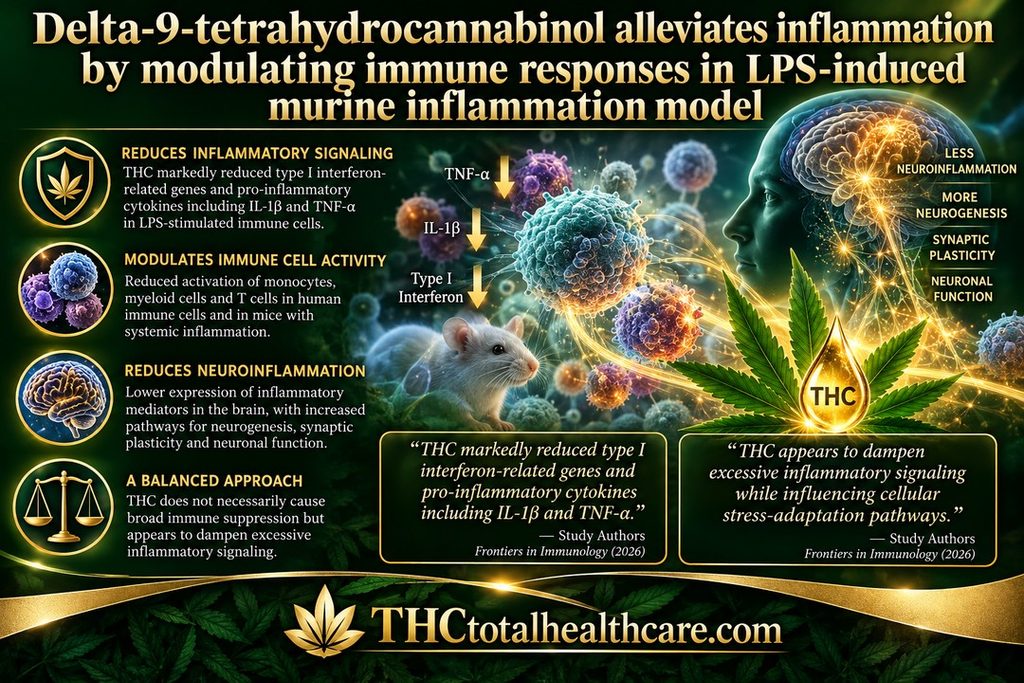
Delta-9-THC reduced inflammatory immune signaling across human immune cells and a mouse model of systemic inflammation. In LPS-stimulated cells, THC markedly suppressed type I interferon-related genes and pro-inflammatory cytokines including IL-1β and TNF-α, while also reducing immune-cell activation markers.
The effects extended beyond isolated cells. In mice exposed to systemic inflammation, THC reduced activation of splenic myeloid cells and T cells. Brain analysis also showed reduced neuroinflammatory signaling, including lower expression of inflammatory mediators, while pathways associated with neurogenesis, synaptic plasticity and neuronal function were enriched.
Importantly, the researchers describe THC’s effects as modulation rather than indiscriminate immune suppression, concluding that THC appears to dampen excessive inflammatory signaling while influencing cellular stress-adaptation pathways. They say these findings support further investigation of cannabinoid signaling in chronic inflammatory, neuroimmune and neurodegenerative disorders.
“Introduction: Δ9-Tetrahydrocannabinol (THC), the primary psychoactive component of cannabis, has been reported to modulate immune responses; however, its effects on complex innate immune signaling pathways and inflammation remain incompletely understood. Here, we investigated the immunomodulatory effects of THC on lipopolysaccharide (LPS)-induced inflammation across cellular and in vivo models.
Methods: We integrated transcriptomic, cellular, and in vivo approaches to characterize the effects of THC on innate immune activation. Human THP-1 monocytic cells were treated with THC in the presence or absence of LPS, followed by transcriptomic and gene expression analyses to evaluate inflammatory, type I interferon, unfolded protein response (UPR), and autophagy pathways. Findings were validated in primary human monocytes by assessing immune activation markers. The effects of chronic THC exposure were further evaluated in a murine model of systemic inflammation by examining splenic myeloid and T-cell activation. RNA sequencing of brain tissue was performed to assess the effects of THC on neuroinflammatory and neuronal pathways.
Results: THC induced a stress-adaptive transcriptional program in THP-1 cells, characterized by upregulation of genes associated with the UPR and autophagy pathways. In contrast, THC markedly suppressed LPS-induced type I interferon-stimulated genes (ISGs) and pro-inflammatory cytokines, including IL-1β and TNF-α. In primary human monocytes, THC significantly reduced the expression of activation markers CD80, CD83, and CD209. Consistent with these findings, chronic THC exposure attenuated the activation of splenic myeloid and T cells in mice subjected to systemic inflammation. Brain transcriptomic analysis further demonstrated reduced expression of neuroinflammatory pathways following THC exposure, accompanied by enrichment of pathways associated with neurogenesis and synaptic plasticity.
Discussion: Our findings demonstrate that THC exerts broad immunomodulatory effects characterized by suppression of inflammatory and type I interferon responses while promoting cellular stress-adaptation pathways. These effects were observed across human monocytic cells, primary monocytes, and peripheral immune populations in vivo, and were accompanied by reduced neuroinflammatory signaling and increased neuronal plasticity-associated pathways in the brain. Together, these findings provide mechanistic insight into the immunomodulatory actions of THC and support further investigation of cannabinoid signaling as a potential regulator of chronic inflammatory and neuroimmune disorders.”
https://pubmed.ncbi.nlm.nih.gov/42818626
“Chronic THC exposure reduces LPS-induced immune activation in vivo.”
https://www.frontiersin.org/journals/immunology/articles/10.3389/fimmu.2026.1856131/full
Need this THC study explained? thcXplained.com
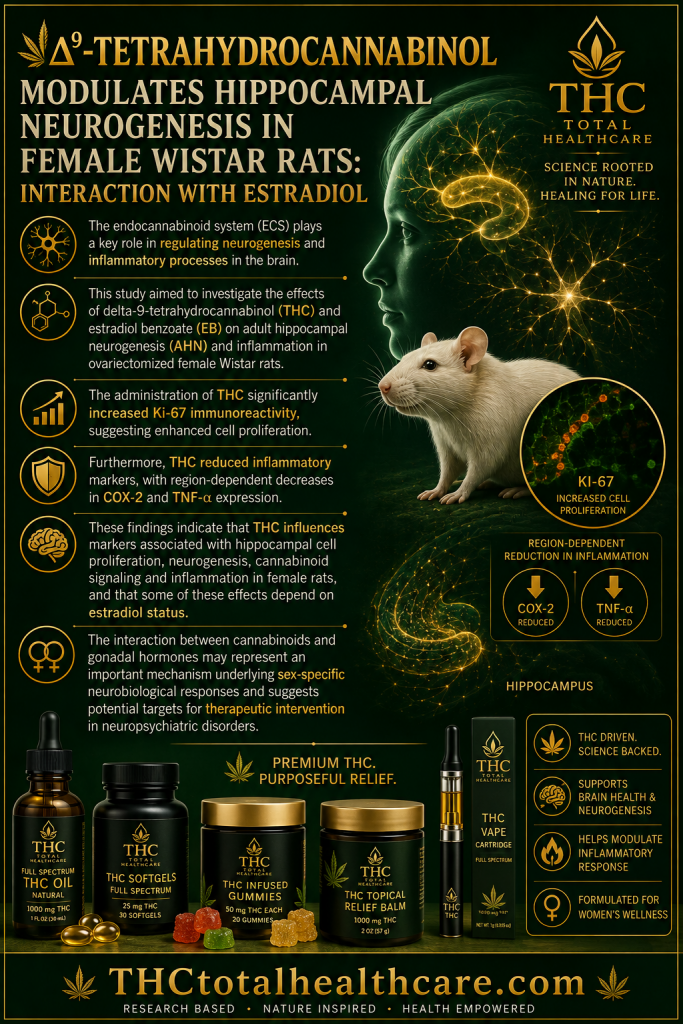
 “The concept of neurons as irreplaceable cells does not hold true today. Experiments and evidence of neurogenesis, also, in the adult brain give hope that some compounds or drugs can enhance this process, helping to reverse the outcomes of diseases or traumas that once were thought to be everlasting.
 “During the last decades, researchers have investigated the functional relevance of adult hippocampal neurogenesis in normal brain function as well as in the pathogenesis of diverse psychiatric conditions.
 “Studies have reported changes in the endocannabinoid system in the brain of patients with Alzheimer’s disease (AD), playing a role in the pathophysiology of AD. Cannabinoids have been shown to have neuroprotective properties, reduce neuroinflammation, and enhance neurogenesis. Evidence suggests that the utilization of marijuana products containing both tetrahydrocannabinol (THC) and cannabidiol (CBD) or CBD alone have been effective and safe for use in older people with agitation associated with dementia.
 “The endocannabinoid system (eCB) is a ubiquitous lipid signaling system composed of at least two receptors, their endogenous ligands, and the enzymes responsible for their synthesis and degradation. Within the brain, the eCB system is highly expressed in the hippocampus and controls basic biological processes, including neuronal proliferation, migration and differentiation, which are intimately linked with embryonal neurogenesis. Accumulated preclinical evidence has indicated that eCBs play a major role also in regulating adult neurogenesis. Increased
 “The G-protein coupled cannabinoid receptor 2 (CB2) has been implicated in the regulation of adult neurogenesis in the hippocampus. The contribution of CB2 towards basal levels of proliferation and the number of neural progenitors in the subgranular zone (SGZ) of the dentate gyrus, however, remain unclear. We stained hippocampal brain sections of 16- to 17-week-old wildtype and CB2-deficient mice, for neural progenitor and immature neuron markers doublecortin (DCX) and calretinin (CR) and for the proliferation marker Ki67 and quantified the number of positive cells in the SGZ. The quantification revealed that CB2 deficiency neither altered overall cell proliferation nor the size of the DCX+ or DCX and CR double-positive populations in the SGZ compared to control animals. The results indicate that CB2 might not contribute to basal levels of adult neurogenesis in four-month-old healthy mice. CB2 signaling might be more relevant in conditions where adult neurogenesis is dynamically regulated, such as neuroinflammation.”
 “The administration of cannabidiol has shown promising evidence in the treatment of some neuropsychiatric disorders, including cocaine addiction. However, little information is available as to the mechanisms by which cannabidiol reduces drug use and compulsive seeking.