Cannabinoids in Cancer: Molecular Mechanisms of Tumor Cell Death and Translational Opportunities

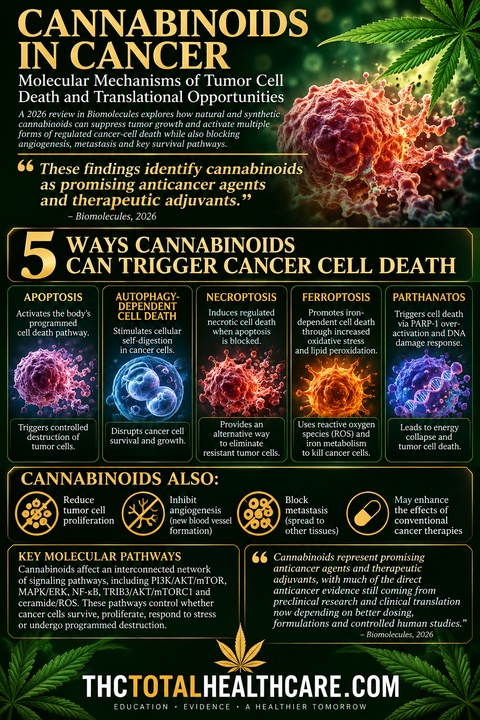
Cannabinoids can attack cancer cells through far more than a single mechanism. This 2026 review describes how natural and synthetic cannabinoids can suppress tumor-cell growth, angiogenesis and metastasis while activating multiple forms of regulated cancer-cell death, including apoptosis, autophagy-dependent cell death, necroptosis, ferroptosis and parthanatos.

The researchers detail an interconnected network of molecular pathways affected by cannabinoids, including PI3K/AKT/mTOR, MAPK/ERK, NF-κB, TRIB3/AKT/mTORC1 and ceramide/ROS signaling. These pathways control whether cancer cells survive, proliferate, respond to stress or undergo programmed destruction, giving cannabinoids multiple potential points of attack against malignant cells.

The review also finds that cannabinoids may enhance conventional anticancer treatments by engaging complementary cell-death pathways. The authors conclude that cannabinoids represent promising anticancer agents and therapeutic adjuvants, with much of the direct anticancer evidence still coming from preclinical research and clinical translation now depending on better dosing, formulations and controlled human studies.

“Cannabinoids are terpenophenolic compounds derived from Cannabis sativa L. that exert a broad range of biological and pharmacological activities. Increasing evidence highlights their potential as modulators of cancer progression specifically through the suppression of tumor cell growth, angiogenesis, and metastasis across multiple tumor models.

This review provides a comprehensive overview of the molecular mechanisms by which natural and synthetic cannabinoids induce regulated cancer cell death.

Current evidence demonstrates that cannabinoids regulate multiple forms of cancer cell death, including apoptosis, autophagy-dependent cell death, necroptosis, ferroptosis, and parthanatos. These effects are mediated through complex and interconnected signaling pathways such as TRIB3/AKT/mTORC1, PI3K/AKT/mTOR, MAPK/ERK, NF-κB, ERK/JNK/p38-MAPK, and ceramide/Raf1/ERK/ROS.

In addition to their direct antitumor effects, cannabinoids can enhance the efficacy of conventional anticancer therapies through the coordinated regulation of complementary cell death pathways. They also provide clinically relevant supportive benefits in palliative care, alleviating chemotherapy-induced nausea, cachexia, and mood or sleep disturbances.

Collectively, these findings identify cannabinoids as promising anticancer agents and therapeutic adjuvants, predominantly in the preclinical setting. However, significant challenges remain regarding their safety, optimal dosing, formulation, and clinical efficacy. Further mechanistic studies, rigorous preclinical research, and well-designed clinical trials are required to establish the translation of cannabinoid-based therapies into precision oncology.”

https://pubmed.ncbi.nlm.nih.gov/42793092

“The cannabis plant, a member of the Cannabaceae family, has been traditionally utilized for centuries for spiritual and remedial healing.”

“The anticancer activity of cannabinoids was discovered in 1975 by Munson et al.. Cannabinoids suppress cancer cell proliferation, angiogenesis, tumor invasion, metastasis, and stemness while inducing different modes of cell death pathways.”

“In summary, this review highlights the growing body of evidence supporting the ability of cannabinoids to induce multiple forms of cell death across a broad spectrum of cancer types. Through the modulation of diverse molecular and signaling pathways, cannabinoids have emerged as promising anticancer agents, mostly in preclinical models, with the potential to target tumor growth, survival, and progression, ultimately triggering diverse cell death mechanisms.”
https://www.mdpi.com/2218-273X/16/9/1260

Cytotoxicity of Cannabinoids in Combination with Traditional Lymphoma Chemotherapeutic Drugs Against Non-Hodgkin’s Lymphoma

“Background: Cannabinoids (CBs) are FDA-approved for mitigating chemotherapy-induced side effects such as pain, nausea, and loss of appetite. Beyond palliative care, CBs exhibit anti-tumor properties in various cancers, including non-Hodgkin’s lymphoma (NHL). Previously, we demonstrated the cytotoxic effect of endogenous and exogenous cannabinoids on human and canine B- and T-cell-type NHL cell lines. The purpose of this study was to establish the cytotoxic effect of cannabinoids in combination with the components of CHOP and lomustine. This traditional NHL chemotherapy regimen comprises cyclophosphamide, doxorubicin, vincristine, and prednisolone. 

Methods: In this study, we studied three cannabinoids, one from each of the three major categories of cannabinoids (endocannabinoid AEA, phytocannabinoid CBD, and synthetic cannabinoid WIN-55 212 22). Each cannabinoid was selected based on potency, as determined in our previous experiments. For the combination, we used five NHL chemotherapy drugs. We analyzed the cytotoxicity of each drug alone and in combinations using canine malignant B-type NHL cell line 1771 and a colorimetric MTT (3-(4,5-dimethylthiazol-2-yl)-2,5 diphenyl tetrazolium bromide) cell proliferation assay and combination index (CI) based on the Chou-Talalay method. 

Results: Our results demonstrate that the cytotoxic effects of all traditional NHL chemotherapy drugs are synergistically enhanced (interaction with CI < 1) by each of the three cannabinoids at sub-IC50 concentrations. 

Conclusions: This work provides a proof of concept for using cannabinoids and traditional NHL drugs in combination to reduce the dose, and thereby potentially reducing the toxicity, of chemotherapeutic drugs and increasing the survival benefit in lymphoma clinical translation studies, offering a significant advancement in cancer treatment.”

https://pubmed.ncbi.nlm.nih.gov/41595541

https://www.mdpi.com/2227-9059/14/1/3


Neutrophil extracellular traps and cannabinoids: potential in cancer metastasis

pubmed logo

“Cancer is the second leading cause of global mortality after cardiovascular diseases, with breast, lung, colon, and prostate cancers being the most common. WHO projects around 30 million new cancer cases worldwide by 2045, with breast cancer being the most common in women and lung cancer in men.

Metastasis is responsible for nearly 90% of cancer-related deaths. Breast and lung cancers tend to metastasize to the bones, lymph nodes, lungs, liver, and brain. Lungs remains one of the most common organs to which various forms of cancer metastasize.

An important factor in metastasis is NETosis – it can initially help to eliminate cancer cells, but it can also promote metastasis. Phytocannabinoids, compounds derived from Cannabis sativa, and the endocannabinoid system (ECS) offer promising therapeutic potential to inhibit NETosis and consequently cancer development and metastasis.

Although the precise effects of phytocannabinoids on neutrophil functions and NETosis are not fully understood and require further research in the context of cancer, preliminary studies suggest their potential to inhibit NET release in various disease models.

This review consolidates current knowledge and provides new insights into how phytocannabinoids and the ECS may serve as effective therapeutic tools to limit cancer metastasis.”

https://pubmed.ncbi.nlm.nih.gov/40599866/

“Research indicates that metastatic progression is responsible for most deaths caused by breast cancer, with metastatic processes accounting for nearly 90% of cancer-related mortality.”

“Phytocannabinoids, together with the endocannabinoid system (ECS), represent a highly promising therapeutic avenue for attenuating neutrophil effector functions, particularly the process of NETosis.

We believe that these compounds have significant potential as agents capable of effectively inhibiting metastatic progression.

Phytocannabinoids, derived primarily from the Cannabis sativa plant, are a group of organic compounds that interact with the endocannabinoid system (ECS) in the human body.”

“Both phytocannabinoids and the endocannabinoid system (ECS) show significant therapeutic potential in cancer treatment. Research indicates that these agents affect the proliferation, apoptosis, migration, and invasiveness of cancer cells. In addition, they modulate the tumor microenvironment, particularly the cells of the immune system.”

https://www.frontiersin.org/journals/oncology/articles/10.3389/fonc.2025.1595913/full

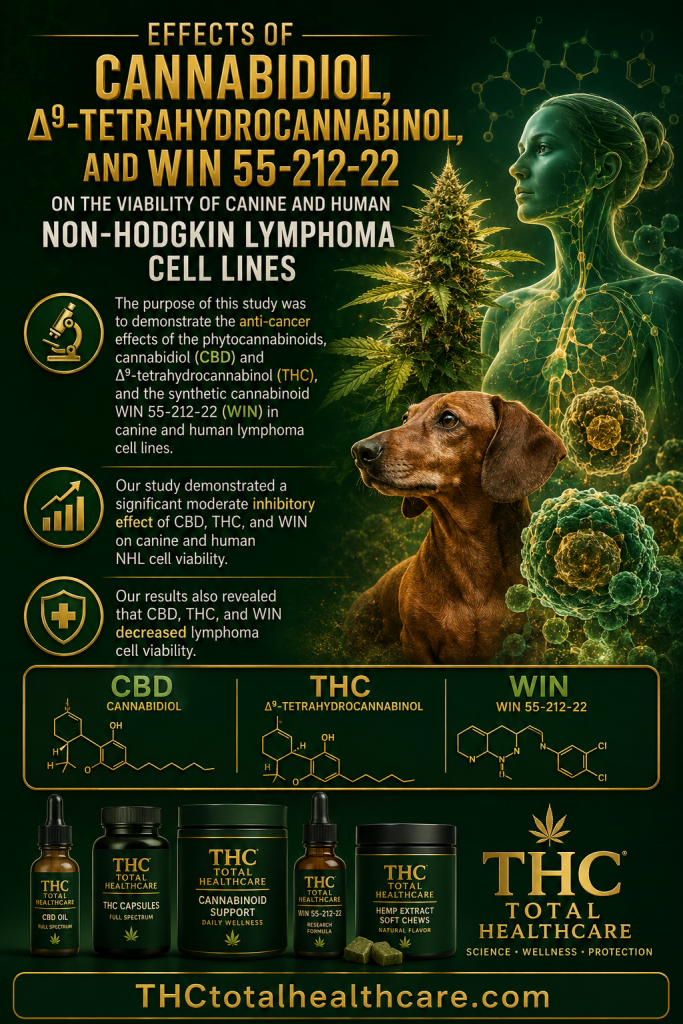
Effects of Cannabidiol, ∆9-Tetrahydrocannabinol, and WIN 55-212-22 on the Viability of Canine and Human Non-Hodgkin Lymphoma Cell Lines

“In our previous study, we demonstrated the impact of overexpression of CB1 and CB2 cannabinoid receptors and the inhibitory effect of endocannabinoids (2-arachidonoylglycerol (2-AG) and Anandamide (AEA)) on canine (Canis lupus familiaris) and human (Homo sapiens) non-Hodgkin lymphoma (NHL) cell lines’ viability compared to cells treated with a vehicle.

The purpose of this study was to demonstrate the anti-cancer effects of the phytocannabinoids, cannabidiol (CBD) and ∆9-tetrahydrocannabinol (THC), and the synthetic cannabinoid WIN 55-212-22 (WIN) in canine and human lymphoma cell lines and to compare their inhibitory effect to that of endocannabinoids.

We used malignant canine B-cell lymphoma (BCL) (1771 and CLB-L1) and T-cell lymphoma (TCL) (CL-1) cell lines, and human BCL cell line (RAMOS). Our cell viability assay results demonstrated, compared to the controls, a biphasic effect (concentration range from 0.5 μM to 50 μM) with a significant reduction in cancer viability for both phytocannabinoids and the synthetic cannabinoid. However, the decrease in cell viability in the TCL CL-1 line was limited to CBD.

The results of the biochemical analysis using the 1771 BCL cell line revealed a significant increase in markers of oxidative stress, inflammation, and apoptosis, and a decrease in markers of mitochondrial function in cells treated with the exogenous cannabinoids compared to the control. Based on the IC50 values, CBD was the most potent phytocannabinoid in reducing lymphoma cell viability in 1771, Ramos, and CL-1. Previously, we demonstrated the endocannabinoid AEA to be more potent than 2-AG.

Our study suggests that future studies should use CBD and AEA for further cannabinoid testing as they might reduce tumor burden in malignant NHL of canines and humans.”

https://pubmed.ncbi.nlm.nih.gov/38672512/

“Our study demonstrated a significant moderate inhibitory effect of CBD, THC, and WIN on canine and human NHL cell viability. Our results also revealed that CBD, THC, and WIN decreased lymphoma cell viability because they increased oxidative stress, leading to downstream apoptosis.”

https://www.mdpi.com/2218-273X/14/4/495

Cannabinoids in Treating Chemotherapy-Induced Nausea and Vomiting, Cancer-Associated Pain, and Tumor Growth

pubmed logo

“Cannabis has been used as an herbal remedy for thousands of years, and recent research indicates promising new uses in medicine. So far, some studies have shown cannabinoids to be safe in helping mitigate some cancer-associated complications, including chemotherapy-induced nausea and vomiting, cancer-associated pain, and tumor growth.

Researchers have been particularly interested in the potential uses of cannabinoids in treating cancer due to their ability to regulate cancer-related cell cycle pathways, prompting many beneficial effects, such as tumor growth prevention, cell cycle obstruction, and cell death.

Cannabinoids have been found to affect tumors of the brain, prostate, colon and rectum, breast, uterus, cervix, thyroid, skin, pancreas, and lymph. However, the full potential of cannabinoids is yet to be understood.

This review discusses current knowledge on the promising applications of cannabinoids in treating three different side effects of cancer-chemotherapy-induced nausea and vomiting, cancer-associated pain, and tumor development.

The findings suggest that cannabinoids can be used to address some side effects of cancer and to limit the growth of tumors, though a lack of supporting clinical trials presents a challenge for use on actual patients. An additional challenge will be examining whether any of the over one hundred naturally occurring cannabinoids or dozens of synthetic compounds also exhibit useful clinical properties.

Currently, clinical trials are underway; however, no regulatory agencies have approved cannabinoid use for any cancer symptoms beyond antinausea.”

https://pubmed.ncbi.nlm.nih.gov/38203245/

https://www.mdpi.com/1422-0067/25/1/74

The Effectiveness and Safety of Medical Cannabis for Treating Cancer Related Symptoms in Oncology Patients

Frontiers in Pain Research (@FrontPain) / Twitter

“The use of medical cannabis (MC) to treat cancer-related symptoms is rising. However, there is a lack of long-term trials to assess the benefits and safety of MC treatment in this population. In this work, we followed up prospectively and longitudinally on the effectiveness and safety of MC treatment.

Oncology patients reported on multiple symptoms before and after MC treatment initiation at one-, three-, and 6-month follow-ups. Oncologists reported on the patients’ disease characteristics. Intention-to-treat models were used to assess changes in outcomes from baseline. MC treatment was initiated by 324 patients and 212, 158 and 126 reported at follow-ups.

Most outcome measures improved significantly during MC treatment for most patients (p < 0.005). Specifically, at 6 months, total cancer symptoms burden declined from baseline by a median of 18%, from 122 (82–157) at baseline to 89 (45–138) at endpoint (−18.98; 95%CI= −26.95 to −11.00; p < 0.001). Reported adverse effects were common but mostly non-serious and remained stable during MC treatment.

The results of this study suggest that MC treatment is generally safe for oncology patients and can potentially reduce the burden of associated symptoms with no serious MC-related adverse effects.

The main finding of the current study is that most cancer comorbid symptoms improved significantly during 6 months of MC treatment.

Additionally, we found that MC treatment in cancer patients was well tolerated and safe.”

https://pubmed.ncbi.nlm.nih.gov/35669038/

https://www.frontiersin.org/articles/10.3389/fpain.2022.861037/full?utm_source=fweb

“Cancer Pain Treatment Using Marijuana Safe and Effective, Large Study Finds”

https://www.newsweek.com/cannabis-medicinal-cancer-patient-symptoms-pain-relief-1711981


Cannabis use among patients with cutaneous lymphoma: A cross-sectional survey

“Objective: To evaluate patterns of cannabis use in patients with cutaneous lymphoma (CL), as well as the association between cannabis use and itch specifically.

Design: Cross-sectional survey created in partnership with the Cutaneous Lymphoma Foundation (CLF).

Setting: The online survey was distributed electronically via email to the CLF listserv and links posted to social media over a 2-week period. Main Outcome Measures Respondents were classified as current cannabis users, prior users, and never users. A visual analog scale (VAS) was used to assess itching severity, improvement of itch, and interest in learning about cannabis.

Results: A total of 119 patient responses (61% female, mean age 59y) were included in analysis. The majority had mycosis fungoides or Sézary syndrome (74%; 88/119) and early stage (IA-IIA) disease (56%; 48/86). Mean VAS itch score was 3.2 + 2.8 for the cohort. Over half (55%; 60/110) reported ever having used cannabis, with 22% (24/110) endorsing current cannabis use. Common methods of cannabis use were smoking (54%) and vaporizing (46%). 25% (6/24) of current users reported using cannabis specifically to treat itch; these respondents noted that cannabis resulted in moderate improvement of itching (mean 6.6/10). There was strong interest in learning more about cannabis and cancer, and most desired this information from their CL doctor/nurse.

Conclusions: Cannabis use is common among patients with CL, and patients report improvement of itching as a result of using cannabis. Further studies are needed to elucidate the risks and benefits of cannabis use in this patient population.”

https://pubmed.ncbi.nlm.nih.gov/35395396/

The Endocannabinoid System as a Pharmacological Target for New Cancer Therapies

“Despite the long history of cannabinoid use for medicinal and ritual purposes, an endogenous system of cannabinoid-controlled receptors, as well as their ligands and the enzymes that synthesise and degrade them, was only discovered in the 1990s. Since then, the endocannabinoid system has attracted widespread scientific interest regarding new pharmacological targets in cancer treatment among other reasons.

Meanwhile, extensive preclinical studies have shown that cannabinoids have an inhibitory effect on tumour cell proliferation, tumour invasion, metastasis, angiogenesis, chemoresistance and epithelial-mesenchymal transition (EMT) and induce tumour cell apoptosis and autophagy as well as immune response. Appropriate cannabinoid compounds could moreover be useful for cancer patients as potential combination partners with other chemotherapeutic agents to increase their efficacy while reducing unwanted side effects.

In addition to the direct activation of cannabinoid receptors through the exogenous application of corresponding agonists, another strategy is to activate these receptors by increasing the endocannabinoid levels at the corresponding pathological hotspots. Indeed, a number of studies accordingly showed an inhibitory effect of blockers of the endocannabinoid-degrading enzymes fatty acid amide hydrolase (FAAH) and monoacylglycerol lipase (MAGL) on tumour development and spread.

This review summarises the relevant preclinical studies with FAAH and MAGL inhibitors compared to studies with cannabinoids and provides an overview of the regulation of the endocannabinoid system in cancer.”

https://pubmed.ncbi.nlm.nih.gov/34830856/

“Cannabinoids have been shown to suppress tumour cell proliferation, tumour invasion, metastasis, angiogenesis, chemoresistance and epithelial-mesenchymal transition and to induce tumour cell apoptosis, autophagy and immune response. This review focuses on the current status of investigations on the impact of inhibitors of endocannabinoid-degrading enzymes on tumour growth and spread in preclinical oncology research.”

https://www.mdpi.com/2072-6694/13/22/5701


Plant-derived cannabinoids as anticancer agents

“Substantial preclinical evidence demonstrates the antiproliferative, cytotoxic, and antimetastatic properties of plant-derived cannabinoids (phytocannabinoids) such as cannabidiol and tetrahydrocannabinol. The cumulative body of research into the intracellular mechanisms and phenotypic effects of these compounds supports a logical, judicious progression to large-scale phase II/III clinical trials in certain cancer types to truly assess the efficacy of phytocannabinoids as anticancer agents.”

https://pubmed.ncbi.nlm.nih.gov/35260379/

Cannabinoids as anticancer drugs: current status of preclinical research

“Drugs that target the endocannabinoid system are of interest as pharmacological options to combat cancer and to improve the life quality of cancer patients. From this perspective, cannabinoid compounds have been successfully tested as a systemic therapeutic option in a number of preclinical models over the past decades. As a result of these efforts, a large body of data suggests that the anticancer effects of cannabinoids are exerted at multiple levels of tumour progression via different signal transduction mechanisms. Accordingly, there is considerable evidence for cannabinoid-mediated inhibition of tumour cell proliferation, tumour invasion and metastasis, angiogenesis and chemoresistance, as well as induction of apoptosis and autophagy. Further studies showed that cannabinoids could be potential combination partners for established chemotherapeutic agents or other therapeutic interventions in cancer treatment. Research in recent years has yielded several compounds that exert promising effects on tumour cells and tissues in addition to the psychoactive Δ9-tetrahydrocannabinol, such as the non-psychoactive phytocannabinoid cannabidiol and inhibitors of endocannabinoid degradation. This review provides an up-to-date overview of the potential of cannabinoids as inhibitors of tumour growth and spread as demonstrated in preclinical studies.”

https://pubmed.ncbi.nlm.nih.gov/35277658/