
Cannabinoids in Cancer: Molecular Mechanisms of Tumor Cell Death and Translational Opportunities

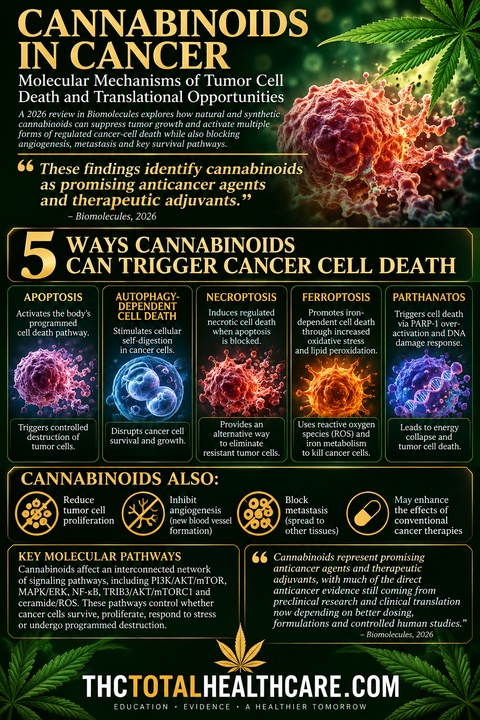
Cannabinoids can attack cancer cells through far more than a single mechanism. This 2026 review describes how natural and synthetic cannabinoids can suppress tumor-cell growth, angiogenesis and metastasis while activating multiple forms of regulated cancer-cell death, including apoptosis, autophagy-dependent cell death, necroptosis, ferroptosis and parthanatos.

The researchers detail an interconnected network of molecular pathways affected by cannabinoids, including PI3K/AKT/mTOR, MAPK/ERK, NF-κB, TRIB3/AKT/mTORC1 and ceramide/ROS signaling. These pathways control whether cancer cells survive, proliferate, respond to stress or undergo programmed destruction, giving cannabinoids multiple potential points of attack against malignant cells.

The review also finds that cannabinoids may enhance conventional anticancer treatments by engaging complementary cell-death pathways. The authors conclude that cannabinoids represent promising anticancer agents and therapeutic adjuvants, with much of the direct anticancer evidence still coming from preclinical research and clinical translation now depending on better dosing, formulations and controlled human studies.

“Cannabinoids are terpenophenolic compounds derived from Cannabis sativa L. that exert a broad range of biological and pharmacological activities. Increasing evidence highlights their potential as modulators of cancer progression specifically through the suppression of tumor cell growth, angiogenesis, and metastasis across multiple tumor models.

This review provides a comprehensive overview of the molecular mechanisms by which natural and synthetic cannabinoids induce regulated cancer cell death.

Current evidence demonstrates that cannabinoids regulate multiple forms of cancer cell death, including apoptosis, autophagy-dependent cell death, necroptosis, ferroptosis, and parthanatos. These effects are mediated through complex and interconnected signaling pathways such as TRIB3/AKT/mTORC1, PI3K/AKT/mTOR, MAPK/ERK, NF-κB, ERK/JNK/p38-MAPK, and ceramide/Raf1/ERK/ROS.

In addition to their direct antitumor effects, cannabinoids can enhance the efficacy of conventional anticancer therapies through the coordinated regulation of complementary cell death pathways. They also provide clinically relevant supportive benefits in palliative care, alleviating chemotherapy-induced nausea, cachexia, and mood or sleep disturbances.

Collectively, these findings identify cannabinoids as promising anticancer agents and therapeutic adjuvants, predominantly in the preclinical setting. However, significant challenges remain regarding their safety, optimal dosing, formulation, and clinical efficacy. Further mechanistic studies, rigorous preclinical research, and well-designed clinical trials are required to establish the translation of cannabinoid-based therapies into precision oncology.”

https://pubmed.ncbi.nlm.nih.gov/42793092

“The cannabis plant, a member of the Cannabaceae family, has been traditionally utilized for centuries for spiritual and remedial healing.”

“The anticancer activity of cannabinoids was discovered in 1975 by Munson et al.. Cannabinoids suppress cancer cell proliferation, angiogenesis, tumor invasion, metastasis, and stemness while inducing different modes of cell death pathways.”

“In summary, this review highlights the growing body of evidence supporting the ability of cannabinoids to induce multiple forms of cell death across a broad spectrum of cancer types. Through the modulation of diverse molecular and signaling pathways, cannabinoids have emerged as promising anticancer agents, mostly in preclinical models, with the potential to target tumor growth, survival, and progression, ultimately triggering diverse cell death mechanisms.”
https://www.mdpi.com/2218-273X/16/9/1260

The Use of Tetrahydrocannabinol Is Associated with an Increase in Survival Time in Palliative Cancer Patients: A Retrospective Multicenter Cohort Study

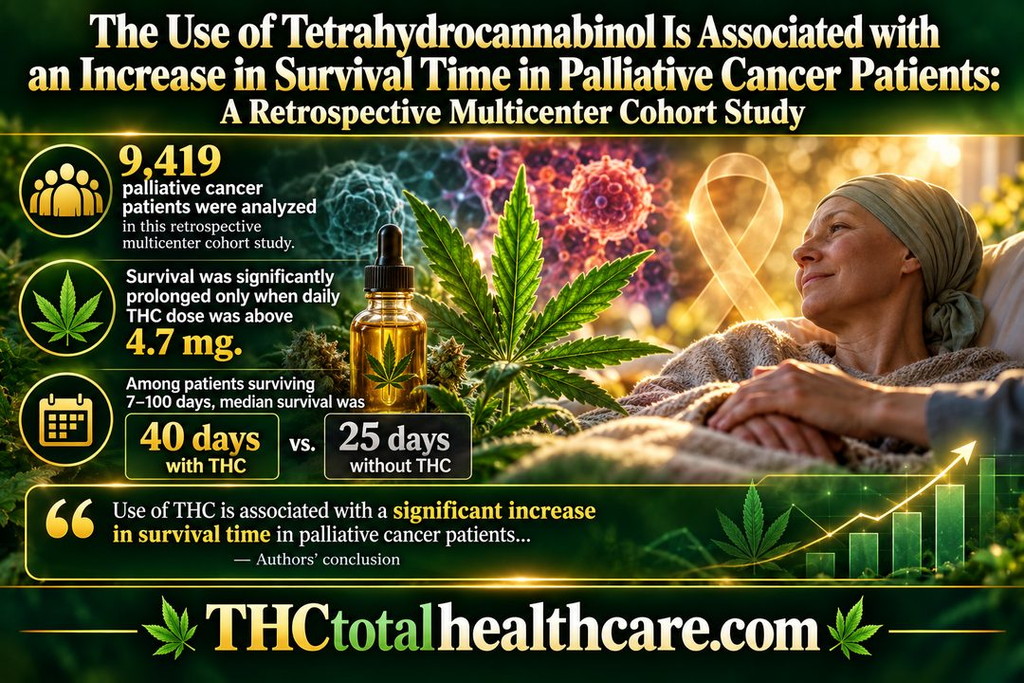
A large retrospective multicenter study of 9,419 palliative cancer patients found that THC use was associated with longer survival. The researchers reported the strongest association among patients receiving more than 4.7 mg of THC per day.

In patients who survived between 7 and 100 days, median survival was 40 days in the THC group compared with 25 days in patients who did not receive THC. The study also examined THC alongside palliative-care treatment rather than as a replacement for standard care.

These findings add an important human-data signal to the growing research on cannabinoids in cancer care. While the study was observational, the association between THC use and longer survival makes this a significant finding for palliative oncology and cannabinoid research.

“Introduction: Tetrahydrocannabinol (THC) is often prescribed for ambulatory palliative patients to improve sleep quality and appetite and to reduce anxiety, stress, and pain. However, it is not known if THC has also an effect on the mortality of these patients.

Method: The objective was the impact of THC on mortality of ambulatory palliative patients. For this purpose, data from the palliative treatment documentation from 5 ambulatory palliative care teams in Brandenburg, Germany were used for this analysis. Survival time was calculated for 3 groups of patients: (1) without THC; (2) with THC in a low dosage (≤4.7 mg per day); and (3) THC in higher doses (≥4.7 mg per day). The analysis was done for 2 cohorts of patients. Cohort 1: all patients with a survival time of at least 7 days after inclusion in specialized ambulatory palliative care (SAPC) and cohort 2: a subgroup of patients with a survival time between 7 and 100 days. Kaplan-Meier curves were created, and multivariate analysis was done to investigate the impact of THC on mortality.

Results: A total of 9,419 patients with a survival time of at least 7 days after inclusion in SAPC were included in the analysis (cohort 1). 7,085 among them had a survival time between 7 and 100 days (cohort 2). In both cohorts, survival time was significantly prolonged by THC, but only when the daily THC dose was above the median of 4.7 mg. Survival time was 15 days longer in cohort 2 (40 vs. 25 days), when more than 4.7 mg THC were prescribed per day.

Conclusion: Use of THC is associated with a significant increase in survival time in ambulatory palliative patients which survive longer than 7 days the initiation of THC prescription and which use of THC >4.7 mg/day.”

https://pubmed.ncbi.nlm.nih.gov/38655402/

“Thus, in view of its significant prolongation of patient survival time, THC therapy should be included as part of the first-line therapy for ambulatory palliative patients.”

https://karger.com/mca/article/7/1/59/896816/The-Use-of-Tetrahydrocannabinol-Is-Associated-with

Need this THC study explained? thcXplained.com

Established and potential therapeutic applications of cannabinoids in oncology.

Abstract

“Cannabis occurs naturally in the dried flowering or fruiting tops of the Cannabis sativa plant. Cannabis is most often consumed by smoking marihuana. Cannabinoids are the active compounds extracted from cannabis. Recently, there has been renewed interest in cannabinoids for medicinal purposes. The two proven indications for the use of the synthetic cannabinoid (dronabinol) are chemotherapy-induced nausea and vomiting and AIDS-related anorexia. Other possible effects that may prove beneficial in the oncology population include analgesia, antitumor effect, mood elevation, muscle relaxation, and relief of insomnia. Two types of cannabinoid receptors, CB1 and CB2, have been detected. CB1 receptors are expressed mainly in the central and peripheral nervous system. CB2 receptors are found in certain nonneuronal tissues, particularly in the immune cells. Recent discovery of both the cannabinoid receptors and endocannabinoids has opened a new era in research on the pharmaceutical applications of cannabinoids. The use of cannabinoids should be continued in the areas indicated, and further studies are needed to evaluate other potential uses in clinical oncology.”

http://www.ncbi.nlm.nih.gov/pubmed/12618922