
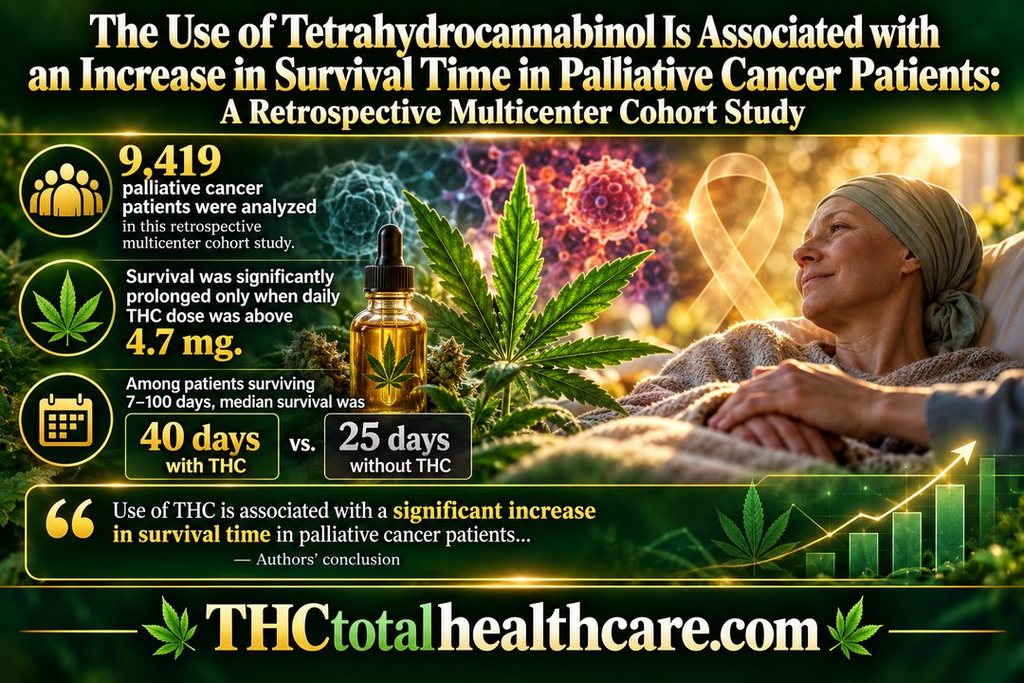
A large retrospective multicenter study of 9,419 palliative cancer patients found that THC use was associated with longer survival. The researchers reported the strongest association among patients receiving more than 4.7 mg of THC per day.
In patients who survived between 7 and 100 days, median survival was 40 days in the THC group compared with 25 days in patients who did not receive THC. The study also examined THC alongside palliative-care treatment rather than as a replacement for standard care.
These findings add an important human-data signal to the growing research on cannabinoids in cancer care. While the study was observational, the association between THC use and longer survival makes this a significant finding for palliative oncology and cannabinoid research.
“Introduction: Tetrahydrocannabinol (THC) is often prescribed for ambulatory palliative patients to improve sleep quality and appetite and to reduce anxiety, stress, and pain. However, it is not known if THC has also an effect on the mortality of these patients.
Method: The objective was the impact of THC on mortality of ambulatory palliative patients. For this purpose, data from the palliative treatment documentation from 5 ambulatory palliative care teams in Brandenburg, Germany were used for this analysis. Survival time was calculated for 3 groups of patients: (1) without THC; (2) with THC in a low dosage (≤4.7 mg per day); and (3) THC in higher doses (≥4.7 mg per day). The analysis was done for 2 cohorts of patients. Cohort 1: all patients with a survival time of at least 7 days after inclusion in specialized ambulatory palliative care (SAPC) and cohort 2: a subgroup of patients with a survival time between 7 and 100 days. Kaplan-Meier curves were created, and multivariate analysis was done to investigate the impact of THC on mortality.
Results: A total of 9,419 patients with a survival time of at least 7 days after inclusion in SAPC were included in the analysis (cohort 1). 7,085 among them had a survival time between 7 and 100 days (cohort 2). In both cohorts, survival time was significantly prolonged by THC, but only when the daily THC dose was above the median of 4.7 mg. Survival time was 15 days longer in cohort 2 (40 vs. 25 days), when more than 4.7 mg THC were prescribed per day.
Conclusion: Use of THC is associated with a significant increase in survival time in ambulatory palliative patients which survive longer than 7 days the initiation of THC prescription and which use of THC >4.7 mg/day.”
https://pubmed.ncbi.nlm.nih.gov/38655402/
“Thus, in view of its significant prolongation of patient survival time, THC therapy should be included as part of the first-line therapy for ambulatory palliative patients.”
https://karger.com/mca/article/7/1/59/896816/The-Use-of-Tetrahydrocannabinol-Is-Associated-with
Need this THC study explained? thcXplained.com