As the opioid crisis continues, researchers are examining whether cannabis may play a role in reducing withdrawal symptoms or helping some people decrease opioid use. In this cross-sectional study of people using unregulated opioids, many participants reported using cannabis specifically to manage withdrawal-related symptoms, and some also reported reductions in opioid consumption. The findings add real-world evidence that people are already using cannabis as a self-directed strategy during opioid withdrawal. The study supports further research into whether cannabinoid-based approaches could have a formal role in harm reduction or opioid-use treatment.
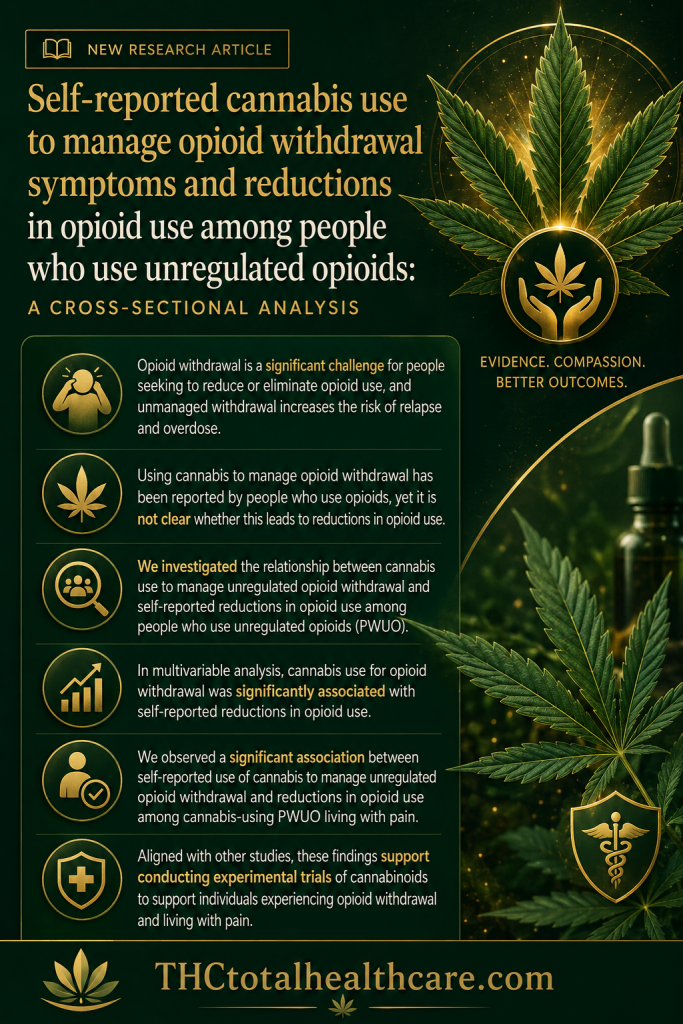
“Background: Opioid withdrawal is a significant challenge for people seeking to reduce or eliminate opioid use, and unmanaged withdrawal increases the risk of relapse and overdose. Using cannabis to manage opioid withdrawal has been reported by people who use opioids, yet it is not clear whether this leads to reductions in opioid use. Moreover, because pain is prevalent among people who use unregulated opioids (PWUO) and may contribute to ongoing opioid use, the effects of cannabis use to manage withdrawal symptoms may differ among individuals experiencing moderate to severe pain. We investigated the relationship between cannabis use to manage unregulated opioid withdrawal and self-reported reductions in opioid use among PWUO.
Methods: Data were derived from a cross-sectional questionnaire administered to cannabis-using PWUO in Vancouver, Canada, between December 2019 and November 2021. Multivariable logistic regression estimated the associations between cannabis use for opioid withdrawal and self-reported reductions in opioid use. A sub-analysis explored if these associations varied among participants living with and without moderate to severe pain.
Results: Among 197 participants, 89 (45.2%) reported cannabis use to manage symptoms of opioid withdrawal in the past six months. In multivariable analysis, cannabis use for opioid withdrawal was significantly associated with self-reported reductions in opioid use (adjusted Odds Ratio [AOR] = 2.16, 95% Confidence Interval [CI]: 1.13-4.19) in the same time period. In a sub-analysis, this association was only significant among participants with moderate to severe pain (AOR = 6.55; 95% CI: 2.44-19.63).
Conclusions: We observed a significant association between self-reported use of cannabis to manage unregulated opioid withdrawal and reductions in opioid use among cannabis-using PWUO living with pain. Aligned with other studies, these findings support conducting experimental trials of cannabinoids to support individuals experiencing opioid withdrawal and living with pain.”
https://pubmed.ncbi.nlm.nih.gov/42343486
https://link.springer.com/article/10.1186/s42238-026-00458-0