
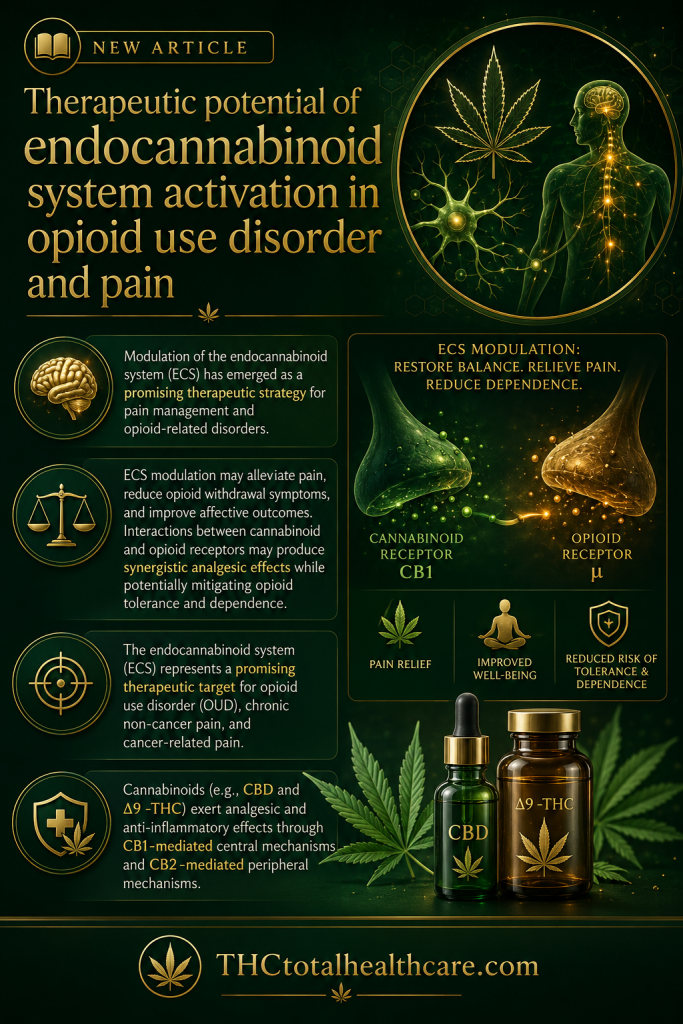
Pain and opioid use disorder are closely linked, creating a need for treatments that can reduce pain without reinforcing opioid dependence. This review examines the endocannabinoid system as a potential therapeutic target for both conditions, focusing on how cannabinoid receptors and endogenous cannabinoid signaling influence pain perception, reward, withdrawal, and opioid-related behaviors. The authors discuss evidence that activating or modulating this system may reduce pain while also affecting mechanisms involved in opioid dependence and relapse. The review highlights the endocannabinoid system as a promising bridge between pain management and addiction treatment, supporting further development of cannabinoid-based and endocannabinoid-targeted therapies.
“Introduction: Opioid use disorder (OUD) and chronic pain remain major global health challenges. Although opioid-based therapies provide effective analgesia, their long-term use is limited by safety concerns, dependence, and variable efficacy. Modulation of the endocannabinoid system (ECS) has emerged as a promising therapeutic strategy for pain management and opioid-related disorders.
Areas covered: This narrative review summarizes current evidence on ECS-targeted interventions for OUD, chronic non-cancer pain, and cancer-related pain. Relevant literature was identified through PubMed using search terms related to the ECS, cannabinoid receptors (CB1 and CB2), phytocannabinoids (Δ9 -tetrahydrocannabinol [THC] and cannabidiol [CBD]), synthetic cannabinoids, fatty acid amide hydrolase (FAAH) and monoacylglycerol lipase (MAGL) inhibitors, and opioid – cannabinoid interactions. Particular emphasis is placed on mechanistic interactions between ECS and opioid signaling pathways, as well as evidence from preclinical and clinical studies evaluating therapeutic efficacy and safety.
Expert opinion: ECS modulation may alleviate pain, reduce opioid withdrawal symptoms, and improve affective outcomes. Interactions between cannabinoid and opioid receptors may produce synergistic analgesic effects while potentially mitigating opioid tolerance and dependence. However, clinical translation remains limited by small sample sizes, heterogeneous study populations, and variability in trial design. Well-controlled clinical trials are needed to establish optimal dosing strategies, evaluate long-term safety, and clarify the therapeutic role of ECS-targeted interventions in OUD and pain management.”
https://pubmed.ncbi.nlm.nih.gov/42295097
“The endocannabinoid system (ECS) represents a promising therapeutic target for opioid use disorder (OUD), chronic non-cancer pain, and cancer-related pain.”
“Cannabinoids (e.g., CBD and Δ9 -THC) exert analgesic and anti-inflammatory effects through CB1-mediated central mechanisms and CB2-mediated peripheral mechanisms.”
https://www.tandfonline.com/doi/full/10.1080/14728222.2026.2690138