Cannabinoids in Cancer: Molecular Mechanisms of Tumor Cell Death and Translational Opportunities

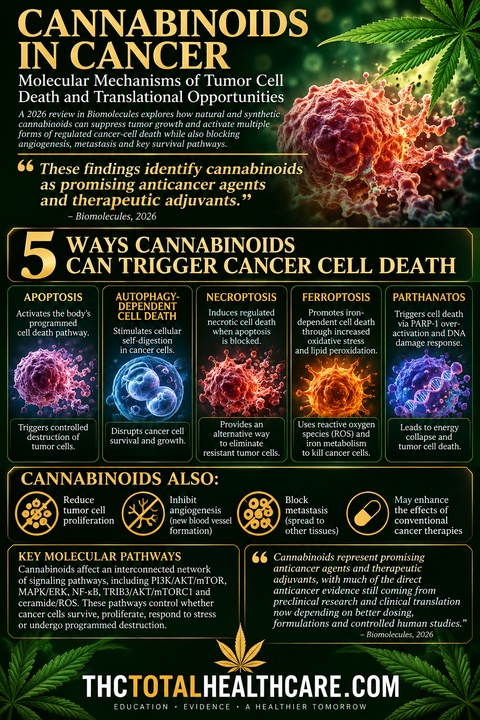
Cannabinoids can attack cancer cells through far more than a single mechanism. This 2026 review describes how natural and synthetic cannabinoids can suppress tumor-cell growth, angiogenesis and metastasis while activating multiple forms of regulated cancer-cell death, including apoptosis, autophagy-dependent cell death, necroptosis, ferroptosis and parthanatos.

The researchers detail an interconnected network of molecular pathways affected by cannabinoids, including PI3K/AKT/mTOR, MAPK/ERK, NF-κB, TRIB3/AKT/mTORC1 and ceramide/ROS signaling. These pathways control whether cancer cells survive, proliferate, respond to stress or undergo programmed destruction, giving cannabinoids multiple potential points of attack against malignant cells.

The review also finds that cannabinoids may enhance conventional anticancer treatments by engaging complementary cell-death pathways. The authors conclude that cannabinoids represent promising anticancer agents and therapeutic adjuvants, with much of the direct anticancer evidence still coming from preclinical research and clinical translation now depending on better dosing, formulations and controlled human studies.

“Cannabinoids are terpenophenolic compounds derived from Cannabis sativa L. that exert a broad range of biological and pharmacological activities. Increasing evidence highlights their potential as modulators of cancer progression specifically through the suppression of tumor cell growth, angiogenesis, and metastasis across multiple tumor models.

This review provides a comprehensive overview of the molecular mechanisms by which natural and synthetic cannabinoids induce regulated cancer cell death.

Current evidence demonstrates that cannabinoids regulate multiple forms of cancer cell death, including apoptosis, autophagy-dependent cell death, necroptosis, ferroptosis, and parthanatos. These effects are mediated through complex and interconnected signaling pathways such as TRIB3/AKT/mTORC1, PI3K/AKT/mTOR, MAPK/ERK, NF-κB, ERK/JNK/p38-MAPK, and ceramide/Raf1/ERK/ROS.

In addition to their direct antitumor effects, cannabinoids can enhance the efficacy of conventional anticancer therapies through the coordinated regulation of complementary cell death pathways. They also provide clinically relevant supportive benefits in palliative care, alleviating chemotherapy-induced nausea, cachexia, and mood or sleep disturbances.

Collectively, these findings identify cannabinoids as promising anticancer agents and therapeutic adjuvants, predominantly in the preclinical setting. However, significant challenges remain regarding their safety, optimal dosing, formulation, and clinical efficacy. Further mechanistic studies, rigorous preclinical research, and well-designed clinical trials are required to establish the translation of cannabinoid-based therapies into precision oncology.”

https://pubmed.ncbi.nlm.nih.gov/42793092

“The cannabis plant, a member of the Cannabaceae family, has been traditionally utilized for centuries for spiritual and remedial healing.”

“The anticancer activity of cannabinoids was discovered in 1975 by Munson et al.. Cannabinoids suppress cancer cell proliferation, angiogenesis, tumor invasion, metastasis, and stemness while inducing different modes of cell death pathways.”

“In summary, this review highlights the growing body of evidence supporting the ability of cannabinoids to induce multiple forms of cell death across a broad spectrum of cancer types. Through the modulation of diverse molecular and signaling pathways, cannabinoids have emerged as promising anticancer agents, mostly in preclinical models, with the potential to target tumor growth, survival, and progression, ultimately triggering diverse cell death mechanisms.”
https://www.mdpi.com/2218-273X/16/9/1260

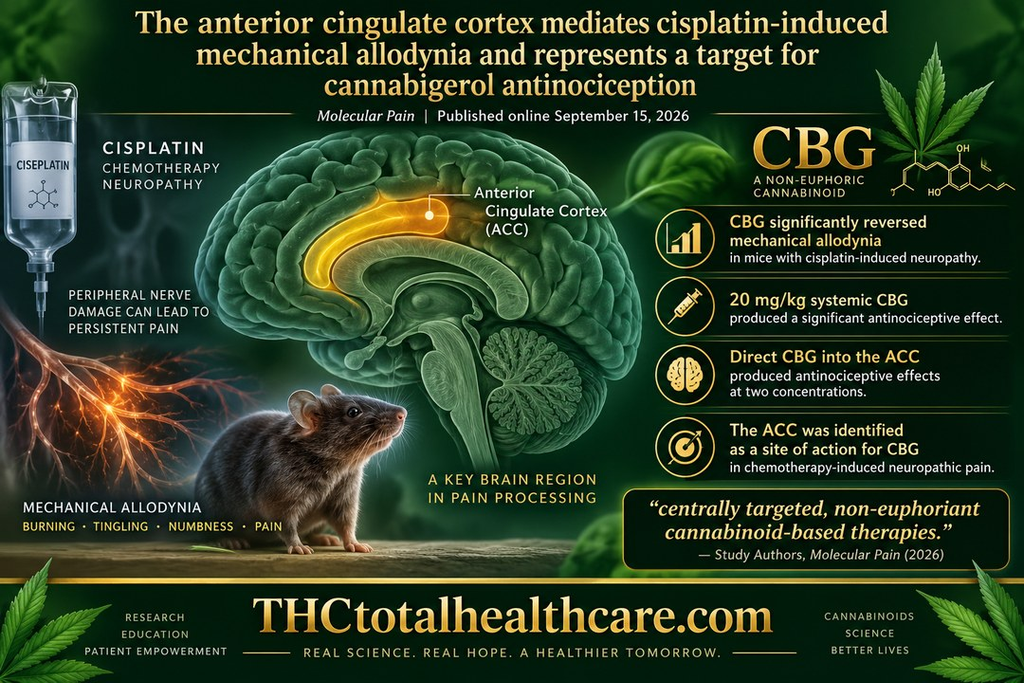
The anterior cingulate cortex mediates cisplatin-induced mechanical allodynia and represents a target for cannabigerol antinociception

Chemotherapy-induced peripheral neuropathy can cause persistent burning, tingling, numbness and pain long after cancer treatment ends. A new 2026 study investigated how the brain contributes to this neuropathic pain and whether cannabigerol (CBG), a non-euphoric cannabinoid, can reduce it.

Using a mouse model of cisplatin-induced neuropathy, researchers found that CBG significantly reversed mechanical allodynia. They also identified the anterior cingulate cortex, a brain region involved in processing pain, as an important part of the neuropathic pain response. Directly administering CBG into this region produced antinociceptive effects.

The findings suggest that CBG can act within central pain-processing circuits and identify the anterior cingulate cortex as a potential target for cannabinoid-based treatment of chemotherapy-induced neuropathic pain. The researchers say the results highlight the potential for “centrally targeted, non-euphoriant cannabinoid-based therapies.”

“Chemotherapy-induced peripheral neuropathy (CIPN) is a prevalent and debilitating consequence of cancer treatment with limited effective therapeutic options. While peripheral nerve injury is a key driver, emerging evidence suggests that maladaptive plasticity within central pain circuits, including the anterior cingulate cortex (ACC), contributes to the maintenance of neuropathic pain.

Here, we tested the hypothesis that the ACC is a critical substrate for cisplatin-induced mechanical allodynia and a target for cannabigerol (CBG)-mediated antinociception.

Adult male C57BL/6 mice received cisplatin (5 mg/kg, i.p., once weekly for four weeks) to induce CIPN. Mechanical allodynia was assessed using electronic von Frey testing.

Systemic administration of CBG (20 mg/kg, i.p.) significantly reversed mechanical allodynia in CIPN mice without affecting baseline thresholds in non-neuropathic animals, indicating a state-dependent effect. Chemogenetic inhibition of ACC neurons using hM4Di DREADDs similarly attenuated mechanical allodynia, identifying the ACC as a functionally relevant component of the CIPN pain state. To determine whether CBG acts within this circuit, bilateral intra-ACC microinjections of CBG (20 nM and 20 µM) were performed, both of which produced transient antinociceptive effects.

These findings demonstrate that the ACC contributes to the maintenance of mechanical allodynia in CIPN and establish this region as a site of action for CBG.

Together, our results support a model in which the ACC represents a convergent cortical mechanism underlying pathological pain and highlight the potential for centrally targeted, non-euphoriant cannabinoid-based therapies.”

https://pubmed.ncbi.nlm.nih.gov/42744343/

“In conclusion, this study identifies the ACC as a hub in the maintenance of mechanical allodynia in a model of CIPN. By demonstrating that chemogenetic inhibition of the ACC reverses hypersensitivity and that both systemic and local administration of CBG produce antinociceptive effects, our findings link circuit-level dysfunction to a pharmacologically targetable mechanism within this region. These results support a model in which increased or dysregulated ACC neuronal activity may represent a convergent feature of pathological pain states. Importantly, these findings demonstrate that CBG can act within the ACC to modulate mechanical allodynia. Future studies identifying the receptor targets and circuit mechanisms through which CBG acts within the ACC will be essential for refining therapeutic strategies for chronic pain.”

https://journals.sagepub.com/doi/10.1177/17448069261491110

Medical Cannabis and the Hallmarks of Cancer: A Critical Narrative Review

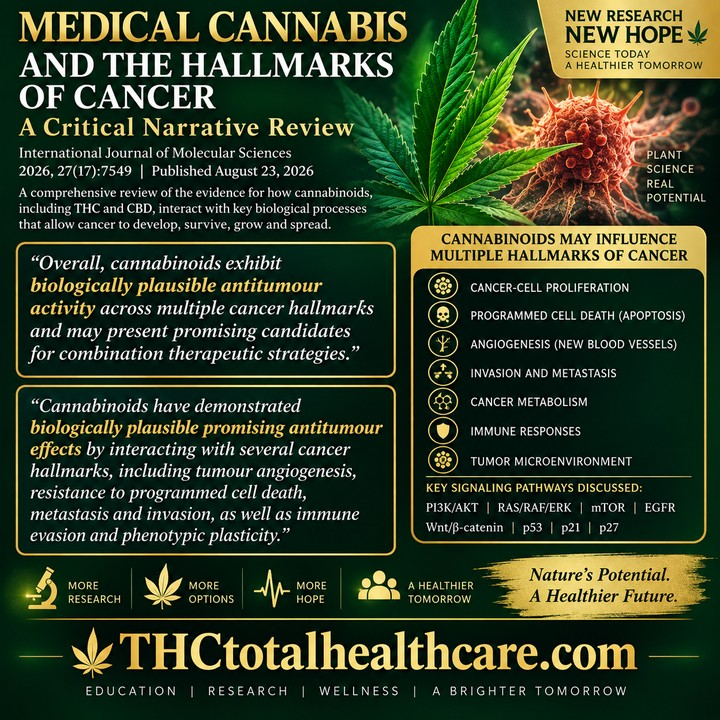
A 2026 critical narrative review examines medical cannabis through one of the most important frameworks in cancer biology: the hallmarks of cancer. Rather than looking only at symptom relief, the authors reviewed evidence for how cannabinoids, including THC and CBD, may interact with biological processes that allow cancer to develop, survive, grow and spread.

The review discusses cannabinoid effects involving cancer-cell proliferation, programmed cell death, angiogenesis, invasion, metastasis, tumor metabolism, immune responses and the tumor microenvironment. It also examines major cancer-related signaling pathways, including PI3K/AKT, RAS/RAF/ERK, mTOR, EGFR, Wnt/β-catenin and p53.

Taken together, the research shows that cannabinoids can influence multiple hallmarks of cancer through several interconnected mechanisms. The authors describe the evidence as showing biologically plausible antitumor activity and highlight cannabinoids as an important area for continued cancer research and development.

“Cancer remains a highly complex and heterogeneous disease, causing major morbidity and mortality worldwide despite advances in diagnosis and treatment. The hallmarks of cancer enlighten the biological mechanisms supporting tumourigenesis and malignant evolution, while helping to identify potential therapeutic targets.

Medical cannabis has mostly been used in oncology for supportive care, but increasing preclinical evidence suggests interference with cancer-related signalling pathways.

This narrative review summarizes the current evidence on cannabinoids, in particular the phytocannabinoids cannabidiol (CBD) and Δ9-tetrahydrocannabinol (THC), framing their prospective anticancer effects in the hallmarks of cancer.

Preclinical studies imply that CBD exerts antiproliferative effects by modulating oncogenic signalling pathways, including EGFR, PI3K/AKT, RAS/RAF/ERK, mTOR and Wnt/β-catenin, while also influencing tumour suppressor pathways involving p53, p21 and p27, causing cell cycle arrest. CBD has additionally been shown to promote programmed cell death via mitochondrial dysfunction and autophagy, altering cancer metabolism as well. Furthermore, CBD has shown anti-invasive and antiangiogenic properties and also appears to modulate immune responses and interactions with the tumour microenvironment, including emerging links with the microbiome.

Overall, cannabinoids exhibit biologically plausible antitumour activity across multiple cancer hallmarks and may present promising candidates for combination therapeutic strategies.

Nonetheless, the current evidence remains predominantly preclinical, and robust translational studies and clinical trials are needed to clarify their pharmacokinetic and pharmacodynamic profiles, determine their clinical efficacy and safety while assessing their potential integration into multimodal cancer treatment.”

https://pubmed.ncbi.nlm.nih.gov/42737454/

“Cannabinoids have demonstrated biologically plausible promising antitumour effects by interacting with several cancer hallmarks, including tumour angiogenesis, resistance to programmed cell death, metastasis and invasion, as well as immune evasion and phenotypic plasticity.”

“Cannabinoids can interfere with several biological mechanisms involved in cancer development and progression and even though their role in oncology remains mostly supportive with predominance in symptom control, preclinical studies increasingly suggest that cannabis can also influence tumour biology.”

https://www.mdpi.com/1422-0067/27/17/7549

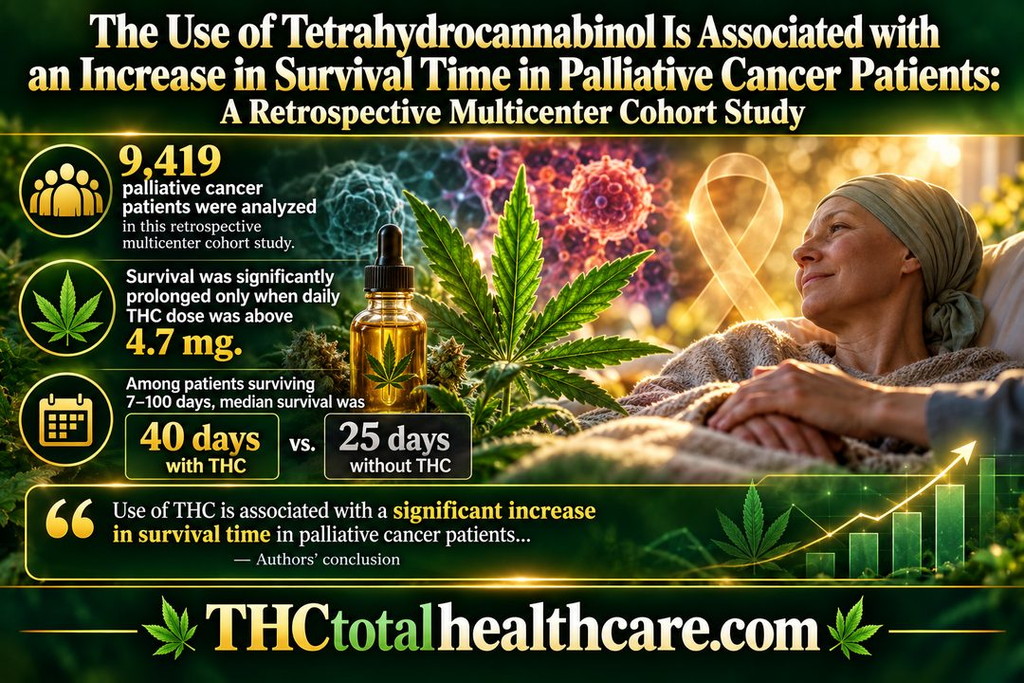
The Use of Tetrahydrocannabinol Is Associated with an Increase in Survival Time in Palliative Cancer Patients: A Retrospective Multicenter Cohort Study

A large retrospective multicenter study of 9,419 palliative cancer patients found that THC use was associated with longer survival. The researchers reported the strongest association among patients receiving more than 4.7 mg of THC per day.

In patients who survived between 7 and 100 days, median survival was 40 days in the THC group compared with 25 days in patients who did not receive THC. The study also examined THC alongside palliative-care treatment rather than as a replacement for standard care.

These findings add an important human-data signal to the growing research on cannabinoids in cancer care. While the study was observational, the association between THC use and longer survival makes this a significant finding for palliative oncology and cannabinoid research.

“Introduction: Tetrahydrocannabinol (THC) is often prescribed for ambulatory palliative patients to improve sleep quality and appetite and to reduce anxiety, stress, and pain. However, it is not known if THC has also an effect on the mortality of these patients.

Method: The objective was the impact of THC on mortality of ambulatory palliative patients. For this purpose, data from the palliative treatment documentation from 5 ambulatory palliative care teams in Brandenburg, Germany were used for this analysis. Survival time was calculated for 3 groups of patients: (1) without THC; (2) with THC in a low dosage (≤4.7 mg per day); and (3) THC in higher doses (≥4.7 mg per day). The analysis was done for 2 cohorts of patients. Cohort 1: all patients with a survival time of at least 7 days after inclusion in specialized ambulatory palliative care (SAPC) and cohort 2: a subgroup of patients with a survival time between 7 and 100 days. Kaplan-Meier curves were created, and multivariate analysis was done to investigate the impact of THC on mortality.

Results: A total of 9,419 patients with a survival time of at least 7 days after inclusion in SAPC were included in the analysis (cohort 1). 7,085 among them had a survival time between 7 and 100 days (cohort 2). In both cohorts, survival time was significantly prolonged by THC, but only when the daily THC dose was above the median of 4.7 mg. Survival time was 15 days longer in cohort 2 (40 vs. 25 days), when more than 4.7 mg THC were prescribed per day.

Conclusion: Use of THC is associated with a significant increase in survival time in ambulatory palliative patients which survive longer than 7 days the initiation of THC prescription and which use of THC >4.7 mg/day.”

https://pubmed.ncbi.nlm.nih.gov/38655402/

“Thus, in view of its significant prolongation of patient survival time, THC therapy should be included as part of the first-line therapy for ambulatory palliative patients.”

https://karger.com/mca/article/7/1/59/896816/The-Use-of-Tetrahydrocannabinol-Is-Associated-with

Need this THC study explained? thcXplained.com

Anandamide, Acting via CB2 Receptors, Alleviates LPS-Induced Neuroinflammation in Rat Primary Microglial Cultures.

“Microglial activation is a polarized process divided into potentially neuroprotective phenotype M2 and neurotoxic phenotype M1, predominant during chronic neuroinflammation.

Endocannabinoid system provides an attractive target to control the balance between microglial phenotypes.

Anandamide as an immune modulator in the central nervous system acts via not only cannabinoid receptors (CB1 and CB2) but also other targets (e.g., GPR18/GPR55).

In summary, we showed that the endocannabinoid system plays a crucial role in the management of neuroinflammation by dampening the activation of an M1 phenotype. This effect was primarily controlled by the CB2 receptor, although functional cross talk with GPR18/GPR55 may occur.”

http://www.ncbi.nlm.nih.gov/pubmed/26090232

Marijuana kills brain cancer, new study confirms

“The active molecules in cannabis kill brain cancer — another study has revealed.”

“Scientists using an extract of whole-plant marijuana rich in pot’s main psychoactive ingredient THC as well as cannabidiol (CBD) showed “dramatic reductions in tumor volumes” of a type of brain cancer.”  http://blog.sfgate.com/smellthetruth/2014/11/18/marijuana-kills-brain-cancer-new-study-confirms/

“Marijuana kills brain cancer, new study confirms. The active molecules in cannabis kill brain cancer — another study has revealed.” http://blog.seattlepi.com/marijuana/2014/11/18/marijuana-kills-brain-cancer-new-study-confirms/#13130101=0

“Marijuana Kills Brain Cancer Cells. Researchers have found that the THC in marijuana causes brain cancer cells to die in both mice and humans.”  http://www.nbcphiladelphia.com/news/health/Marijuana_Kills_Brain_Cancer_Cells_All__National_.html

“Marijuana Kills Brain Cancer, New Study Confirms” http://cancerguide.byethost8.com/marijuana-kills-brain-cancer-new-study-confirms-sfgate-blog/

http://www.thctotalhealthcare.com/category/brain-cancer/

Cannabis has been shown to kill cancer cells


“The use of Cannabis for medicinal purposes dates back to ancient times.” http://www.cancer.gov/cancertopics/pdq/cam/cannabis/patient/page1

“Cannabis has been used for medicinal purposes for thousands of years.” http://www.cancer.gov/cancertopics/pdq/cam/cannabis/healthprofessional/page1

“The use of Cannabis for medicinal purposes dates back at least 3,000 years. It came into use in Western medicine in the 19th century and was said to relieve pain, inflammation, spasms, and convulsions.” http://www.cancer.gov/cancertopics/pdq/cam/cannabis/patient/page2

“Cannabis has been shown to kill cancer cells in the laboratory”  http://www.cancer.gov/cancertopics/pdq/cam/cannabis/patient/page1

“…cannabinoids may be able to kill cancer cells while protecting normal cells…

A laboratory study of delta-9-THC… showed that it damaged or killed the cancer cells…

A laboratory study of cannabidiol… showed that it caused cancer cell death…” http://www.cancer.gov/cancertopics/pdq/cam/cannabis/patient/page2

“Cannabinoids appear to kill tumor cells but do not effect their nontransformed counterparts and may even protect them from cell death.” http://www.cancer.gov/cancertopics/pdq/cam/cannabis/healthprofessional/page4

“Because cannabinoid receptors, unlike opioid receptors, are not located in the brainstem areas controlling respiration, lethal overdoses from Cannabis and cannabinoids do not occur.” http://www.cancer.gov/cancertopics/pdq/cam/cannabis/healthprofessional/page6

http://www.thctotalhealthcare.com/category/cancer/

Medical marijuana for cancer.

“Marijuana has been used for centuries, and interest in its medicinal properties has been increasing in recent years. Investigations into these medicinal properties has led to the development of cannabinoid pharmaceuticals such as dronabinol, nabilone, and nabiximols.

Dronabinol is best studied in the treatment of nausea secondary to cancer chemotherapy and anorexia associated with weight loss in patients with acquired immune deficiency syndrome, and is approved by the US Food and Drug Administration for those indications.

Nabilone has been best studied for the treatment of nausea secondary to cancer chemotherapy. There are also limited studies of these drugs for other conditions.

Nabiximols is only available in the United States through clinical trials, but is used in Canada and the United Kingdom for the treatment of spasticity secondary to multiple sclerosis and pain.

Studies of marijuana have concentrated on nausea, appetite, and pain.

This article will review the literature regarding the medical use of marijuana and these cannabinoid pharmaceuticals (with emphasis on indications relevant to oncology)”

http://www.ncbi.nlm.nih.gov/pubmed/25503438

“Both cannabis and cannabinoid pharmaceuticals can be helpful for a number of problems, including many affecting patients with cancer… given the limitations inherent in using oral medications to treat nausea and vomiting, inhalation of marijuana or a cannabinoid may be better than oral ingestion in treating this condition.” http://onlinelibrary.wiley.com/doi/10.3322/caac.21260/full

http://www.thctotalhealthcare.com/category/cancer/

Study: Marijuana Appears to Slow Cancer Growth in Laboratory Setting -FOXNEWS

“Certain marijuana components may suppress the tumors of highly invasive cancers, a new study finds.

In laboratory tests, cannabinoids, the active components in marijuana, were found to slow the spread of lung and cervical cancer tumors, according to researchers Robert Ramer and Burkhard Hinz of the University of Rostock in Germany.

Proponents of medical marijuana believe that cannabinoids reduce the side effects of cancer treatment, such as pain, weight loss and vomiting.

The study, published in the Jan. 2 issue of the Journal of the National Cancer Institute, finds that the compounds may also have an anticancer effect;

Click here for the study.

In addition to suppressing tumor cell invasion, cannabinoids also stimulated the expression of TIMP-1, an inhibitor of a group of enzymes involved in tumor cell invasion.

“To our knowledge, this is the first report of TIMP-1-dependent anti-invasive effects of cannabinoids,” the authors wrote. “This signaling pathway may play an important role in the antimetastatic action of cannabinoids, whose potential therapeutic benefit in the treatment of highly invasive cancers should be addressed in clinical trials.””

https://www.foxnews.com/story/study-marijuana-appears-to-slow-cancer-growth-in-laboratory-setting

“Inhibition of Cancer Cell Invasion by Cannabinoids via Increased Expression of Tissue Inhibitor of Matrix Metalloproteinases-1. Cannabinoids may therefore offer a therapeutic option in the treatment of highly invasive cancers.” https://academic.oup.com/jnci/article/100/1/59/2567700

Marijuana as a possible treatment for HIV and cancer

Marijuana

“There’s been some interesting research on using THC (tetrahydrocannabinol), the principal psychoactive drug in marijuana, to help fight HIV, and damage cancer cells in some leukemias and possibly malignant tumors.

…the possibility exists that information from both of these research studies may produce beneficial results in the treatment of HIV and cancer.”

More: http://americablog.com/2014/02/marijuana-treatment-hiv-cancer.html