
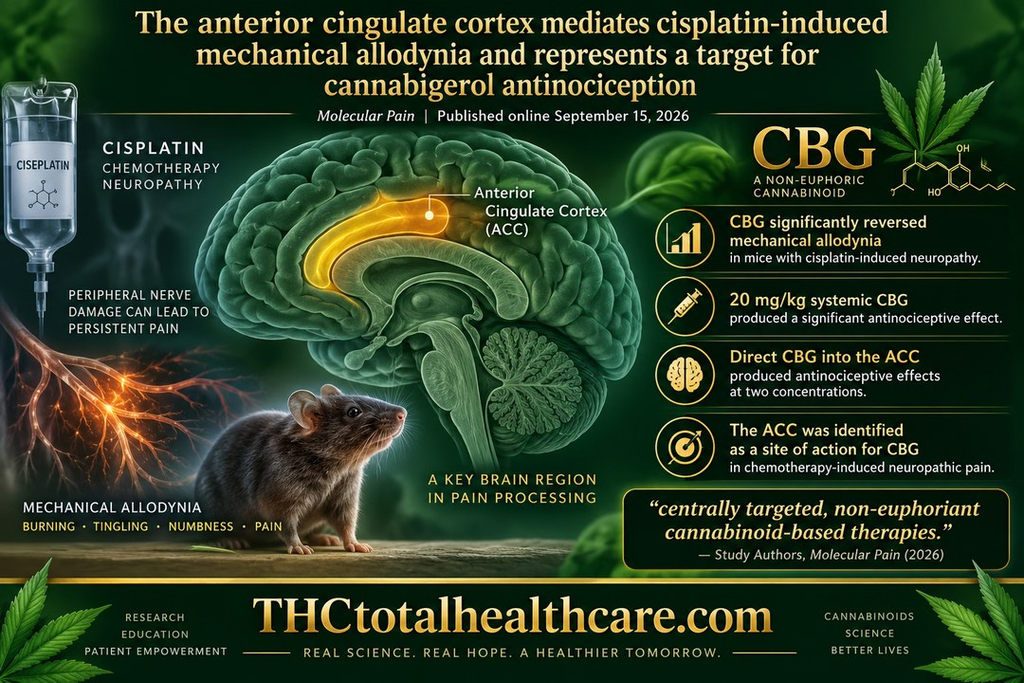
Chemotherapy-induced peripheral neuropathy can cause persistent burning, tingling, numbness and pain long after cancer treatment ends. A new 2026 study investigated how the brain contributes to this neuropathic pain and whether cannabigerol (CBG), a non-euphoric cannabinoid, can reduce it.
Using a mouse model of cisplatin-induced neuropathy, researchers found that CBG significantly reversed mechanical allodynia. They also identified the anterior cingulate cortex, a brain region involved in processing pain, as an important part of the neuropathic pain response. Directly administering CBG into this region produced antinociceptive effects.
The findings suggest that CBG can act within central pain-processing circuits and identify the anterior cingulate cortex as a potential target for cannabinoid-based treatment of chemotherapy-induced neuropathic pain. The researchers say the results highlight the potential for “centrally targeted, non-euphoriant cannabinoid-based therapies.”
“Chemotherapy-induced peripheral neuropathy (CIPN) is a prevalent and debilitating consequence of cancer treatment with limited effective therapeutic options. While peripheral nerve injury is a key driver, emerging evidence suggests that maladaptive plasticity within central pain circuits, including the anterior cingulate cortex (ACC), contributes to the maintenance of neuropathic pain.
Here, we tested the hypothesis that the ACC is a critical substrate for cisplatin-induced mechanical allodynia and a target for cannabigerol (CBG)-mediated antinociception.
Adult male C57BL/6 mice received cisplatin (5 mg/kg, i.p., once weekly for four weeks) to induce CIPN. Mechanical allodynia was assessed using electronic von Frey testing.
Systemic administration of CBG (20 mg/kg, i.p.) significantly reversed mechanical allodynia in CIPN mice without affecting baseline thresholds in non-neuropathic animals, indicating a state-dependent effect. Chemogenetic inhibition of ACC neurons using hM4Di DREADDs similarly attenuated mechanical allodynia, identifying the ACC as a functionally relevant component of the CIPN pain state. To determine whether CBG acts within this circuit, bilateral intra-ACC microinjections of CBG (20 nM and 20 µM) were performed, both of which produced transient antinociceptive effects.
These findings demonstrate that the ACC contributes to the maintenance of mechanical allodynia in CIPN and establish this region as a site of action for CBG.
Together, our results support a model in which the ACC represents a convergent cortical mechanism underlying pathological pain and highlight the potential for centrally targeted, non-euphoriant cannabinoid-based therapies.”
https://pubmed.ncbi.nlm.nih.gov/42744343/
“In conclusion, this study identifies the ACC as a hub in the maintenance of mechanical allodynia in a model of CIPN. By demonstrating that chemogenetic inhibition of the ACC reverses hypersensitivity and that both systemic and local administration of CBG produce antinociceptive effects, our findings link circuit-level dysfunction to a pharmacologically targetable mechanism within this region. These results support a model in which increased or dysregulated ACC neuronal activity may represent a convergent feature of pathological pain states. Importantly, these findings demonstrate that CBG can act within the ACC to modulate mechanical allodynia. Future studies identifying the receptor targets and circuit mechanisms through which CBG acts within the ACC will be essential for refining therapeutic strategies for chronic pain.”