
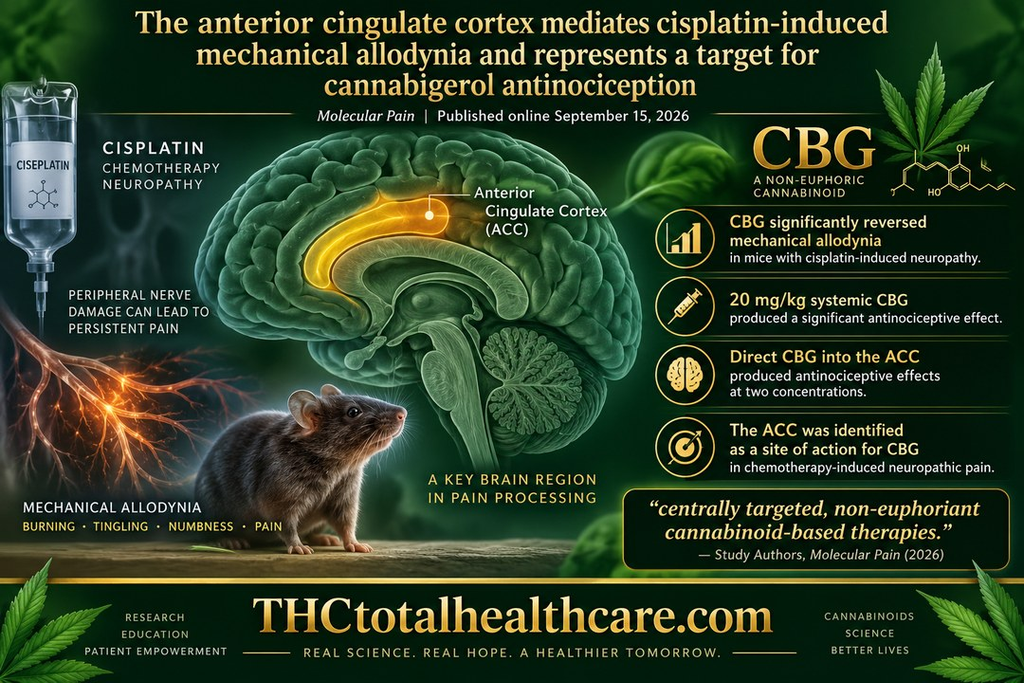
The anterior cingulate cortex mediates cisplatin-induced mechanical allodynia and represents a target for cannabigerol antinociception

Chemotherapy-induced peripheral neuropathy can cause persistent burning, tingling, numbness and pain long after cancer treatment ends. A new 2026 study investigated how the brain contributes to this neuropathic pain and whether cannabigerol (CBG), a non-euphoric cannabinoid, can reduce it.

Using a mouse model of cisplatin-induced neuropathy, researchers found that CBG significantly reversed mechanical allodynia. They also identified the anterior cingulate cortex, a brain region involved in processing pain, as an important part of the neuropathic pain response. Directly administering CBG into this region produced antinociceptive effects.

The findings suggest that CBG can act within central pain-processing circuits and identify the anterior cingulate cortex as a potential target for cannabinoid-based treatment of chemotherapy-induced neuropathic pain. The researchers say the results highlight the potential for “centrally targeted, non-euphoriant cannabinoid-based therapies.”

“Chemotherapy-induced peripheral neuropathy (CIPN) is a prevalent and debilitating consequence of cancer treatment with limited effective therapeutic options. While peripheral nerve injury is a key driver, emerging evidence suggests that maladaptive plasticity within central pain circuits, including the anterior cingulate cortex (ACC), contributes to the maintenance of neuropathic pain.

Here, we tested the hypothesis that the ACC is a critical substrate for cisplatin-induced mechanical allodynia and a target for cannabigerol (CBG)-mediated antinociception.

Adult male C57BL/6 mice received cisplatin (5 mg/kg, i.p., once weekly for four weeks) to induce CIPN. Mechanical allodynia was assessed using electronic von Frey testing.

Systemic administration of CBG (20 mg/kg, i.p.) significantly reversed mechanical allodynia in CIPN mice without affecting baseline thresholds in non-neuropathic animals, indicating a state-dependent effect. Chemogenetic inhibition of ACC neurons using hM4Di DREADDs similarly attenuated mechanical allodynia, identifying the ACC as a functionally relevant component of the CIPN pain state. To determine whether CBG acts within this circuit, bilateral intra-ACC microinjections of CBG (20 nM and 20 µM) were performed, both of which produced transient antinociceptive effects.

These findings demonstrate that the ACC contributes to the maintenance of mechanical allodynia in CIPN and establish this region as a site of action for CBG.

Together, our results support a model in which the ACC represents a convergent cortical mechanism underlying pathological pain and highlight the potential for centrally targeted, non-euphoriant cannabinoid-based therapies.”

https://pubmed.ncbi.nlm.nih.gov/42744343/

“In conclusion, this study identifies the ACC as a hub in the maintenance of mechanical allodynia in a model of CIPN. By demonstrating that chemogenetic inhibition of the ACC reverses hypersensitivity and that both systemic and local administration of CBG produce antinociceptive effects, our findings link circuit-level dysfunction to a pharmacologically targetable mechanism within this region. These results support a model in which increased or dysregulated ACC neuronal activity may represent a convergent feature of pathological pain states. Importantly, these findings demonstrate that CBG can act within the ACC to modulate mechanical allodynia. Future studies identifying the receptor targets and circuit mechanisms through which CBG acts within the ACC will be essential for refining therapeutic strategies for chronic pain.”

https://journals.sagepub.com/doi/10.1177/17448069261491110

Cannabinoid system as a potential target for drug development in the treatment of cardiovascular disease.

“Although cannabinoids have been recreationally employed for thousands of years, it was not until the discovery of their specific receptors, in the early nineties, that the molecular basis of cannabinoid activity have began to be understood.

Growing research in this field has demonstrated not only that the action of cannabinoids in mammals is mainly receptor-mediated, but also that endogenous cannabinoids, such as anandamide, are produced, metabolized, and taken up across the cell membrane through a facilitated uptake process.

The exogenous administration of cannabinoids, as well as the manipulation of their endogenous levels have been related to a variety of effects, such as analgesia, (temporary) impairment of cognition and learning, appetite enhancement and peripheral vasodilation.

Hence, the endocannabinoid system, including the CB1 and CB2 receptors, the metabolizing enzyme fatty acid amide hydrolase and the anandamide transporter, is a potential target for the development of novel therapeutic drugs in the treatment of various conditions, such as pain, feeding disorders and vascular disease among others.

Although most of the research in the field of cannabinoids has been focused on their effects in the central nervous system, a growing line of evidence indicates that cannabinoids can also play a major role in the control of physiopathological functions in the cardiovascular system.

In this context, endocannabinoids have been proposed as novel possible hypotensive agents, and have been involved in the hypotension observed in septic shock, acute myocardial infarction and cirrhosis. In addition, a protective role for endocannabinoids has been described in ischemia.”

http://www.ncbi.nlm.nih.gov/pubmed/15320476

The cannabinoid CB₂ receptor-selective phytocannabinoid beta-caryophyllene exerts analgesic effects in mouse models of inflammatory and neuropathic pain.

European Neuropsychopharmacology Home

“The widespread plant volatile beta-caryophyllene (BCP) was recently identified as a natural selective agonist of the peripherally expressedcannabinoid receptor 2 (CB₂).

…the natural plant product BCP may be highly effective in the treatment of long lasting, debilitating pain states. Our results have important implications for the role of dietary factors in the development and modulation of chronic pain conditions.

Cannabis preparations, which have been used since thousands of years for the treatment of pain have recently come again into the focus as potential therapeutics for inflammatory and neuropathic pain conditions. Currently, cannabis extracts and synthetic preparations of the psychoactive cannabis compound Δ9-tetrahydrocannabinol (THC) have been approved in many countries for clinical pain management at doses and formulations that show on only minor central side effects…

A natural selective agonist for CB2 receptors is the plant volatile BCP, which represents a dietary phytocannabinoid. BCP is found in large amounts in the essential oils of many common spices and food plants… Several health effects have been attributed to BCP or medicinal plants containing BCP, including anti-inflammatory, local anesthetic, anti-carcinogenic, anti-fibrotic and anxiolytic-like activity.

In the present study, we investigated the analgesic effects of BCP in formalin-induced inflammation model and in a model of neuropathic pain, which involves the partial ligation of the sciatic nerve… BCP is the first natural CB2 receptor agonist, which could orally reduce inflammatory responses in different animal models of pain.

Thus, it is likely that BCP belongs to a group of common plant natural products with major potential impact on human health.

The oral intake of this dietary cannabinoid with vegetable food could be advantageous in the daily routine clinical practice over synthetic cannabinoid agonists.”

http://www.europeanneuropsychopharmacology.com/article/S0924-977X(13)00302-7/fulltext

http://www.thctotalhealthcare.com/category/neuropathic-pain/

Therapeutic potential of cannabis in pain medicine†

BJA

“Cannabis has been of medicinal and social significance for millennia.

It is obtained from Cannabis sativa and the plant’s name reflects its ancient use—cannabis may represent a compound of Sanskrit and Hebrew words meaning ‘fragrant cane’, while sativa is Latin for cultivated.

Cannabis is also known as hemp.

Marijuana describes the dried cannabis flowers and leaves which are smoked, while hashish refers to blocks of cannabis resin which can be eaten.

Advances in cannabis research have paralleled developments in opioid pharmacology whereby a psychoactive plant extract has elucidated novel endogenous signalling systems with therapeutic significance.

Cannabinoids (CBs) are chemical compounds derived from cannabis.

This review discusses the basic science and clinical aspects of CB pharmacology with a focus on pain medicine.

Advances in cannabis research have ensured a future for these analgesic molecules which have been used since antiquity.”

http://bja.oxfordjournals.org/content/101/1/59.long

http://www.thctotalhealthcare.com/category/pain-2/

Activation of Cannabinoid CB2 receptors Reduces Hyperalgesia in an Experimental Autoimmune Encephalomyelitis Mouse Model of Multiple Sclerosis.

“Clinical trials investigating the analgesic efficacy of cannabinoids in multiple sclerosis have yielded mixed results, possibly due to psychotropic side effects mediated by cannabinoid CB1 receptors. We hypothesized that a CB2-specific agonist (JWH-133) would decrease hyperalgesia in an experimental autoimmune encephalomyelitis mouse model of multiple sclerosis…

Our results suggest that JWH-133 acts at CB2 receptors, most likely within the dorsal horn of the spinal cord, to suppress the hypersensitivity associated with experimental autoimmune encephalomyelitis.

These are the first pre-clinical studies to directly promote CB2 as a promising target for the treatment of central pain in an animal model of multiple sclerosis.”

http://www.ncbi.nlm.nih.gov/pubmed/25849525

Re-branding cannabis: the next generation of chronic pain medicine?

“The field of pain medicine is at a crossroads given the epidemic of addiction and overdose deaths from prescription opioids. Cannabis and its active ingredients, cannabinoids, are a much safer therapeutic option.

Despite being slowed by legal restrictions and stigma, research continues to show that when used appropriately, cannabis is safe and effective for many forms of chronic pain and other conditions, and has no overdose levels.

Current literature indicates many chronic pain patients could be treated with cannabis alone or with lower doses of opioids.

To make progress, cannabis needs to be re-branded as a legitimate medicine and rescheduled to a more pharmacologically justifiable class of compounds.

This paper discusses the data supporting re-branding and rescheduling of cannabis.”

http://www.ncbi.nlm.nih.gov/pubmed/25537695

http://www.thctotalhealthcare.com/category/chronic-pain/

Cannabinoids in the treatment of pain

“Cannabinoids and the endo-cannabinoid system play an important role in the sensation of pain. As conventional analgesics are often associated with serious side-effects, cannabinoids and agonists of their receptors offer a useful alternative or coanalgesic in the treatment of pain. The aim of this work is to summarize the role of cannabinoids and their receptors in nociception and pain treatment.” http://www.ncbi.nlm.nih.gov/pmc/articles/PMC2991928/

“Cannabinoids seem to be effective against neuropathic pain, inflammatory pain, post-operative pain and cancer pain. Their use as analgesics or coanalgesics may offer a useful alterative option for pain management in clinical practice.” http://www.annals-general-psychiatry.com/content/9/S1/S232/abstract

http://www.thctotalhealthcare.com/category/pain-2/

Cannibinoids offer novel treatment for pain in sickle cell disease, study suggests

ScienceDaily: Your source for the latest research news

“Researchers have discovered that cannibinoids offer a novel approach to ease the chronic and acute pain caused by sickle cell disease.

“This paper provides proof that we can use other classifications of drugs to treat pain in patients with sickle cell disease,” Gupta said.

“Cannibinoids offer great promise in the treatment of chronic and acute pain, and they’re effective in much lower amounts than opioids — the only currently approved treatment for this disease.”

http://www.sciencedaily.com/releases/2010/07/100722121225.htm

“Pain-related behaviors and neurochemical alterations in mice expressing sickle hemoglobin: modulation by cannabinoids… Our observations in these mice suggest that both systemically administered and locally applied cannabinoids may be beneficial in treating pain in SCD.” http://www.ncbi.nlm.nih.gov/pmc/articles/PMC2913454/

Medical Marijuana Could Help Treat Sickle Cell Disease

sickle cell marijuana

“People who suffer from sickle cell disease have to deal with a lot of pain.

Patients with sickle cell disease have crescent shaped blood cells, compared to disc shaped blood cells in people who don’t suffer from sickle cell disease. These cells block blood flow, which causes pain, fatigue, and organ damage. I’ve heard people that suffer from sickle cell disease describe the pain as being like nails poking their entire body.

Doctors usually prescribe opiate based pain killers like morphine for sickle cell disease. Opiate prescriptions have a lot of side effects including respiratory issues, damage to organs, and addiction to name a few. Compare that to medical marijuana, which has far less harmful side effects, especially if consumed in food or vapor form. Patients should have the option to choose medical marijuana if they want to. From Minnesota Daily:

School of Dentistry professor and pain expert Donald Simone, who is also working on the research project, said opiates sometimes have “problematic” side effects, such as respiratory depression. And Gupta said patients sometimes receive incorrect dosages of the drugs because their exact amount of pain is unknown.

Medical marijuana is promising for sickle cell patients because it has a pain-relieving effect without as many severe side effects as morphine, Simone said.

Right now researchers in California are teaming up with researchers at the University of Minnesota to find out how medical marijuana can help those suffering from sickle cell disease. Right now, sickle cell patients can get safe access to medical marijuana if they are in California. However, patients in Minnesota will have to wait until the condition is added to the list of approvable conditions in Minnesota, which could take awhile.”

http://www.theweedblog.com/medical-marijuana-could-help-treat-sickle-cell-disease/

Antinociceptive activity of Delta9-tetrahydrocannabinol non-ionic microemulsions.

“Delta(9)-Tetrahydrocannabinol (Delta(9)-THC), the major psychoactive constituent of Cannabis sativa L., has been widely studied for its potential pharmaceutical application in the treatment of various diseases and disturbs.

The aim of this work was to develop a stable aqueous Delta(9)-THC formulation acceptable for different ways of administration, and to evaluate the therapeutic properties of the new Delta(9)-THC based preparation for pain treatment.

Significant antinociceptive activity has been detected by both intraperitoneal and intragastric administration of the new Delta(9)-THC pharmaceutical preparation.”

http://www.ncbi.nlm.nih.gov/pubmed/20399844