
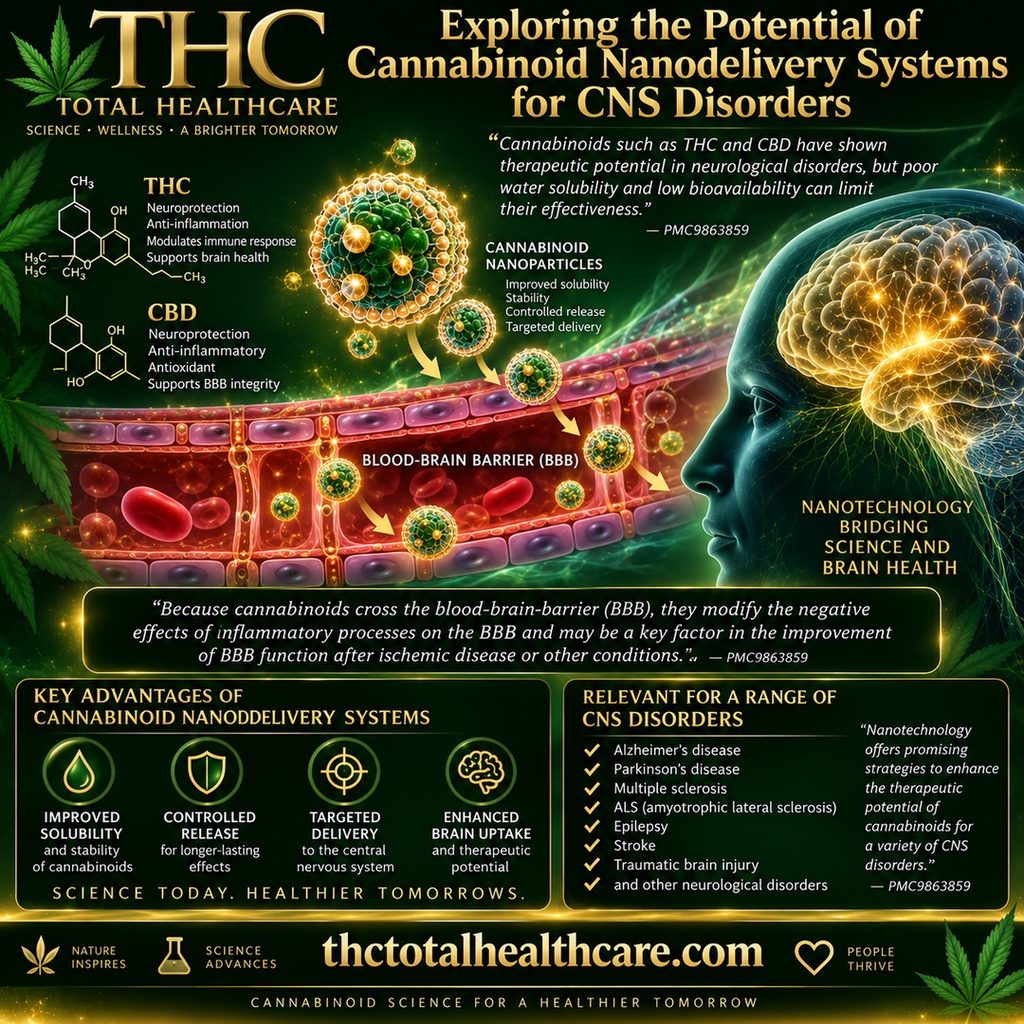
Cannabinoids such as THC and CBD have shown therapeutic potential in neurological disorders, but poor water solubility and low bioavailability can limit their effectiveness. This review explores how nanotechnology may overcome these barriers by improving cannabinoid stability, controlled release and targeted delivery to the central nervous system, including strategies designed to enhance passage across the blood-brain barrier.
“Cannabinoids have a major therapeutic value in a variety of disorders. The concepts of cannabinoids are difficult to develop, but they can be used and are advantageous for a number of diseases that are not sufficiently managed by existing treatments. Nanoconjugation and encapsulation techniques have been shown to be effective in improving the delivery and the therapeutic effectiveness of drugs that are poorly soluble in water. Because the bioavailability of cannabinoids is low, the challenge is to explore different administration methods to improve their effectiveness. Because cannabinoids cross the blood-brain-barrier (BBB), they modify the negative effects of inflammatory processes on the BBB and may be a key factor in the improvement of BBB function after ischemic disease or other conditions. This review discusses various types of cannabinoid administration, as well as nanotechnologies used to improve the bioavailability of these compounds in CNS diseases.”
“The growing acceptance of Cannabis and cannabinoids has led to an increasing number of clinical trials testing various nanoproducts. CNS disorders are key therapeutic targets for cannabinoids, and nanoformulation platforms for cannabinoid nanoconjugates provide efficient transport across the BBB. Selected examples of cannabinoid nanoconjugates have shown enhanced bioavailability and improved bio-efficacy with promising outcomes in biomedical applications. We expect to see many results from clinical trials in the near future to evaluate the adverse effects and effectiveness of this treatment. However, precise delivery of these nanoformulations to pathological sites inside the brain remains a challenge.”
 “Cannabinoids reduce tremor associated with motor disorders induced by injuries and neurodegenerative disease. Here we show that this effect is mediated by cannabinoid receptors on astrocytes in the ventral horn of the spinal cord, where alternating limb movements are initiated. We first demonstrate that tremor is reduced in a mouse model of essential tremor after intrathecal injection of the cannabinoid analog WIN55,212-2. We investigate the underlying mechanism using electrophysiological recordings in spinal cord slices and show that endocannabinoids released from depolarized interneurons activate astrocytic cannabinoid receptors, causing an increase in intracellular Ca2+, subsequent release of purines and inhibition of excitatory neurotransmission. Finally, we show that the anti-tremor action of WIN55,212-2 in the spinal cords of mice is suppressed after knocking out CB1 receptors in astrocytes. Our data suggest that cannabinoids reduce tremor via their action on spinal astrocytes.”
 “The concept of neurons as irreplaceable cells does not hold true today. Experiments and evidence of neurogenesis, also, in the adult brain give hope that some compounds or drugs can enhance this process, helping to reverse the outcomes of diseases or traumas that once were thought to be everlasting.
 “Background:
 “Background: Children with cancer are increasingly using cannabis therapeutically.
 “In response to the need of more rigorous data on medical cannabis and chronic pain, we conducted a 3-month prospective study incorporating ecological momentary assessment (EMA) to examine the effects of medical cannabis on pain, anxiety/depression, sleep, and quality of life.
 “Aging is a complex phenomenon associated with a wide spectrum of physical and physiological changes affecting every part of all metazoans, if they escape death prior to reaching maturity. Critical to survival, the immune system evolved as the principal component of response to injury and defense against pathogen invasions. Because how significantly immune system affects and is affected by aging, several neologisms now appear to encapsulate these reciprocal relationships, such as Immunosenescence. The central part of Immunosenescence is Inflammaging -a sustained, low-grade, sterile inflammation occurring after reaching reproductive prime. Once initiated, the impact of Inflammaging and its adverse effects determine the direction and magnitudes of further Inflammaging. In this article, we review the nature of this vicious cycle, we will propose that phytocannabinoids as immune regulators may possess the potential as effective adjunctive therapies to slow and, in certain cases, reverse the pathologic senescence to permit a more healthy aging.”
 “Purpose:

 “Chronic hepatitis B virus (HBV) infection may evolve into cirrhosis and hepatocellular carcinoma, and this progression may be accelerated by specific risk factors, including overweight and obesity. Although evidence for a protective effect of cannabis use on elevated body weight has been found for other populations, no data are available for HBV-infected patients.