
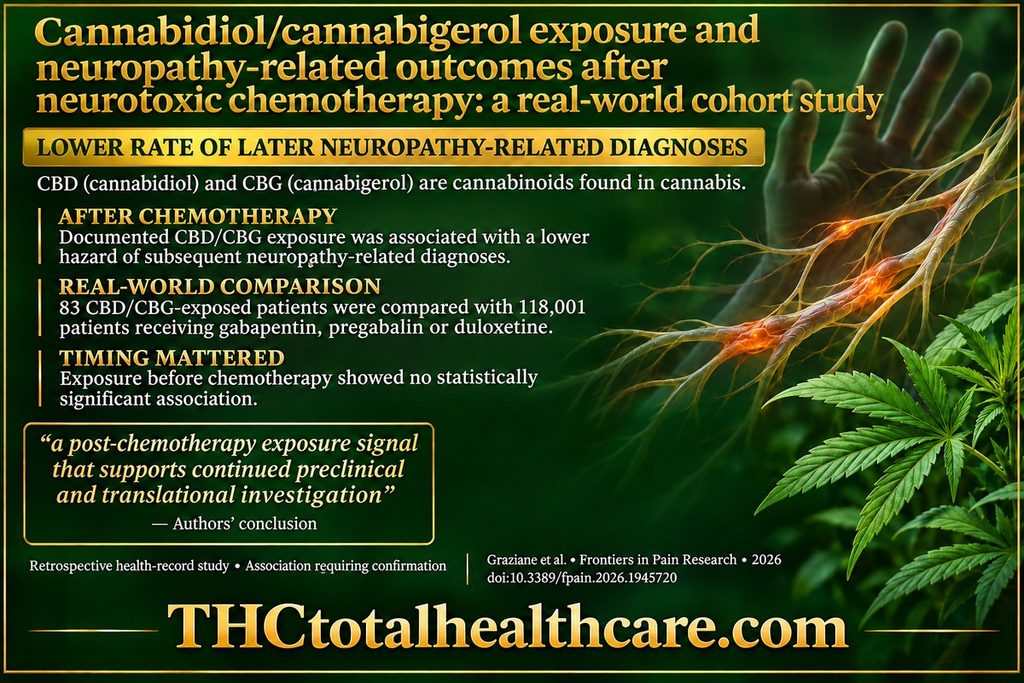
Documented cannabidiol (CBD) or cannabigerol (CBG) exposure after chemotherapy was associated with a lower rate of subsequent neuropathy-related diagnoses in electronic health records. These cannabis cannabinoids are being investigated for chemotherapy-associated nerve problems, which can include numbness, tingling, and pain.
Researchers compared 83 patients with post-chemotherapy CBD/CBG exposure against 118,001 patients receiving gabapentin, pregabalin, or duloxetine. The adjusted analysis found a significantly lower hazard of later neuropathy-related diagnoses in the CBD/CBG group. A separate analysis of exposure before chemotherapy found no significant association. Records did not reliably establish cannabinoid doses, formulations, or continued use.
The findings support further investigation, but measure recorded diagnoses rather than demonstrated symptom relief or nerve recovery. Very few neuropathy events occurred in the cannabinoid group, and more patients in that group died during follow-up, potentially reducing opportunities to record neuropathy. These factors make the result an exploratory signal requiring confirmation.
“Background: Chemotherapy-induced peripheral neuropathy (CIPN) is a common complication of neurotoxic chemotherapy, yet effective pharmacologic options for both prevention and treatment of established painful CIPN remain limited. Non-delta-9-tetrahydrocannabinol (THC) cannabinoids and related minor cannabinoids show antinociceptive effects in preclinical CIPN models, but their real-world clinical relevance remains unclear.
Methods: We performed a retrospective secondary analysis of de-identified electronic health record (EHR) data using the TriNetX Research Network to examine whether documented cannabidiol/cannabigerol (CBD/CBG) exposure was associated with subsequent neuropathy-related diagnoses among adults receiving neurotoxic chemotherapy. Patients with neuropathy-related diagnoses on or before chemotherapy were excluded. Two Cox proportional hazards analyses were performed. The post-chemotherapy exposure analysis compared post-chemotherapy CBD/CBG exposure with post-chemotherapy exposure to gabapentin, pregabalin, or duloxetine. The pre-chemotherapy exposure analysis compared patients with documented CBD/CBG exposure within one year before chemotherapy to patients who had no documented CBD/CBG exposure during that pre-chemotherapy window. The outcome was a composite neuropathy-related diagnosis 30-365 days after the index event.
Results: In the adjusted post-chemotherapy exposure model, 83 CBD/CBG-exposed patients were compared with 118,001 active-comparator patients. Post-chemotherapy CBD/CBG exposure was associated with lower hazard of subsequent neuropathy-related diagnosis-code outcomes (Hazard ratio [HR] = 0.162, 95% confidence interval [CI] = 0.041-0.649, p = 0.010). In the adjusted pre-chemotherapy exposure model, 162 CBD/CBG-exposed patients were compared with 633,329 controls. Pre-chemotherapy CBD/CBG exposure was not significantly associated with neuropathy-related diagnosis-code outcomes (HR = 0.859, 95% CI = 0.476-1.551, p = 0.614).
Conclusions: Post-chemotherapy CBD/CBG exposure was associated with lower observed hazard of neuropathy-related diagnosis-code outcomes, whereas pre-chemotherapy exposure was not significant. These exploratory findings require cautious interpretation because of sparse exposed-arm events, EHR exposure limitations, and potential competing-risk bias.”
https://pubmed.ncbi.nlm.nih.gov/42840002
“Post-chemotherapy CBD/CBG exposure was associated with a significantly lower hazard of subsequent neuropathy-related diagnoses compared with active-comparator neuropathic-pain medications in a real-world EHR cohort. Pre-chemotherapy CBD/CBG exposure was not significantly associated with neuropathy-related outcomes. These findings should be interpreted as hypothesis-generating rather than causal and should not be considered evidence for treatment of established CIPN. Instead, they identify a post-chemotherapy exposure signal that supports continued preclinical and translational investigation of CBD/CBG and related non-THC cannabinoids in chemotherapy-associated neuropathy.”
https://www.frontiersin.org/journals/pain-research/articles/10.3389/fpain.2026.1945720/full