
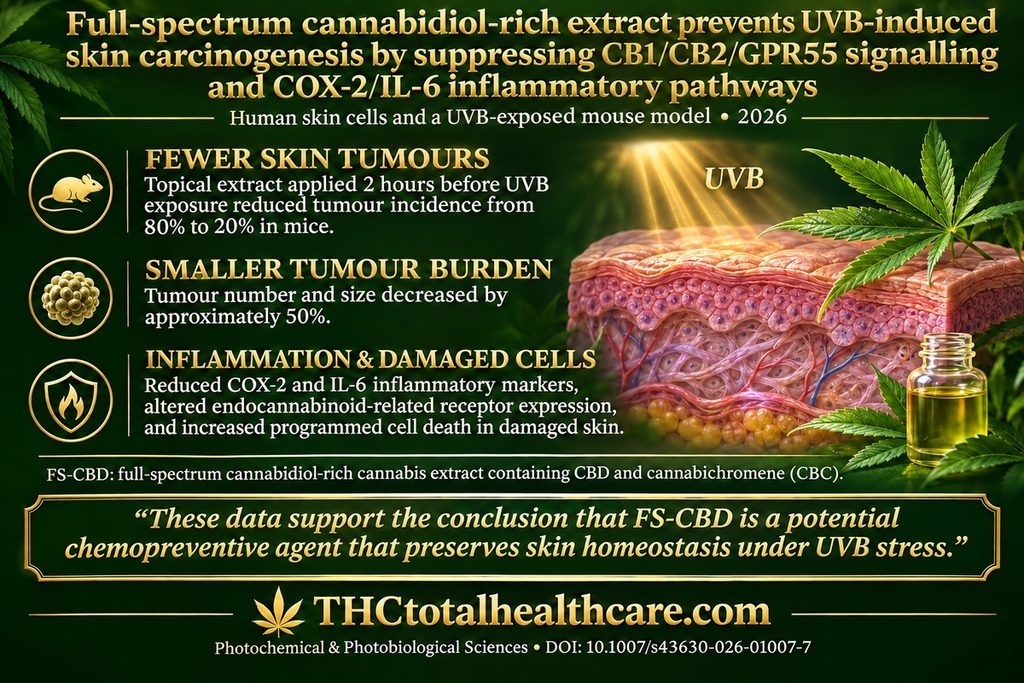
A full-spectrum cannabidiol-rich cannabis extract reduced UVB-induced skin tumour development in mice, lowering tumour incidence from 80% to 20% when applied two hours before exposure. Tumour number and size also decreased by approximately half.
Researchers studied human skin cells and mice repeatedly exposed to UVB radiation. The extract moderated changes in endocannabinoid-related receptors and reduced COX-2 and IL-6, inflammatory proteins involved in skin cancer development. Pretreatment also increased programmed cell death in damaged skin, alongside fewer malignant changes.
Cannabidiol (CBD) is a naturally occurring cannabis compound. This study used a full-spectrum extract containing CBD and cannabichromene (CBC), rather than isolated CBD. The findings support further investigation of topical cannabis extracts for preventing UVB-driven skin cancer.
“This study aimed to evaluate whether full-spectrum cannabidiol-rich extract (FS-CBD) prevents UVB-induced skin carcinogenesis through the modulation of endocannabinoid receptors and inflammatory pathways in HaCaT keratinocytes and CD-1 et/et mice.
In vitro, UVB exposure increased cannabinoid receptor type 1 (CB1) and cannabinoid receptor type 2 (CB2) expression by approximately 83% and decreased G protein-coupled receptor 55 (GPR55) expression. FS-CBD attenuated the upregulation and restored GPR55 expression to approximately four times the value measured after UVB exposure alone.
In vivo, compared with the control treatment, UVB treatment resulted in an 80% increase in tumour incidence, while FS-CBD pretreatment for 2 h reduced the incidence to 20%, corresponding to a 75% reduction. Tumour multiplicity and size decreased by approximately 50%, accompanied by significant reductions in the immunodetection of CB1, CB2, GPR55, COX-2, and IL-6, as assessed by confocal microscopy.
Notably, prolonged FS-CBD pre-treatment was associated with a marked increase in epidermal apoptosis, displaying a moderate-intensity, multifocal-to-diffuse pattern, which coincided with a lower frequency of malignant transformation.
Overall, these findings suggest that FS-CBD pre-treatment may have chemopreventive potential against UVB-induced skin carcinogenesis.”
https://pubmed.ncbi.nlm.nih.gov/42970043
“Full-spectrum cannabidiol (FS-CBD) reduced UVB-induced tumour incidence by 75% and decreased tumour multiplicity and size by ~50% in vivo.”
“FS-CBD reduced UVB-induced tumour development, as evidenced by decreased carcinoma incidence and tumour multiplicity. In keratinocytes, FS-CBD reduced the immunodetection of CB1 and CB2, while GPR55 expression increased following acute UVB exposure. In the In the chronic UVB-exposed CD1et/et murine model, FS-CBD reduced the immunodetectable expression of CB1, CB2, GPR55, COX-2, and IL-6.
These data support the conclusion that FS-CBD is a potential chemopreventive agent that preserves skin homeostasis under UVB stress.”
https://link.springer.com/article/10.1007/s43630-026-01007-7