
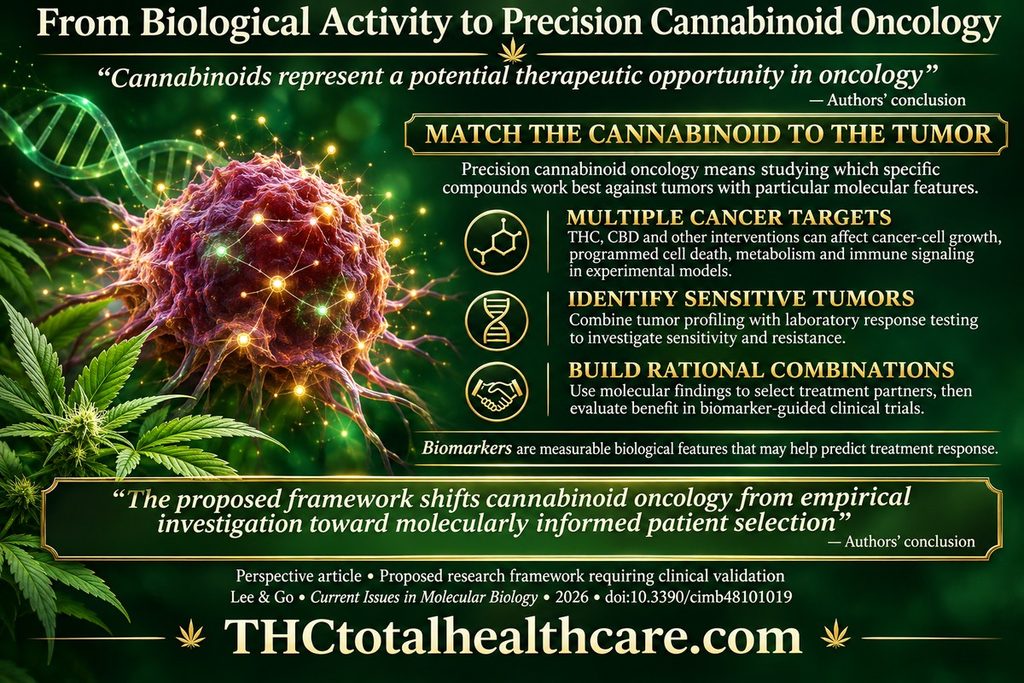
Matching specific cannabinoids to the molecular features of individual tumors could help advance cannabis-based cancer research toward more personalized treatment. This perspective article proposes “precision cannabinoid oncology”: identifying which tumors are most likely to respond to a particular cannabinoid, formulation, or treatment combination.
The authors examine how THC, CBD, and other cannabinoid interventions affect cancer-related processes, including cell growth, programmed cell death, metabolism, and immune signaling. Responses vary with the compound, dose, tumor biology, and cellular environment. Their proposed approach combines tumor profiling with laboratory response testing to identify biomarkers—measurable biological features that could help predict treatment sensitivity.
The goal is to connect promising anticancer activity with carefully selected patients and rational treatment combinations. The framework calls for prospective clinical trials to establish whether these molecular features predict meaningful benefit; cannabinoid-response biomarkers remain candidates requiring validation.
“Cannabinoids have gained increasing attention as potential anticancer agents because of their ability to modulate diverse cancer-associated signaling pathways and biological processes.:
Cannabinoids, including cannabidiol (CBD) and Δ9-tetrahydrocannabinol (THC), can influence tumor proliferation, apoptosis, angiogenesis, metabolism, immune regulation, and tumor-microenvironment interactions. However, clinical translation remains limited, as evidence of anticancer efficacy is derived predominantly from preclinical studies.
Major knowledge gaps include the absence of validated predictive biomarkers, unclear criteria for patient selection, and limited evidence regarding optimal therapeutic and combination strategies. Thus, the central challenge is to identify the patients and tumor contexts most likely to benefit from cannabinoid-based therapy.
We propose a precision cannabinoid oncology framework that integrates molecular characterization, molecular classification, predictive biomarker development, rational combination strategies, and prospective clinical validation.
This approach may provide a conceptual foundation for moving cannabinoid oncology from broadly empirical investigation toward molecularly informed patient selection and prospective validation of cannabinoid-based therapies in molecularly defined patient populations.”
https://pubmed.ncbi.nlm.nih.gov/42939557
“Cannabinoids represent a potential therapeutic opportunity in oncology because their biological effects extend across multiple signaling, metabolic, stress-response, and tumor–microenvironmental pathways.”