
Computational and Comparative In Vitro Evaluation of GC-MS Profiled Cannabis sativa Inflorescence Extracts’ Metabolites on Selected Diabetes Therapeutic Targets

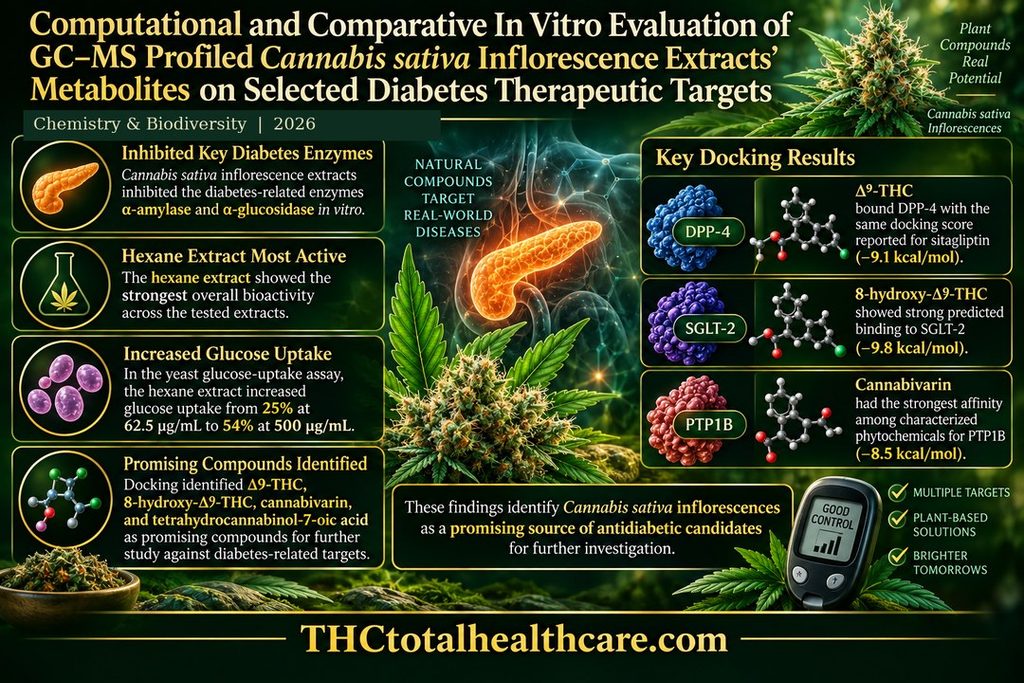
A new 2026 study found that Cannabis sativa flower extracts showed activity against several biological targets involved in diabetes. Researchers tested the extracts for effects on carbohydrate-digesting enzymes, glucose uptake and oxidative stress, then used computational modeling to examine how 36 cannabis metabolites interacted with diabetes-related proteins.

The hexane extract showed the strongest overall activity, including inhibition of α-amylase and α-glucosidase and the greatest increase in glucose uptake in the yeast model. Glucose uptake with the hexane extract rose from 25% at 62.5 µg/mL to 54% at 500 µg/mL.

The docking analysis identified several cannabinoids — including Δ9-THC, 8-hydroxy-Δ9-THC, cannabivarin and tetrahydrocannabinol-7-oic acid — as promising candidates for further study against diabetes-related targets such as DPP-4, SGLT-2 and PTP1B. The authors concluded that cannabis inflorescences may be a promising source of compounds for future antidiabetic drug research.

“Cannabis sativa, a medicinal plant rich in cannabinoids, terpenoids, and flavonoids, has been shown to have various pharmacological activities.

This study investigated the antidiabetic potential of C. sativa inflorescence extracts using in vitro and computational models.

Dried C. sativa inflorescences were extracted sequentially with hexane, dichloromethane, and methanol, before their metabolites were identified by GC-MS. The extracts were tested for α-amylase and α-glucosidase inhibition, glucose uptake activity, and antioxidant effects using DPPH and nitric oxide (NO) inhibition assays. Thirty-six metabolites were further docked against diabetes-related proteins.

Among the extracts, the hexane extract showed the strongest bioactivity with notable α-amylase inhibition (IC50: 727 µg/mL), DPPH free radical scavenging (IC50: 478.62 µg/mL), and nitric oxide inhibition activity (IC50: 356.51 µg/mL). Docking analyses revealed strong binding affinities for 8-hydroxy-delta-9-THC, cannabivarin, and 9-tetrahydrocannabinol with DPP-4, PTP1B, and other target proteins.

These findings highlight the potential of C. sativa inflorescences as a source of antidiabetic agents, warranting further in vivo and clinical validation.”

https://pubmed.ncbi.nlm.nih.gov/42763912

“This study provides preliminary evidence that C. sativa inflorescence extracts contain phytoconstituents with antioxidant, enzyme-inhibitory, and potential antidiabetic activities under the experimental conditions investigated. Among the extracts, the hexane extract exhibited the strongest enzyme inhibition and capacity to interact with free radicals.

In addition, compounds including Δ9-tetrahydrocannabinol, 8-hydroxy-Δ9-THC, cannabivarin, and tetrahydrocannabinol-7-oic acid exhibited favorable binding affinities toward diabetes-related protein targets, identifying them as promising candidates for further investigation.”
https://onlinelibrary.wiley.com/doi/10.1002/cbdv.71684

Impacts of delta 9-tetrahydrocannabinol against myocardial ischemia/reperfusion injury in diabetic rats: Role of PTEN/PI3K/Akt signaling pathway

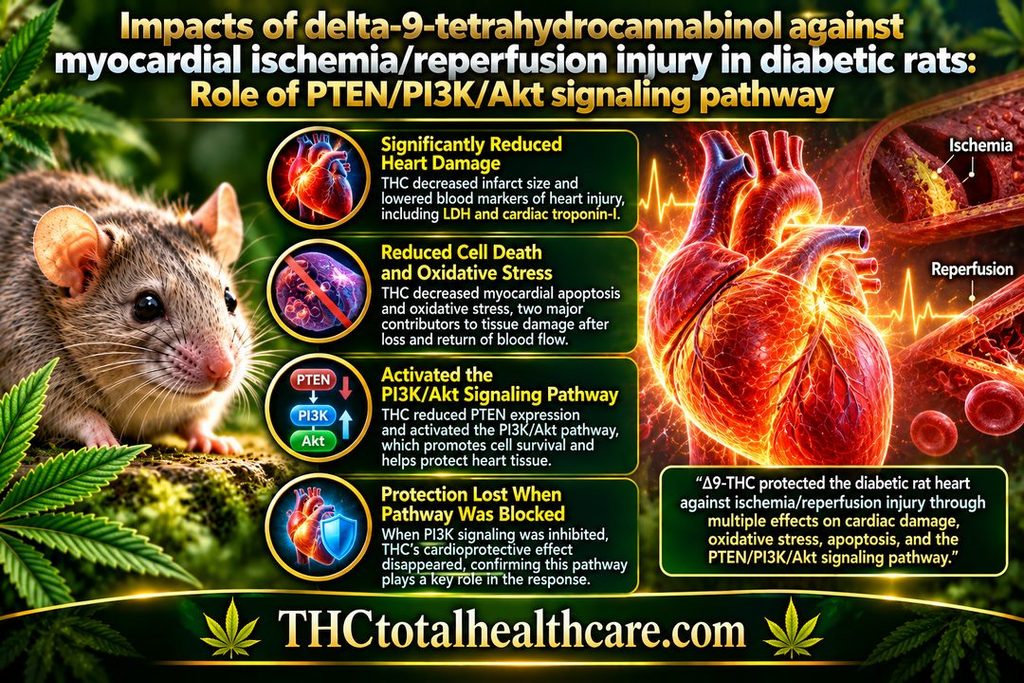
In diabetic rats with myocardial ischemia/reperfusion injury, Δ9-THC significantly reduced heart damage and improved cardiac function. THC pretreatment decreased infarct size as well as blood markers of heart injury, including LDH and cardiac troponin-I.

THC also reduced myocardial apoptosis and oxidative stress, two major contributors to tissue damage when blood flow returns to the heart after a period of ischemia. These protective effects were accompanied by reduced PTEN expression and activation of the PI3K/Akt signaling pathway, which is involved in cell survival.

When researchers blocked PI3K signaling, THC’s cardioprotective effect disappeared, strengthening the evidence that this pathway played an important role in the response. The findings show that THC protected the diabetic rat heart against ischemia/reperfusion injury through multiple measurable effects on cardiac damage, oxidative stress, cell death, and survival signaling.

“Despite the current optimal therapy, patients with myocardial ischemia/reperfusion (IR) injury still experience a high mortality rate, especially when diabetes mellitus is present as a comorbidity. Investigating potential treatments aimed at improving the outcomes of myocardial IR injury in diabetic patients is necessary.

Our objective was to ascertain the cardioprotective effect of delta 9-tetrahydrocannabinol (THC) against myocardial IR injury in diabetic rats and examine the role of phosphatase and tensin homolog (PTEN)/phosphatidylinositol 3-kinase (PI3K)/protein kinase B (Akt) signaling pathway in mediating this effect.

Diabetes was induced in male Wistar rats (8-10 weeks old, 200-250 g; n = 60) by a single injection of streptozotocin. The duration of the diabetic period was 10 weeks. During the last 4 weeks of diabetic period, rats were treated with THC (1.5 mg/kg/day; intraperitoneally), either alone or in combination with LY294002, and then underwent IR intervention. After 24 h of reperfusion, infarct size, cardiac function, lactate dehydrogenase (LDH) and cardiac-specific isoform of troponin-I (cTn-I) levels, myocardial apoptosis, oxidative stress markers, and expression of PTEN, PI3K, and Akt proteins were evaluated.

THC pretreatment resulted in significant improvements in infarct size and cardiac function and decreases in LDH and cTn-I levels (P < 0.05). It also reduced myocardial apoptosis and oxidative stress, accompanied by the downregulation of PTEN expression and activation of the PI3K/Akt signaling pathway (P < 0.05). LY294002 pretreatment abolished the cardioprotective action of THC.

This study revealed the cardioprotective effects of THC against IR-induced myocardial injury in diabetic rats and also suggested that the mechanism may be associated with enhanced activity of the PI3K/Akt signaling pathway through the reduction of PTEN phosphorylation.”

https://pubmed.ncbi.nlm.nih.gov/38149557/

“Delta 9-tetrahydrocannabinol (THC) is the main psychoactive component of cannabis and has been shown to have potential therapeutic effects in various medical conditions. THC has been shown to have anti-inflammatory and antioxidant properties, which may reduce the inflammation and oxidative stress associated with myocardial IR injury. Recent studies have suggested that THC improves glucose metabolism and insulin sensitivity and reduces blood glucose concentrations, oxidative stress, and inflammation associated with diabetic cardiomyopathy.”

https://www.cjphysiology.org/article.asp?issn=0304-4920;year=2023;volume=66;issue=6;spage=446;epage=455;aulast=Zhao

Need this THC study explained? thcXplained.com