
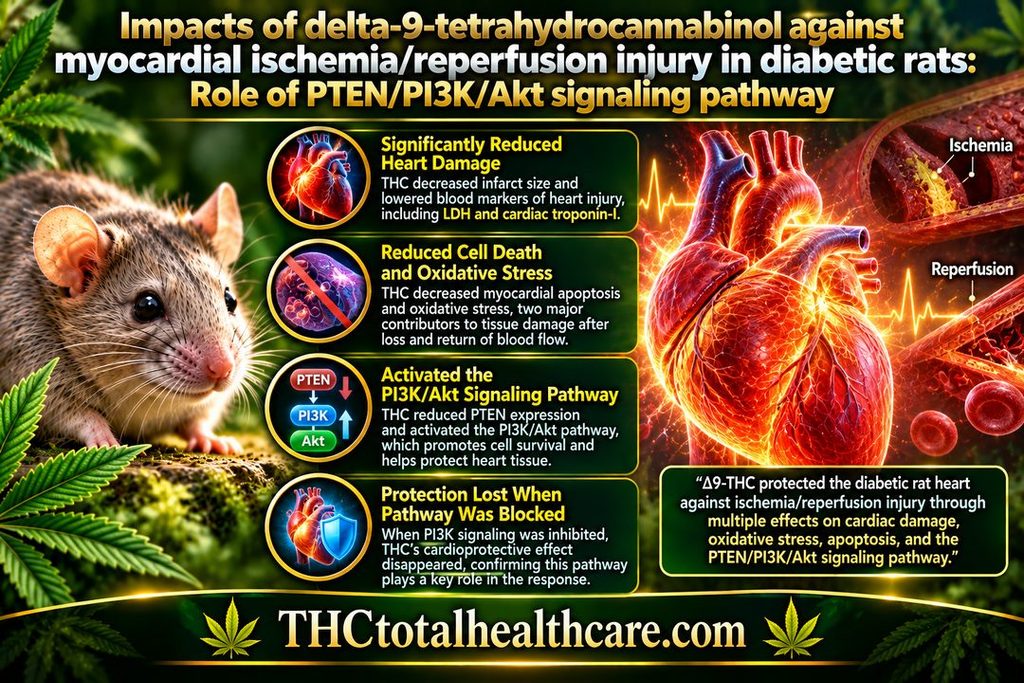
Impacts of delta 9-tetrahydrocannabinol against myocardial ischemia/reperfusion injury in diabetic rats: Role of PTEN/PI3K/Akt signaling pathway

In diabetic rats with myocardial ischemia/reperfusion injury, Δ9-THC significantly reduced heart damage and improved cardiac function. THC pretreatment decreased infarct size as well as blood markers of heart injury, including LDH and cardiac troponin-I.

THC also reduced myocardial apoptosis and oxidative stress, two major contributors to tissue damage when blood flow returns to the heart after a period of ischemia. These protective effects were accompanied by reduced PTEN expression and activation of the PI3K/Akt signaling pathway, which is involved in cell survival.

When researchers blocked PI3K signaling, THC’s cardioprotective effect disappeared, strengthening the evidence that this pathway played an important role in the response. The findings show that THC protected the diabetic rat heart against ischemia/reperfusion injury through multiple measurable effects on cardiac damage, oxidative stress, cell death, and survival signaling.

“Despite the current optimal therapy, patients with myocardial ischemia/reperfusion (IR) injury still experience a high mortality rate, especially when diabetes mellitus is present as a comorbidity. Investigating potential treatments aimed at improving the outcomes of myocardial IR injury in diabetic patients is necessary.

Our objective was to ascertain the cardioprotective effect of delta 9-tetrahydrocannabinol (THC) against myocardial IR injury in diabetic rats and examine the role of phosphatase and tensin homolog (PTEN)/phosphatidylinositol 3-kinase (PI3K)/protein kinase B (Akt) signaling pathway in mediating this effect.

Diabetes was induced in male Wistar rats (8-10 weeks old, 200-250 g; n = 60) by a single injection of streptozotocin. The duration of the diabetic period was 10 weeks. During the last 4 weeks of diabetic period, rats were treated with THC (1.5 mg/kg/day; intraperitoneally), either alone or in combination with LY294002, and then underwent IR intervention. After 24 h of reperfusion, infarct size, cardiac function, lactate dehydrogenase (LDH) and cardiac-specific isoform of troponin-I (cTn-I) levels, myocardial apoptosis, oxidative stress markers, and expression of PTEN, PI3K, and Akt proteins were evaluated.

THC pretreatment resulted in significant improvements in infarct size and cardiac function and decreases in LDH and cTn-I levels (P < 0.05). It also reduced myocardial apoptosis and oxidative stress, accompanied by the downregulation of PTEN expression and activation of the PI3K/Akt signaling pathway (P < 0.05). LY294002 pretreatment abolished the cardioprotective action of THC.

This study revealed the cardioprotective effects of THC against IR-induced myocardial injury in diabetic rats and also suggested that the mechanism may be associated with enhanced activity of the PI3K/Akt signaling pathway through the reduction of PTEN phosphorylation.”

https://pubmed.ncbi.nlm.nih.gov/38149557/

“Delta 9-tetrahydrocannabinol (THC) is the main psychoactive component of cannabis and has been shown to have potential therapeutic effects in various medical conditions. THC has been shown to have anti-inflammatory and antioxidant properties, which may reduce the inflammation and oxidative stress associated with myocardial IR injury. Recent studies have suggested that THC improves glucose metabolism and insulin sensitivity and reduces blood glucose concentrations, oxidative stress, and inflammation associated with diabetic cardiomyopathy.”

https://www.cjphysiology.org/article.asp?issn=0304-4920;year=2023;volume=66;issue=6;spage=446;epage=455;aulast=Zhao

Need this THC study explained? thcXplained.com

Cannabidiol-mediated RISK PI3K/AKT and MAPK/ERK pathways decreasing reperfusion myocardial damage

“Myocardial ischemia continues to be the first cause of morbimortality in the world; the definitive treatment is reperfusion; however, this action causes additional damage to ischemic myocardial tissue; this forces to seek therapies of cardioprotection to reduce this additional damage. There are many cardioprotective agents; within these, cannabinoids have shown to have beneficial effects, mainly cannabidiol (CBD). CBD is a non psychoactive cannabinoid. To evaluate the effect in experimental models of CBD in myocardial ischemia reperfusion in rats, twelve-week-old male rats have been used. The animals were divides in 3 groups: control(C), ischemia reperfusion (IR) and CBD pretreatment (1/day/5mg/kg /10days). Langendorff organ isolate studies were performed, and the area of infarction was assessed with triphenyl tetrazolium, in addition to molecular analysis of AT1 and AT2 receptors and Akt and Erk proteins and their phosphorylated forms related to RISK pathways. It was observed that there is an improvement with the use of CBD increasing inotropism and cardiac lusitropism, improving considerably the cardiovascular functionality. These could be related to the reduction of the area of infarction and activation of the AT2 receptor and the RISK pathway with absence of activation of the AT2 receptor (these could relate the reduction of the infarct area and the restoration of cardiovascular function with the activation of the AT2 receptor and the RISK pathway with the absence of activation of the AT2 receptor). The use of cannabinoids was shown to have beneficial effects when used as a treatment for myocardial reperfusion damage.”

https://pubmed.ncbi.nlm.nih.gov/34176244/

Δ 9-Tetrahydrocannabinol (Δ 9-THC) Improves Ischemia/Reperfusion Heart Dysfunction and Might Serve as a Cardioprotective Agent in the Future Treatment

Researchers examined whether Δ9-THC could protect heart tissue from ischemia/reperfusion injury—the damage that can occur when blood flow returns after a period of oxygen deprivation. Using isolated rat hearts and human cardiac cells, the study found that THC improved recovery of heart function, reduced cellular injury and death, supported antioxidant defenses, and helped restore normal cardiac mechanical function.

“Background: Ischemia/reperfusion (I/R) is a pivotal mechanism of organ injury during clinical stetting for example for cardiopulmonary bypasses. The generation of reactive oxygen species (ROS) during I/R induces oxidative stress that promotes endothelial dysfunction, DNA dissociation and local inflammation. In turn, those processes induce cytokine release, resulting in damage to cellular structures and cell death. One of the major psychoactive compounds of Cannabis is delta-9-tetrahydrocannabinol (Δ9-THC), which is known as an anti-inflammatory mediator. Our research aimed to test if Δ9-THC may be protective in the treatment of cardiovascular system dysfunction arising from I/R heart injury.

Methods: Two experimental models were used: isolated rat hearts perfused with the Langendorff method and human cardiac myocytes (HCM) culture. Rat hearts and HCM underwent ex vivo/chemical in vitro I/R protocol with/without Δ9-THC treatment. The following parameters were measured: cell metabolic activity, morphology changes, cell damage as lactate dehydrogenase (LDH) activity, ceramide kinase (CERK) activity, ROS level, total antioxidant capacity (TAC) and heart hemodynamic parameters.

Results: Δ9-THC protected the heart, as evidenced by the improved recovery of cardiac function (p < 0.05, N = 3-6). Cells subjected to I/R showed lower cytoplasmic LDH activity, and 10 μM Δ9-THC treatment reduced cell injury and increased LDH content (p = 0.019, N = 6-9). Morphology changes of HCM-spherical shape, vacuolisation of cytoplasm and swollen mitochondria-were inhibited due to Δ9-THC treatment. I/R condition affected cell viability, but 10 μM Δ9-THC decreased the number of dead cells (p = 0.005, N = 6-9). The total level of CERK was lower in the I/R group, reflecting oxidative/nitrosative stress changes. The administration of Δ9-THC effectively increased the production of CERK to the level of aerobic control (p = 0.028, N = 6-9). ROS level was significantly decreased in I/R cells (p = 0.007, N = 6-8), confirming oxidative stress, while administration of 10 μM Δ9-THC enhanced TAC in cardiomyocytes subjected to I/R (p = 0.010, N = 6-8).

Conclusions: Δ9-THC promotes the viability of cardiomyocytes, improves their metabolic activity, decreases cell damage and restores heart mechanical function, serving as a cardioprotective. We proposed the use of Δ9-THC as a cardioprotective drug to be, administered before onset of I/R protocol.”

https://pubmed.ncbi.nlm.nih.gov/35468673/

“In conclusion, in this study we found that Δ9-THC promotes the viability and improves the metabolic activity of cardiomyocytes, as well as decreasing cell damage and restoring heart mechanical function, proving that it has a cardioprotective function at the pre-treatment level.

We propose the use of THC as a potentially cardioprotective compound to be, administered before ischemia and during the first minutes of reperfusion.

We hope that this cannabis product may be included in future clinical investigations using similar models of ischemia-reperfusion injury. We also recommend the presented data to be considered alongside clinical observations of patient outcomes with history of cannabis use.”

https://www.imrpress.com/journal/FBL/27/4/10.31083/j.fbl2704114

Marijuana and Myocardial Infarction in the UK Biobank Cohort

“Background: Atrial fibrillation, ventricular tachycardia, acute coronary syndromes, and cardiac arrest have been attributed to marijuana. But the National Academy of Science’s 2017 Report, The Health Effects of Cannabis and Cannabinoids, found limited evidence that acute marijuana smoking is positively associated with an increased risk of acute myocardial infarction, and uncovered no evidence to support or refute associations between any chronic effects of marijuana use and increased risk of myocardial infarct (MI).

Aims: We sought to determine the association of marijuana smoking with MI in the UK Biobank cohort. Because red wine is a mood-altering substance, we compared the effect of marijuana with red wine on MI incidence.

Methods: Our analysis included all subjects with MI. The diagnosis was ascertained using the 10th Revision of the International Classification of Diseases (ICD10 I21). Marijuana was recorded in UKB Category 143, medical conditions, marijuana use. Cigarette smoking information was from UKB Category 100058, smoking. To compare marijuana smoking with the effect of wine drinking we used data from UKB Category 10051, alcohol.

Results: With marijuana use, MI incidence decreased (p < 0.001, two tail Fisher exact test). Red wine was associated with lower MI incidence, although the incidence begins to rise at 11 or more glasses per week (p < 0.001, two tail Fisher exact test). Multivariate analysis was done with logistic regression, MI dependent variable, cigarette pack-years, diabetes type 2, sex, BMI, hypertension, marijuana use, age, red wine consumption, independent variables. Odds ratio (O.R.) 0.844 associated with marijuana use indicates that MI was less likely in marijuana users and was comparable to the effect of red wine (O.R. 0.847).

Conclusion: Marijuana, which has not been shown to have the favorable physiologic effects of red wine on the heart, does reduce MI risk to an extent comparable to red wine. Perhaps both affect the heart by reducing stress.”

https://pubmed.ncbi.nlm.nih.gov/35165641/

Activation of Cannabinoid Receptors Attenuates Endothelin-1-induced Mitochondrial Dysfunction in Rat Ventricular Myocytes.

Image result for Journal of Cardiovascular Pharmacology.“Evidence suggests that activation of the endocannabinoid system offers cardioprotection.

Aberrant energy production by impaired mitochondria purportedly contributes to various aspects of cardiovascular disease. We investigated whether cannabinoid (CB) receptor activation would attenuate mitochondrial dysfunction induced by endothelin-1 (ET1).

Acute exposure to ET1 (4 h) in the presence of palmitate as primary energy substrate induced mitochondrial membrane depolarization, and decreased mitochondrial bioenergetics and expression of genes related to fatty acid oxidation (i.e. peroxisome proliferator-activated receptor-gamma coactivator (PGC)-1α, a driver of mitochondrial biogenesis, and carnitine palmitoyltransferase (CPT)-1β, facilitator of fatty acid uptake).

A CB1/CB2 dual agonist with limited brain penetration, CB-13, corrected these parameters. AMP-activated protein kinase (AMPK), an important regulator of energy homeostasis, mediated the ability of CB-13 to rescue mitochondrial function. In fact, the ability of CB-13 to rescue fatty acid oxidation-related bioenergetics, as well as expression of PGC-1α and CPT-1β, was abolished by pharmacological inhibition of AMPK using compound C and shRNA knockdown of AMPKα1/α2, respectively.

Interventions that target CB/AMPK signaling might represent a novel therapeutic approach to address the multi-factorial problem of cardiovascular disease.”

https://www.ncbi.nlm.nih.gov/pubmed/31815823

https://insights.ovid.com/crossref?an=00005344-900000000-98463

β-Caryophyllene, a natural bicyclic sesquiterpene attenuates doxorubicin-induced cardiotoxicity via activation of myocardial cannabinoid type-2 (CB2) receptors in rats.

Chemico-Biological Interactions

“The cannabinoid type 2 receptor (CB2) has recently emerged as an important therapeutic target for cancer as well as cardiovascular diseases. The CB2 receptor downregulation has been reported in solid tumors and cardiovascular diseases, therefore the CB2receptor activation has been considered as a viable strategy for chemotherapy as well as cardioprotection.

In chemotherapy, doxorubicin (DOX) is an important drug that continues to be the mainstay of chemotherapy in solid tumors, leukemia, and lymphoma. However, the use of DOX is often limited due to its lethal cardiotoxicity. Considering the role of CB2 receptors in cardiovascular diseases and cancer, the activation of CB2 receptors may protect against DOX-induced chronic cardiotoxicity in rats.

In the present study, we investigated the cardioprotective effect of a selective CB2 receptor agonist; β-Caryophyllene (BCP), a natural bicyclic sesquiterpene, against DOX-induced chronic cardiotoxicity in rats. AM630, a CB2 receptor antagonist was administered as a pharmacological challenge prior to BCP treatment to demonstrate CB2 receptor mediated cardioprotective mechanism of BCP. DOX (2.5 mg/kg) was injected intraperitoneally once a week for five weeks to induce chronic cardiotoxicity in rats.

BCP was also injected into rats six days a week for a total duration of five weeks. DOX induced a significant decline in cardiac function and oxidative stress evidenced by the depletion of antioxidant enzymes, glutathione, and increased lipid peroxidation. DOX also triggered activation of nuclear factor kappa B (NF-κB) and increased the levels of pro-inflammatory cytokines (TNF-α, IL-6, and IL-1β) and expression of the inflammatory mediators (iNOS and COX-2) in the heart.

Furthermore, DOX also upregulated the expression of pro-apoptotic markers such as Bax, p53, cleaved PARP, active caspase-3 and downregulated anti-apoptotic marker Bcl-2 in the myocardium. BCP treatment exerted significant cardioprotective effect by salvaging the heart tissues, improving cardiac function, mitigating oxidative stress, inflammation, and apoptosis. The histological and ultrastructural studies also appear in line with our findings of biochemical and molecular parameters.

The CB2 receptor-mediated cardioprotective mechanism was further confirmed by the abrogation of the beneficial effects of BCP with prior administration of the CB2 receptor antagonist; AM630.

Our study revealed the novel mechanism of BCP in cardioprotection against DOX-induced chronic cardiotoxicity by the activation of CB2 receptors.”

https://www.ncbi.nlm.nih.gov/pubmed/30836069

https://www.sciencedirect.com/science/article/pii/S0009279718316284?via%3Dihub

“β-caryophyllene (BCP) is a common constitute of the essential oils of numerous spice, food plants and major component in Cannabis.”   http://www.ncbi.nlm.nih.gov/pubmed/23138934

“Beta-caryophyllene is a dietary cannabinoid.”   https://www.ncbi.nlm.nih.gov/pubmed/18574142

The Endocannabinoid System and Heart Disease: The Role of Cannabinoid Receptor Type 2.

Image result for Cardiovasc Hematol Disord Drug Targets. “Decades of research has provided evidence for the role of the endocannabinoid system in human health and disease. This versatile system, consisting of two receptors (CB1 and CB2), their endogenous ligands (endocannabinoids), and metabolic enzymes has been implicated in a wide variety of disease states, ranging from neurological disorders to cancer. CB2 has gained much interest for its beneficial immunomodulatory role that can be obtained without eliciting psychotropic effects through CB1. Recent studies have shed light on a protective role of CB2 in cardiovascular disease, an ailment which currently takes more lives each year in Western countries than any other disease or injury. By use of CB2 knockout mice and CB2-selective ligands, knowledge of how CB2 signaling affects atherosclerosis and ischemia has been acquired, providing a major stepping stone between basic science and translational clinical research. Here, we summarize the current understanding of the endocannabinoid system in human pathologies and provide a review of the results from preclinical studies examining its function in cardiovascular disease, with a particular emphasis on possible CB2-targeted therapeutic interventions to alleviate atherosclerosis.” https://www.ncbi.nlm.nih.gov/pubmed/29412125 “Researchers suggest that THC and other cannabinoids, which are active at CB2, the cannabinoid receptor expressed on immune cells, may be valuable in treating atherosclerosis.” https://www.medscape.com/viewarticle/787468

“Cardiovascular disease: New use for cannabinoids”  https://www.nature.com/articles/nrd1733

]]>