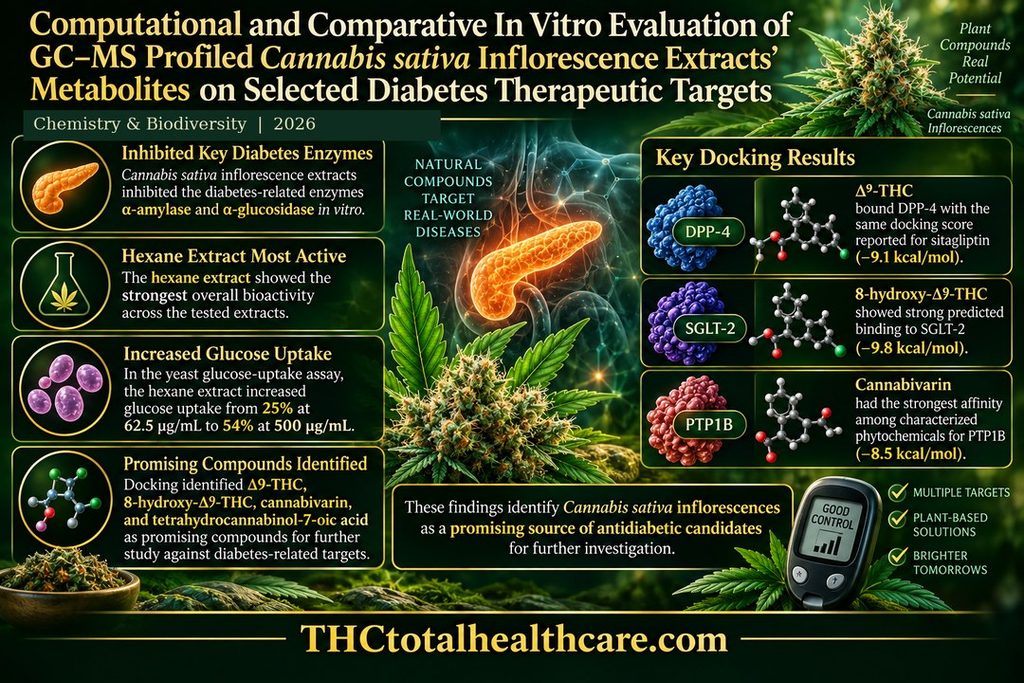
Computational and Comparative In Vitro Evaluation of GC-MS Profiled Cannabis sativa Inflorescence Extracts’ Metabolites on Selected Diabetes Therapeutic Targets

A new 2026 study found that Cannabis sativa flower extracts showed activity against several biological targets involved in diabetes. Researchers tested the extracts for effects on carbohydrate-digesting enzymes, glucose uptake and oxidative stress, then used computational modeling to examine how 36 cannabis metabolites interacted with diabetes-related proteins.

The hexane extract showed the strongest overall activity, including inhibition of α-amylase and α-glucosidase and the greatest increase in glucose uptake in the yeast model. Glucose uptake with the hexane extract rose from 25% at 62.5 µg/mL to 54% at 500 µg/mL.

The docking analysis identified several cannabinoids — including Δ9-THC, 8-hydroxy-Δ9-THC, cannabivarin and tetrahydrocannabinol-7-oic acid — as promising candidates for further study against diabetes-related targets such as DPP-4, SGLT-2 and PTP1B. The authors concluded that cannabis inflorescences may be a promising source of compounds for future antidiabetic drug research.

“Cannabis sativa, a medicinal plant rich in cannabinoids, terpenoids, and flavonoids, has been shown to have various pharmacological activities.

This study investigated the antidiabetic potential of C. sativa inflorescence extracts using in vitro and computational models.

Dried C. sativa inflorescences were extracted sequentially with hexane, dichloromethane, and methanol, before their metabolites were identified by GC-MS. The extracts were tested for α-amylase and α-glucosidase inhibition, glucose uptake activity, and antioxidant effects using DPPH and nitric oxide (NO) inhibition assays. Thirty-six metabolites were further docked against diabetes-related proteins.

Among the extracts, the hexane extract showed the strongest bioactivity with notable α-amylase inhibition (IC50: 727 µg/mL), DPPH free radical scavenging (IC50: 478.62 µg/mL), and nitric oxide inhibition activity (IC50: 356.51 µg/mL). Docking analyses revealed strong binding affinities for 8-hydroxy-delta-9-THC, cannabivarin, and 9-tetrahydrocannabinol with DPP-4, PTP1B, and other target proteins.

These findings highlight the potential of C. sativa inflorescences as a source of antidiabetic agents, warranting further in vivo and clinical validation.”

https://pubmed.ncbi.nlm.nih.gov/42763912

“This study provides preliminary evidence that C. sativa inflorescence extracts contain phytoconstituents with antioxidant, enzyme-inhibitory, and potential antidiabetic activities under the experimental conditions investigated. Among the extracts, the hexane extract exhibited the strongest enzyme inhibition and capacity to interact with free radicals.

In addition, compounds including Δ9-tetrahydrocannabinol, 8-hydroxy-Δ9-THC, cannabivarin, and tetrahydrocannabinol-7-oic acid exhibited favorable binding affinities toward diabetes-related protein targets, identifying them as promising candidates for further investigation.”
https://onlinelibrary.wiley.com/doi/10.1002/cbdv.71684

Impacts of delta 9-tetrahydrocannabinol against myocardial ischemia/reperfusion injury in diabetic rats: Role of PTEN/PI3K/Akt signaling pathway

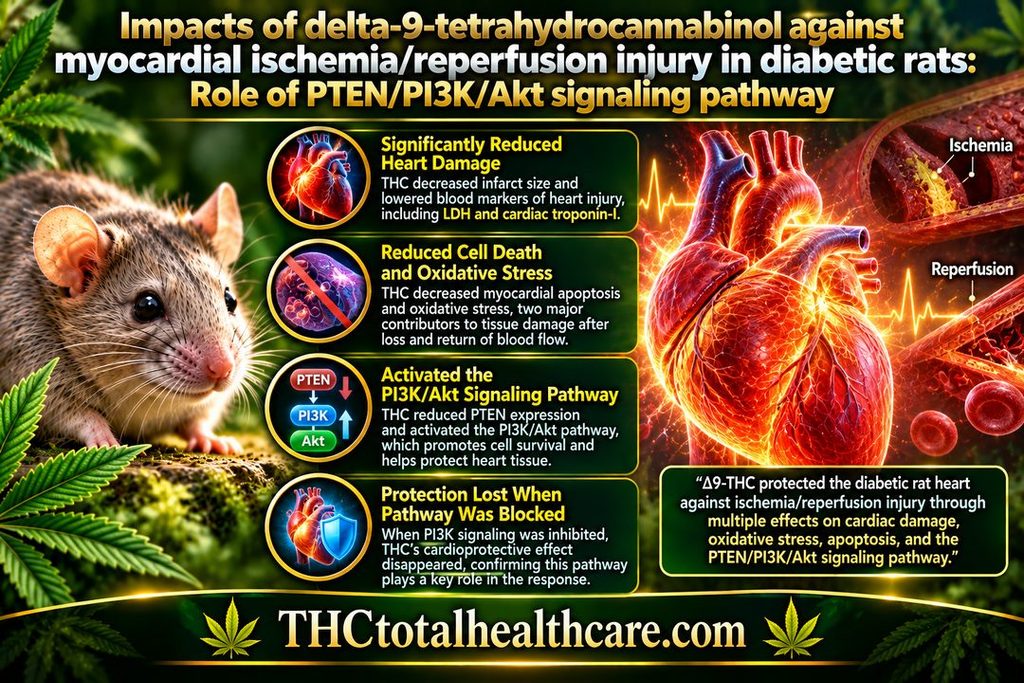
In diabetic rats with myocardial ischemia/reperfusion injury, Δ9-THC significantly reduced heart damage and improved cardiac function. THC pretreatment decreased infarct size as well as blood markers of heart injury, including LDH and cardiac troponin-I.

THC also reduced myocardial apoptosis and oxidative stress, two major contributors to tissue damage when blood flow returns to the heart after a period of ischemia. These protective effects were accompanied by reduced PTEN expression and activation of the PI3K/Akt signaling pathway, which is involved in cell survival.

When researchers blocked PI3K signaling, THC’s cardioprotective effect disappeared, strengthening the evidence that this pathway played an important role in the response. The findings show that THC protected the diabetic rat heart against ischemia/reperfusion injury through multiple measurable effects on cardiac damage, oxidative stress, cell death, and survival signaling.

“Despite the current optimal therapy, patients with myocardial ischemia/reperfusion (IR) injury still experience a high mortality rate, especially when diabetes mellitus is present as a comorbidity. Investigating potential treatments aimed at improving the outcomes of myocardial IR injury in diabetic patients is necessary.

Our objective was to ascertain the cardioprotective effect of delta 9-tetrahydrocannabinol (THC) against myocardial IR injury in diabetic rats and examine the role of phosphatase and tensin homolog (PTEN)/phosphatidylinositol 3-kinase (PI3K)/protein kinase B (Akt) signaling pathway in mediating this effect.

Diabetes was induced in male Wistar rats (8-10 weeks old, 200-250 g; n = 60) by a single injection of streptozotocin. The duration of the diabetic period was 10 weeks. During the last 4 weeks of diabetic period, rats were treated with THC (1.5 mg/kg/day; intraperitoneally), either alone or in combination with LY294002, and then underwent IR intervention. After 24 h of reperfusion, infarct size, cardiac function, lactate dehydrogenase (LDH) and cardiac-specific isoform of troponin-I (cTn-I) levels, myocardial apoptosis, oxidative stress markers, and expression of PTEN, PI3K, and Akt proteins were evaluated.

THC pretreatment resulted in significant improvements in infarct size and cardiac function and decreases in LDH and cTn-I levels (P < 0.05). It also reduced myocardial apoptosis and oxidative stress, accompanied by the downregulation of PTEN expression and activation of the PI3K/Akt signaling pathway (P < 0.05). LY294002 pretreatment abolished the cardioprotective action of THC.

This study revealed the cardioprotective effects of THC against IR-induced myocardial injury in diabetic rats and also suggested that the mechanism may be associated with enhanced activity of the PI3K/Akt signaling pathway through the reduction of PTEN phosphorylation.”

https://pubmed.ncbi.nlm.nih.gov/38149557/

“Delta 9-tetrahydrocannabinol (THC) is the main psychoactive component of cannabis and has been shown to have potential therapeutic effects in various medical conditions. THC has been shown to have anti-inflammatory and antioxidant properties, which may reduce the inflammation and oxidative stress associated with myocardial IR injury. Recent studies have suggested that THC improves glucose metabolism and insulin sensitivity and reduces blood glucose concentrations, oxidative stress, and inflammation associated with diabetic cardiomyopathy.”

https://www.cjphysiology.org/article.asp?issn=0304-4920;year=2023;volume=66;issue=6;spage=446;epage=455;aulast=Zhao

Need this THC study explained? thcXplained.com

Biochemical and immunohistochemical changes in delta-9-tetrahydrocannabinol-treated type 2 diabetic rats.

“The regulation of glucose, lipid metabolism and immunoreactivities of insulin and glucagon peptides by delta-9-tetrahydrocannabinol (Δ9-THC) in diabetes were examined in an experimental rat model… 

These results indicate that Δ9-THC may serve a protective role against hyperlipidemia and hyperglycemia in diabetic rats.”

http://www.ncbi.nlm.nih.gov/pubmed/23845579

Even More Science Suggesting That Cannabinoids May Halt Diabetes

“Preclinical study data published online in the scientific journal Nutrition & Diabetes reports that tetrahydrocannabivarin (THCV) — a naturally occurring analogue of THC — possesses positive metabolic effects in animal models of obesity.

British researchers assessed the effects of THCV administration on dietary-induced and genetically modified obese mice. Authors reported that although THCV administration did not significantly affect food intake or body weight gain in any of the models, it did produce several metabolically beneficial effects, including reduced glucose intolerance, improved glucose tolerance, improved liver triglyceride levels, and increased insulin sensitivity.

Researchers concluded: “Based on these data, it can be suggested that THCV may be useful for the treatment of the metabolic syndrome and/or type 2 diabetes (adult onset diabetes), either alone or in combination with existing treatments. Given the reported benefits of another non-THC cannabinoid, CBD in type 1 diabetes, a CBD/THCV combination may be beneficial for different types of diabetes mellitus.””

More: http://beforeitsnews.com/marijuana-debate/2013/06/even-more-science-suggesting-that-cannabinoids-may-halt-diabetes-2444932.html

Looking at Cannabis Based Type 2 Treatment

“One of the classic effects of cannabis on people is raging hunger-the “marijuana munchies.” The drug has been used to good effect on people with diseases that diminish appetite, helping them to regain a healthy interest in food. So it is a bit ironic that British drug maker GW Pharmaceuticals has created a cross-bred cannabis plant whose appetite-suppressing qualities could be used to treat type 2 diabetes.”

 
“The new strain contains an appetite-suppressing compound called THCV (tetrahydrocannabivarin), a cannabinoid* found in cannabis sativa-marijuana. The company sees a drug that uses THCV as potentially useful in helping type 2s and obese people control their appetites-a key to good blood sugar control.

In 2010, GW introduced a cannabis-based drug to treat the symptoms of multiple sclerosis. Already, the company has found 60 cannabinoids in the cannabis sativa plant. A company spokesman says that only 12 to 15 of them have been explored in any depth.

*Cannabinoids are the active ingredients in cannabis sativa that create the plant’s physical and mental effects when it is ingested or smoked.”

http://diabeteshealth.com/read/2011/06/30/7200/looking-at-cannabis-based-type-2-treatment/

Marijuana blood sugar study shows potential health benefits for users

“A study shows a positive link between marijuana and blood sugar control in diabetes patients. A study by the National Health and Nutrition Surveyfound that marijuana use is linked to smaller waists, better blood sugar control and insulin resistance.”
 
File/UPI /Jim Bryant
 

“Researchers based in Boston compared five years’ worth of data from 579 marijuana users and thousands of non-users, LA Weekly reported.

The results come from a comparison of insulin and glucose levels in both groups. Participants that had used pot in the last month had much lower levels of fasting insulin and higher levels of so-called “good” cholesterol HDL-C — which may mean big news for diabetics.

Researchers hypothesize that marijuana could be used to control and manage diabetics’ blood sugar levels.”

More: http://www.upi.com/blog/2013/05/23/Marijuana-blood-sugar-study-shows-potential-health-benefits-for-users/8731369343626/

Marijuana Blood Sugar: A New Study Shows That Pot Smoking May Reduce Weight and Diabetes Risk

“A new study has shown there may be a link between marijuana and diabetes prevention.”
 
joint
 

“A new study has found that people who had used marijuana in the past month had smaller waists and lower levels of insulin resistance, which is a diabetes precursor, than those who had never tried the drug, according to Reuters.

“These are preliminary findings,” Dr. Murray Mittleman, who worked on the study at Beth Israel Deaconess Medical Center in Boston, told Reuters. “It looks like there may be some favorable effects on blood sugar control.”

More: http://www.travelerstoday.com/articles/6386/20130524/marijuana-blood-sugar-new-study-shows-pot-smoking-reduce-weight.htm

Marijuana, blood sugar control linked, study says – ABC

“Regular marijuana use is associated with favorable indices related to diabetic control, say investigators. They found that current marijuana users had significantly lower fasting insulin and were less likely to be insulin resistant, even after excluding patients with a diagnosis of diabetes mellitus. Their findings are reported in the current issue of The American Journal of Medicine.”

File photo. (AP)
 
“Marijuana has been used for centuries to relieve pain, improve mood and increase appetite. Outlawed in the United States in 1937, its social use continues to increase and public opinion is swinging in favor of the medicinal use of marijuana…”
 

More: http://abclocal.go.com/wabc/story?section=news/health&id=9114798

Marijuana: The next diabetes drug? – CNN

“Toking up may help marijuana users to stay slim and lower their risk of developing diabetes, according to the latest study, which suggests that cannabis compounds may help in controlling blood sugar.”

Marijuana may help control blood sugar and help users stay slimmer, researchers say.
 

“Although marijuana has a well-deserved reputation for increasing appetite via what stoners call “the munchies,” the new research, which was published in the American Journal of Medicine, is not the first to find that the drug has a two-faced relationship to weight.

Three prior studies have shown that marijuana users are less likely to be obese, have a lower risk for diabetes and have lower body-mass-index measurements. And these trends occurred despite the fact that they seemed to take in more calories. Why?”

Read more:http://www.cnn.com/2013/05/23/health/time-marijuana-diabetes/index.html 

Cannabis use associated with lower blood sugar – Fox News

“A new study published in the American Journal of Medicine has revealed a potential benefit from the use of cannabis. The article, entitled “The Impact of Marijuana Use on Glucose, Insulin, and Insulin Resistance among U.S. Adults,” investigated the blood sugar-related effects of cannabis use among participants in the National Health and Nutrition Examination Survey from 2005 to 2010.”Marijuana

“The researchers found that subjects who were current cannabis users had lower levels of fasting insulin, lower levels of insulin resistance, smaller waist circumference, and higher levels of HDL cholesterol, which is known to reduce the risk of cardiovascular disease. This supported findings from earlier studies in which cannabis users showed improved weight, improved insulin resistance, and reduced incidence of diabetes, as compared with non-users.”

Read more: http://www.foxnews.com/health/2013/05/22/cannabis-use-associated-with-lower-blood-sugar/