
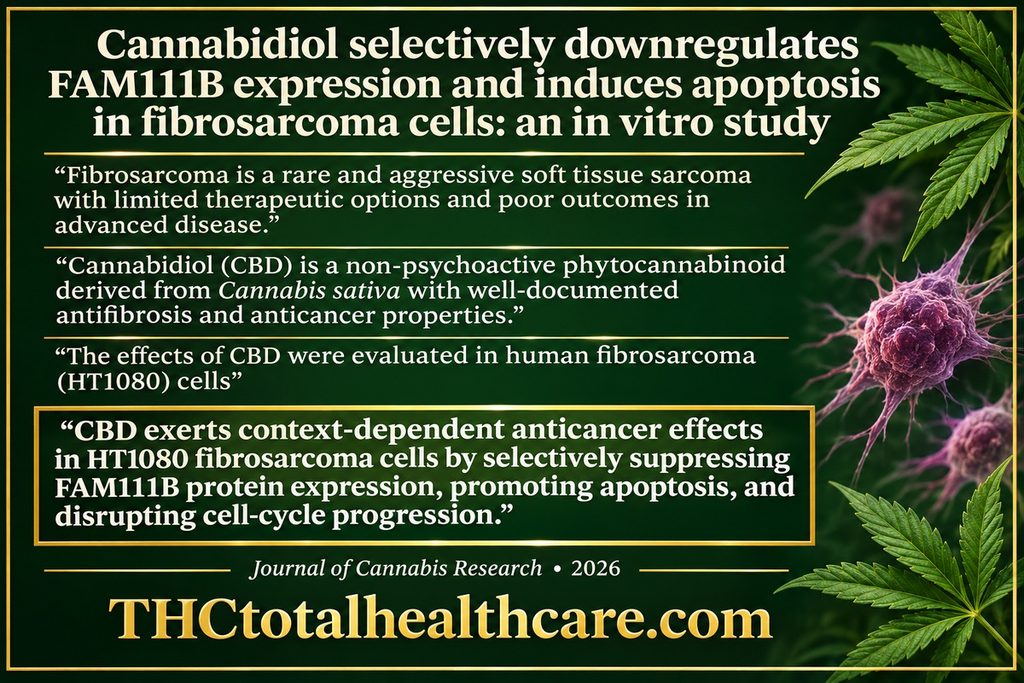
Cannabidiol (CBD) selectively reduced a tumor-associated protein and increased programmed cell death in human fibrosarcoma cells in a laboratory study. CBD, a naturally occurring cannabinoid derived from Cannabis sativa, suppressed FAM111B protein expression in cancer cells without significantly reducing this protein in non-cancerous fibroblasts.
Researchers compared human fibrosarcoma cells (HT1080) with non-cancerous human fibroblasts (FG0). CBD reduced the proteins BAG3 and Cyclin B1, which help regulate cellular survival and division, increased apoptosis, and disrupted cancer-cell progression through the cell cycle. These effects were substantially weaker in the non-cancerous cells, although CBD reduced overall metabolic activity similarly in both cell types.
The findings identify FAM111B- and BAG3-associated pathways as potential vulnerabilities in fibrosarcoma, a rare and aggressive soft tissue cancer. They support further preclinical investigation of CBD’s ability to influence cancer-cell stress responses, survival, and proliferation.
“Background: Fibrosarcoma is a rare and aggressive soft tissue sarcoma with limited therapeutic options and poor outcomes in advanced disease. Family with sequence similarity 111 member B (FAM111B) has emerged as a pro-tumorigenic factor associated with dysregulated cell survival and proliferation. Cannabidiol (CBD), a non-psychoactive phytocannabinoid, exhibits anticancer activity in multiple malignancies, but its effects on FAM111B expression and downstream pathways in fibrosarcoma remain unclear.
Methods: The effects of CBD were evaluated in human fibrosarcoma (HT1080) cells and non-cancerous human fibroblasts (FG0). Cell metabolic activity was assessed using an MTT assay. Gene and protein expression were determined by real-time quantitative PCR and Western blotting, respectively. Apoptosis and cell-cycle distribution were assessed by flow cytometry using Annexin V-FITC/propidium iodide (PI) and PI staining alone, respectively. Statistical analyses were performed using an unpaired Student’s t-test or a two-way analysis of variance (ANOVA) followed by Šídák’s post hoc multiple comparisons test, as appropriate.
Results: CBD reduced metabolic activity in both HT1080 and FG0 cells in a dose-dependent manner, with comparable IC₅₀ values (28.95 ± 3.15 µM and 30.75 ± 9.12 µM, respectively), indicating limited selectivity based on metabolic activity alone. CBD significantly reduced FAM111B mRNA expression by approximately 3-fold in HT1080 cells and 2-fold in FG0 cells; however, a significant reduction in FAM111B protein expression was observed only in HT1080 cells, CBD treatment was associated with marked downregulation of BAG3 and Cyclin B1 proteins, increased apoptosis (Annexin V-positive cells: 3.55 ± 0.78% vs. 13.20 ± 4.56%), and altered cell-cycle progression characterized by increased Sub-G1 (3.44 ± 1.10% vs. 18.37 ± 0.83%) and G0/G1 (28.30 ± 1.57% vs. 39.17 ± 0.85%) populations, with corresponding reductions in the S- and G2/M-phase populations. These effects were markedly attenuated in non-cancerous fibroblasts.
Conclusions: CBD exerts context-dependent anticancer effects in HT1080 fibrosarcoma cells by selectively suppressing FAM111B protein expression, promoting apoptosis, and disrupting cell-cycle progression. These findings identify FAM111B- and BAG3-associated pathways as potential therapeutic vulnerabilities and support further investigation of CBD as a modulator of stress-adaptive and proliferative signaling in preclinical fibrosarcoma models.”
https://pubmed.ncbi.nlm.nih.gov/42958469
“Cannabidiol (CBD) is a non-psychoactive phytocannabinoid derived from Cannabis sativa with well-documented antifibrosis and anticancer properties.”
“Together, these findings identify FAM111B- and BAG3-associated pathways as potential vulnerabilities in HT1080 fibrosarcoma cells and support further investigation of CBD as a mechanistic modulator of stress adaptation, apoptosis and cell-cycle regulation in preclinical sarcoma models.”
https://link.springer.com/article/10.1186/s42238-026-00481-1