
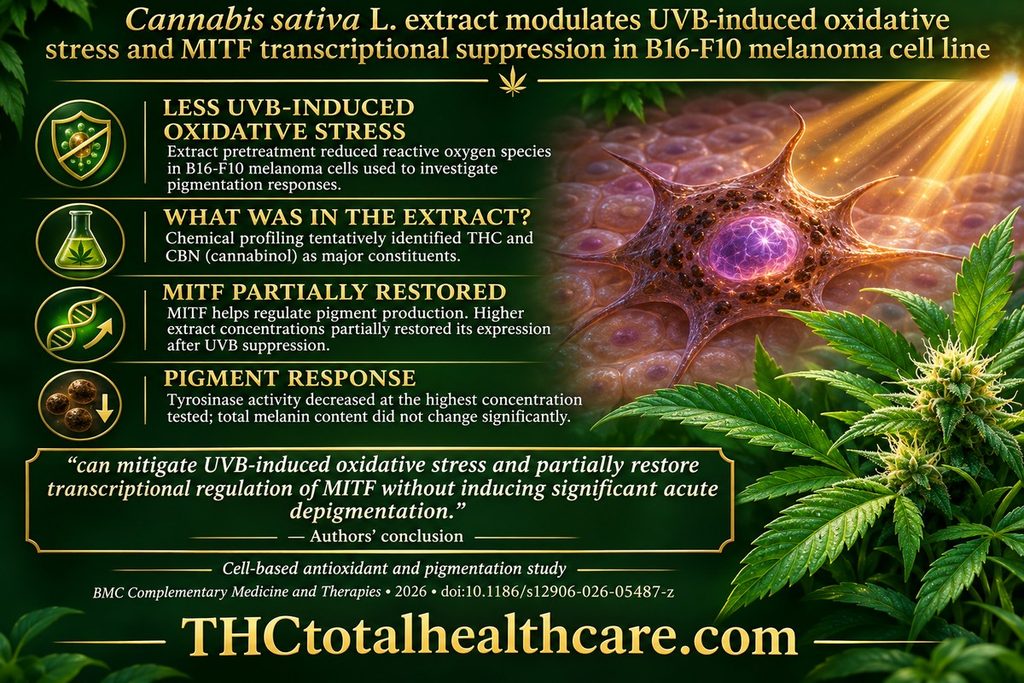
A cannabinoid-rich Cannabis sativa extract reduced UVB-induced oxidative stress in B16-F10 melanoma cells used to study pigmentation responses. Pretreatment lowered the buildup of reactive oxygen species—molecules that can damage cells when produced in excess. Chemical profiling tentatively identified THC and cannabinol (CBN) as major extract constituents.
UVB exposure suppressed expression of MITF, a regulator involved in pigment production, and higher extract concentrations partially restored it. At the highest concentration tested, the extract also reduced UVB-induced activity of tyrosinase, an enzyme involved in making pigment. Total melanin content, however, did not change significantly.
These findings support further investigation of cannabis-derived compounds for formulations targeting UV-related oxidative stress and cellular balance.
“Background: Ultraviolet B (UVB) radiation disrupts skin homeostasis through reactive oxygen species (ROS)-mediated oxidative stress and melanogenic imbalance. The search for effective exogenous photoprotectants has highlighted natural products, including Cannabis sativa L. phytocannabinoids with reported antioxidant activity. However, their role in UVB-induced cellular responses remains to be clarified.
Methods: Chemical profiling was performed using LC-QTOF-MS and Fourier-transform infrared (FTIR) spectroscopy. Biological activities were assessed in B16-F10 pigmented melanoma cells, including cytotoxicity (MTT assay), intracellular ROS generation (DCFDA assay), transcriptional regulation of melanogenic markers (MITF, TYR, TYRP1, TYRP2) by RT-qPCR, and functional melanogenesis outcomes (tyrosinase activity and melanin content).
Results: LC-QTOF-MS revealed that the extract was dominated by neutral cannabinoids, with Δ⁹-tetrahydrocannabinol (Δ⁹-THC) and cannabinol (CBN) as major putatively identified constituents based on relative peak area. The extract showed moderate free radical scavenging activity in a cell-free DPPH assay. Importantly, pre-treatment with the extract significantly reduced UVB-induced intracellular ROS accumulation. UVB exposure resulted in suppression of MITF mRNA expression, which was partially restored at higher extract concentrations, whereas transcript levels of TYR, TYRP1, and TYRP2 remained largely unchanged under the experimental conditions. Functionally, the extract attenuated UVB-induced tyrosinase activity at the highest concentration tested, while total melanin content was not significantly altered.
Conclusions: Collectively, these findings suggest that a neutral cannabinoid-rich C. sativa extract (CSE) can mitigate UVB-induced oxidative stress and partially restore transcriptional regulation of MITF without inducing significant acute depigmentation. The extract may represent a candidate for further investigation as a bioactive component that may support skin cell homeostasis regarding its potential antioxidant-mediated photoprotective activity in dermatological formulations targeted at photo-oxidative stress.”
https://pubmed.ncbi.nlm.nih.gov/42947120
“In conclusion, this study establishes that an ethanolic CSE, characterized by a lipophilic terpene-phenolic matrix of neutral cannabinoids, serves as a potential cytoprotective modulator against UVB-induced oxidative injury. Our data demonstrates that CSE effectively neutralizes intracellular ROS accumulation and partially restores the transcriptional suppression of MITF.
By bridging chemical profiling with molecular resilience, these results provide a strong mechanistic roadmap for utilizing cannabis-derived extracts to enhance skin homeostasis against solar radiation, offering a strong foundation for verifying its full photoprotective capacity in future models.”
https://link.springer.com/article/10.1186/s12906-026-05487-z