
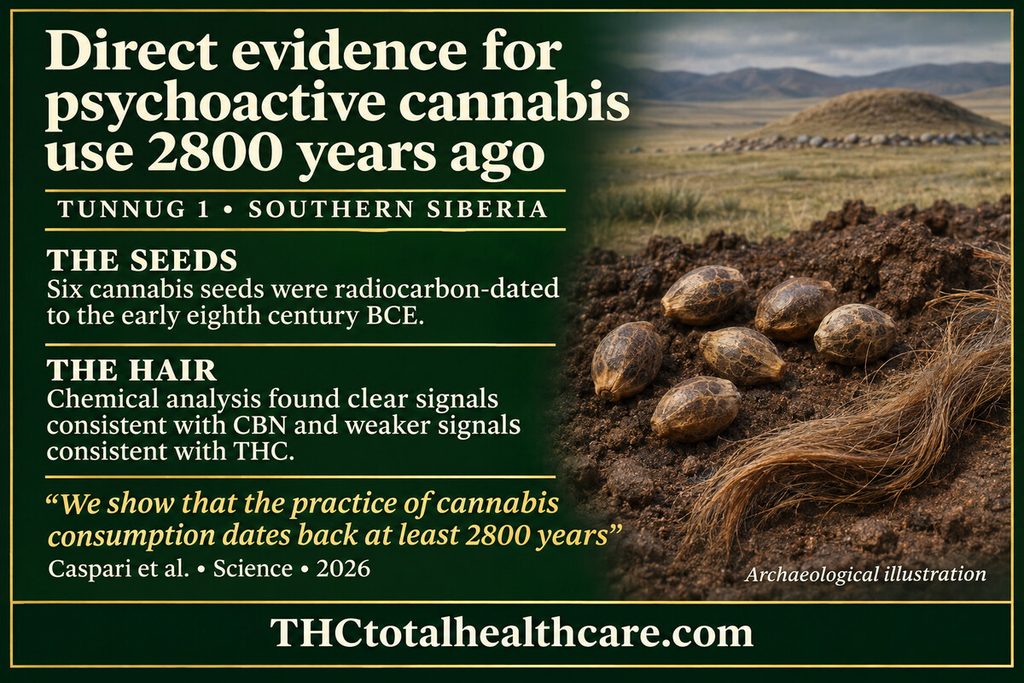
Chemical traces in human hair from a burial mound in southern Siberia provide the oldest directly dated evidence that people used cannabis for its mind-altering effects. The findings, published in Science, place psychoactive cannabis use at least 2,800 years ago.
At the Tunnug 1 burial mound, researchers radiocarbon-dated six cannabis seeds, placing them in the early eighth century BCE. High-resolution mass spectrometry detected clear signals consistent with cannabinol (CBN), which can form as THC oxidizes, in several hair samples. The researchers also found weaker signals consistent with THC itself.
The seeds establish that cannabis was placed in the tomb. The chemical traces in the hair are what led researchers to conclude that people likely used it for its psychoactive effects. The analysis leaves open how much they used and whether they inhaled or ingested it.
“Cannabis is the world’s most-used illicit psychoactive plant, yet direct prehistoric evidence for its consumption is rare. In this study, we present the earliest direct evidence of cannabis use: offerings of plant parts and chemical compounds in ancient human hair recovered from a monumental tomb in Siberia.
The findings suggest that the plant was used for its psychoactive qualities across Eurasia, where specific wild populations might have had naturally higher active compound levels. We show that the practice of cannabis consumption dates back at least 2800 years, anchoring debates around contemporary usage and informing discussions on cannabis in medicine, public health, law, and industry.”
https://pubmed.ncbi.nlm.nih.gov/42986939
“Psychoactive plants are used globally today, with increasing evidence of medicinal value and, in some cases, decreasing illegality. Cannabis is one of the most widely used and cultivated of these plants. The prevalence of past usage, particularly for ritual purposes, has often been suggested, but making conclusions about its use for psychoactive properties has been difficult. Cannabis plants are ephemeral, and even the presence of plant parts and seeds could be an indication of cultivation for its many other useful properties. Caspari et al. found cannabis plant parts in a 2800-year-old tomb in Siberia and also identified its psychoactive compounds in hair found within the tomb, suggesting ritualistic psychoactive use.”