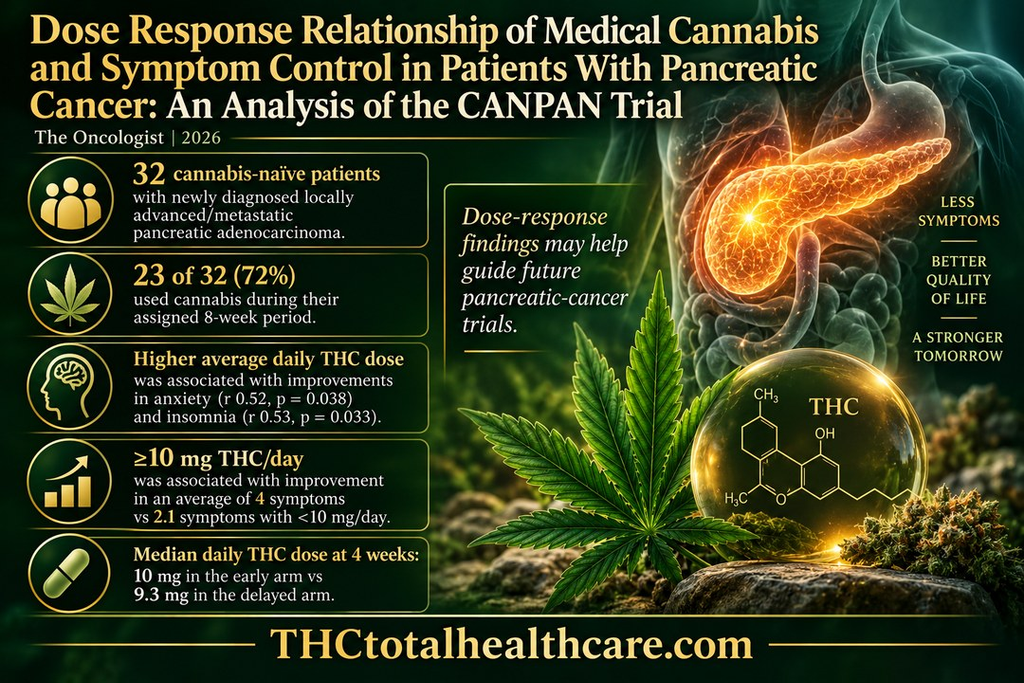
Dose Response Relationship of Medical Cannabis and Symptom Control in Patients With Pancreatic Cancer: An Analysis of the CANPAN Trial

A new analysis of the CANPAN trial found a clear dose-response relationship between THC and symptom improvement in patients with pancreatic cancer. The trial enrolled 32 cannabis-naïve patients with newly diagnosed locally advanced or metastatic pancreatic adenocarcinoma, and 23 used medical cannabis during their assigned eight-week treatment period.

Higher average daily THC doses were significantly associated with greater improvements in anxiety and insomnia. Patients receiving at least 10 mg of THC per day improved in an average of four symptoms, compared with 2.1 symptoms among patients receiving less than 10 mg per day.

The authors say these findings provide important dose-response information for future pancreatic-cancer trials, particularly for psychological symptoms and multi-symptom control. The results add to evidence from the CANPAN trial that personalized medical cannabis may have a role in managing symptoms experienced by people undergoing treatment for pancreatic cancer.

“Background: In a pilot waitlist-control randomized trial, a personalized medical cannabis intervention improved certain symptoms among patients with pancreatic cancer over 8 weeks. Longer-term and dose-response data can guide future trial design.

Methods: CANPAN enrolled 32 cannabis-naïve patients with newly diagnosed locally advanced/metastatic pancreatic adenocarcinoma (NCT06605430). Patients were randomized to early (0-8 weeks) or delayed (9-16 weeks) cannabis intervention. Primary efficacy results over the first 8 weeks were previously reported. We investigated cannabis use and patient-reported outcome (PRO) completion over 9-16 weeks, and the relationship between tetrahydrocannabinol (THC) dose and symptom efficacy.

Results: Among 32 participants, 23 (72%) used cannabis during their assigned 8-week period (12/16 in early arm and 11/16 in delayed arm). Of these, 16 (50%) had both pre-cannabis and 8-week post-cannabis initiation PRO data available. At the end of the 16-week study period, PRO data were available for 16 (50%) participants (9/16 early arm, 7/16 delayed arm). Median daily THC dose 4 weeks after starting cannabis was similar in early vs delayed arms (10 mg vs 9.3 mg). A higher average daily THC dose was associated with improvements in anxiety (r 0.52, p = 0.038) and insomnia (r 0.53, p = 0.033). A ≥ 10 mg daily THC dose (vs < 10 mg) was associated with mean improvement in 4 vs 2.1 symptoms.

Conclusions: The 50% complete data availability at 16 weeks, dose-response relationship with psychological symptoms, and threshold dose for multi-symptom efficacy will guide future trials. Similar cannabis use patterns across arms raise confidence in the waitlist-control design.”

https://pubmed.ncbi.nlm.nih.gov/42767994

https://academic.oup.com/oncolo/advance-article/doi/10.1093/oncolo/oyag374/8826188

Evaluating the impact of cannabinoid extracts on chronic pain and quality of life in endometriosis patients – a pilot study

Women with endometriosis and chronic pelvic pain experienced significant improvements after adding a balanced oral THC cannabis extract to their existing treatment. In this prospective pilot study, 27 women completed three months of treatment, with benefits appearing within the first month and continuing through the study period.

Pain intensity fell significantly, along with the number of pain days and the need for conventional pain medicines. Use of both NSAIDs and opioid analgesics decreased, while fatigue, anxiety, central sensitization and pain-related disability also improved.

Quality of life improved across every measured EHP-30 domain, including pain, emotional well-being, work impairment, self-image and sexual relationships. The authors concluded that balanced THC cannabinoid medicines appear to be a potentially effective adjunct treatment for chronic pelvic pain and related symptoms in women with endometriosis.

“Endometriosis is a chronic gynecological disorder characterized by persistent pain and impaired quality of life, with limited effective treatment options. Emerging evidence indicates that cannabinoids may provide analgesic and symptom-relieving effects in chronic pain conditions.

This prospective single-center cohort study investigated the effects of standardized oral cannabis extracts (cannabinoid-based medicinal products, CBMPs) on pain and quality of life in women with endometriosis.

Thirty premenopausal women aged 18-45 years with confirmed endometriosis and chronic pelvic pain were enrolled; 27 completed the 3-month treatment period. Participants received oral CBMPs containing a balanced THC: CBD ratio. Pain intensity, frequency of pain episodes, analgesic use, fatigue, anxiety, central sensitization, disability, and quality of life were assessed using validated questionnaires (VAS, EHP-30, PDI, CFS, GAD-7, CSI).

Significant improvements were observed after one month of treatment, with continued benefit over three months. Pain intensity decreased markedly (p = 0.0004), accompanied by reductions in the number of pain days and analgesic use, including both NSAIDs (e.g., ibuprofen, diclofenac) and opioid analgesics (e.g., tramadol, tilidin, oxycodone) (p < 0.001). Fatigue (p = 0.0013), anxiety (p < 0.0001), central sensitization (p < 0.0001), disability (p < 0.0001), and overall quality of life (EHP-30) improved significantly.

Treatment was well tolerated; side effects were predominantly mild (severity score 1 on a 0-3 scale) and transient, occurring mainly during the titration phase and declining thereafter. Although limited by its single-center design, lack of placebo control, and short follow-up, this study provides preliminary evidence that oral CBMPs may represent a safe and effective adjunct therapy for managing pain and related symptoms in women with endometriosis. Larger randomized controlled trials are warranted to confirm these findings and establish optimal dosing strategies.”

https://pubmed.ncbi.nlm.nih.gov/42771648

“In conclusion, oral CBMPs with balanced THC: CBD ratios seem to be a safe and potentially effective adjunct therapy for chronic pelvic pain and related symptoms in women with endometriosis. By targeting both nociceptive and neuropsychological aspects of the condition, CBMPs can supplement existing pharmacological and lifestyle strategies, providing a more comprehensive approach to symptom management. These findings establish a basis for future controlled studies to refine dosing, investigate mechanisms, and assess long-term outcomes in this complex patient group.”

https://journals.plos.org/plosone/article?id=10.1371/journal.pone.0356768

UK Medical Cannabis Registry: An Updated Analysis of Inflammatory Arthritis

A new analysis from the UK Medical Cannabis Registry reports sustained improvements in pain, sleep, and health-related quality of life among patients with inflammatory arthritis who were prescribed cannabis-based medicinal products.

The study followed 192 patients for up to 24 months. Improvements were reported across multiple pain measures at every follow-up point, including pain severity, pain interference, and overall pain scores. Sleep quality and general quality of life also improved compared with baseline.

Notably, many patients were prescribed THC-containing products, including dried cannabis flower and oils. The findings add long-term real-world evidence that prescribed cannabis medicines may help some people living with inflammatory arthritis.

“Aim: Cannabis-based medicinal products (CBMPs) are an emerging therapeutic option for pain in inflammatory arthritis, yet clinical evidence remains limited. This study aimed to evaluate changes in pain-specific and general health-related outcomes in patients with inflammatory arthritis treated with CBMPs and to characterize the safety profile by examining the incidence and nature of adverse events.

Methods: Patients treated with CBMPs for inflammatory arthritis-associated pain for ⩾24 months were identified from the UK Medical Cannabis Registry. Primary outcomes included changes in patient-reported measures: Brief Pain Inventory (BPI), Pain Visual Analogue Scale (Pain VAS), Short-Form McGill Pain Questionnaire 2 (SF-MPQ-2), EuroQol 5-dimension 5-level (EQ-5D-5L), Generalized Anxiety Disorder-7 (GAD-7), and Single-Item Sleep Quality Scale (SQS) at 1, 3, 6, 12, 18, and 24 months vs baseline. Adverse events were recorded and analysed. Statistical significance was set at P < .050.

Results: A total of 192 patients met inclusion criteria. The CBMP initiation was associated with improvements in BPI Interference, BPI Severity, Pain VAS, SF-MPQ-2, SQS, and EQ-5D-5L index values at all follow-up time points (P < .010) and in GAD-7 scores up to 3 months (P < .001). Twenty-seven patients (14.06%) reported 296 adverse events: 126 (42.57%) mild, 132 (44.59%) moderate, and 38 (12.84%) severe. No life-threatening events occurred.

Conclusion: The CBMP therapy was associated with reductions in pain and improvements in health-related quality of life among individuals with inflammatory arthritis. Although causality cannot be inferred from this observational design, these findings support the need for randomized controlled trials to determine the efficacy of CBMPs for inflammatory arthritis-related pain.”

https://pubmed.ncbi.nlm.nih.gov/42724108

“Overall, results of this study demonstrate reductions in pain severity and improvements in HRQoL for patients receiving CBMP treatment for chronic pain linked to inflammatory arthritis over a period of 24 months of follow-up. The CBMPs were generally well-tolerated, although the risk of AE and individual responses should be considered before commencing CBMP treatment.”

https://journals.sagepub.com/doi/10.1177/11795441261480709