
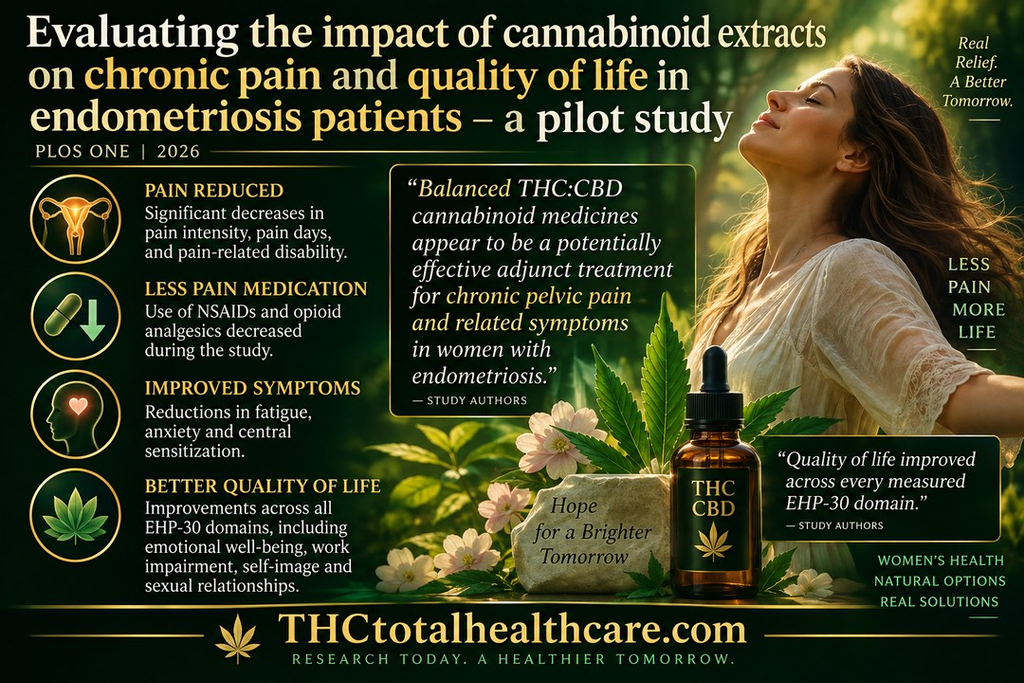
Evaluating the impact of cannabinoid extracts on chronic pain and quality of life in endometriosis patients – a pilot study

Women with endometriosis and chronic pelvic pain experienced significant improvements after adding a balanced oral THC cannabis extract to their existing treatment. In this prospective pilot study, 27 women completed three months of treatment, with benefits appearing within the first month and continuing through the study period.

Pain intensity fell significantly, along with the number of pain days and the need for conventional pain medicines. Use of both NSAIDs and opioid analgesics decreased, while fatigue, anxiety, central sensitization and pain-related disability also improved.

Quality of life improved across every measured EHP-30 domain, including pain, emotional well-being, work impairment, self-image and sexual relationships. The authors concluded that balanced THC cannabinoid medicines appear to be a potentially effective adjunct treatment for chronic pelvic pain and related symptoms in women with endometriosis.

“Endometriosis is a chronic gynecological disorder characterized by persistent pain and impaired quality of life, with limited effective treatment options. Emerging evidence indicates that cannabinoids may provide analgesic and symptom-relieving effects in chronic pain conditions.

This prospective single-center cohort study investigated the effects of standardized oral cannabis extracts (cannabinoid-based medicinal products, CBMPs) on pain and quality of life in women with endometriosis.

Thirty premenopausal women aged 18-45 years with confirmed endometriosis and chronic pelvic pain were enrolled; 27 completed the 3-month treatment period. Participants received oral CBMPs containing a balanced THC: CBD ratio. Pain intensity, frequency of pain episodes, analgesic use, fatigue, anxiety, central sensitization, disability, and quality of life were assessed using validated questionnaires (VAS, EHP-30, PDI, CFS, GAD-7, CSI).

Significant improvements were observed after one month of treatment, with continued benefit over three months. Pain intensity decreased markedly (p = 0.0004), accompanied by reductions in the number of pain days and analgesic use, including both NSAIDs (e.g., ibuprofen, diclofenac) and opioid analgesics (e.g., tramadol, tilidin, oxycodone) (p < 0.001). Fatigue (p = 0.0013), anxiety (p < 0.0001), central sensitization (p < 0.0001), disability (p < 0.0001), and overall quality of life (EHP-30) improved significantly.

Treatment was well tolerated; side effects were predominantly mild (severity score 1 on a 0-3 scale) and transient, occurring mainly during the titration phase and declining thereafter. Although limited by its single-center design, lack of placebo control, and short follow-up, this study provides preliminary evidence that oral CBMPs may represent a safe and effective adjunct therapy for managing pain and related symptoms in women with endometriosis. Larger randomized controlled trials are warranted to confirm these findings and establish optimal dosing strategies.”

https://pubmed.ncbi.nlm.nih.gov/42771648

“In conclusion, oral CBMPs with balanced THC: CBD ratios seem to be a safe and potentially effective adjunct therapy for chronic pelvic pain and related symptoms in women with endometriosis. By targeting both nociceptive and neuropsychological aspects of the condition, CBMPs can supplement existing pharmacological and lifestyle strategies, providing a more comprehensive approach to symptom management. These findings establish a basis for future controlled studies to refine dosing, investigate mechanisms, and assess long-term outcomes in this complex patient group.”

https://journals.plos.org/plosone/article?id=10.1371/journal.pone.0356768
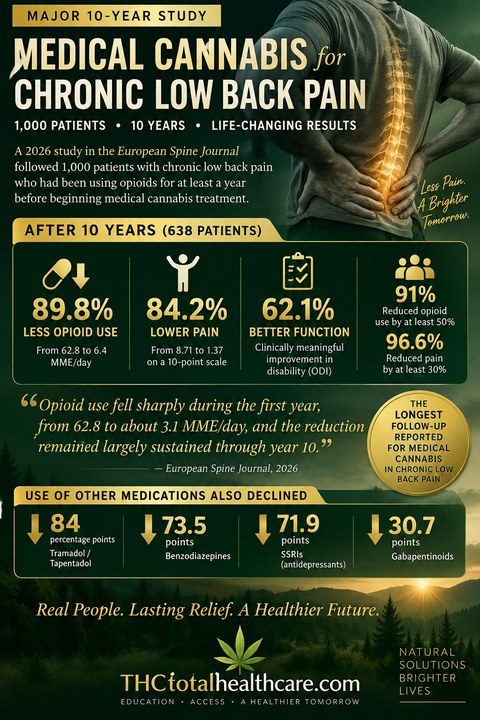
Ten-year outcomes of medical cannabis for chronic low back pain: opioid reduction, pain relief, and functional improvement in 1,000 patients

A 2026 study published in the European Spine Journal followed 1,000 patients with chronic low back pain who had been using opioids for at least a year before beginning medical cannabis treatment. Researchers tracked changes in opioid use, pain, disability, and other medications over as long as 10 years.

Among the 638 patients who completed the full 10-year follow-up, average opioid use fell by 89.8%, while pain scores dropped by 84.2%. More than 91% of patients achieved at least a 50% reduction in opioid use, and 96.6% achieved at least a 30% reduction in pain. Disability scores also improved substantially over the study period.

The reductions were not limited to opioids. Use of benzodiazepines, gabapentinoids, antidepressants, and other pain medications also declined. With a decade of follow-up, this study provides unusually long-term evidence that medical cannabis may play an important role in reducing pain, improving function, and decreasing dependence on multiple medications in people living with chronic low back pain.

“Purpose: To evaluate 10-year outcomes of medical cannabis therapy on opioid use, pain intensity, functional disability, concomitant medication use, and adverse events in cannabis-naïve chronic low back pain (CLBP) patients, with particular attention to clinically meaningful outcomes defined by established minimal clinically important difference (MCID) thresholds.

Methods: Single-center longitudinal observational study of 1,000 consecutive cannabis-naïve CLBP patients from a registry database (2015-2024), reported following STROBE guidelines.

Primary outcome: morphine milligram equivalents (MMEQ).

Secondary outcomes: Numeric Rating Scale (NRS) for pain intensity, Oswestry Disability Index (ODI) for functional disability, cannabis dosing patterns, adverse events, and concomitant medication use. Pre-specified MCID thresholds: ≥50% MMEQ reduction, ≥ 30% NRS reduction, ≥ 10-point ODI improvement. Statistical analyses included paired t-tests for completers and linear mixed-effects models for sensitivity analyses.

Results: Of 1,000 enrolled patients, 638 (63.8%) completed 10-year follow-up. Among completers, MMEQ decreased from 62.8 ± 35.7 to 6.4 ± 7.1 mg/day (- 89.8%, p < 0.001); NRS from 8.71 ± 1.23 to 1.37 ± 1.71 (- 84.2%, p < 0.001); ODI from 52.9 ± 11.9% to 36.8 ± 14.9% (16.1-point reduction, – 30.4%, p < 0.001). MCID responders: 91.2% for MMEQ, 96.6% for NRS, 62.1% for ODI. Substantial polypharmacy reductions occurred: tramadol/tapentadol – 84.0% points (pp), benzodiazepines – 73.5 pp, SSRIs – 71.9 pp, gabapentinoids – 30.7 pp. True tolerability adverse events occurred in 11.4% of visits; serious psychiatric events in 0.02%.

Conclusions: In this uncontrolled observational study, medical cannabis therapy was associated with reductions in opioid use, pain intensity, and functional disability over 10 years, accompanied by polypharmacy reduction and acceptable tolerability. Effect sizes substantially exceeded RCT benchmarks (e.g., – 0.6 NRS difference vs. placebo in a recent phase 3 trial), suggesting observational biases contribute to these findings. These hypothesis-generating data warrant validation in randomized controlled trials.”

https://pubmed.ncbi.nlm.nih.gov/42734834

“In this 10-year single-arm observational study, medical cannabis therapy was associated with reductions in opioid use (− 89.8%), pain intensity (− 84.2%), and functional disability (− 30.4%), with high proportions of patients achieving pre-specified MCID thresholds. Substantial polypharmacy reductions and acceptable tolerability were observed.”

https://link.springer.com/article/10.1007/s00586-026-10290-y