
Ten-year outcomes of medical cannabis for chronic low back pain: opioid reduction, pain relief, and functional improvement in 1,000 patients

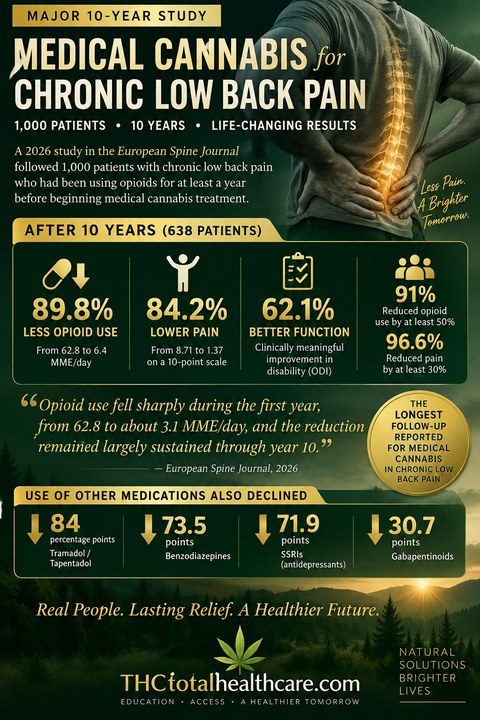
A 2026 study published in the European Spine Journal followed 1,000 patients with chronic low back pain who had been using opioids for at least a year before beginning medical cannabis treatment. Researchers tracked changes in opioid use, pain, disability, and other medications over as long as 10 years.

Among the 638 patients who completed the full 10-year follow-up, average opioid use fell by 89.8%, while pain scores dropped by 84.2%. More than 91% of patients achieved at least a 50% reduction in opioid use, and 96.6% achieved at least a 30% reduction in pain. Disability scores also improved substantially over the study period.

The reductions were not limited to opioids. Use of benzodiazepines, gabapentinoids, antidepressants, and other pain medications also declined. With a decade of follow-up, this study provides unusually long-term evidence that medical cannabis may play an important role in reducing pain, improving function, and decreasing dependence on multiple medications in people living with chronic low back pain.

“Purpose: To evaluate 10-year outcomes of medical cannabis therapy on opioid use, pain intensity, functional disability, concomitant medication use, and adverse events in cannabis-naïve chronic low back pain (CLBP) patients, with particular attention to clinically meaningful outcomes defined by established minimal clinically important difference (MCID) thresholds.

Methods: Single-center longitudinal observational study of 1,000 consecutive cannabis-naïve CLBP patients from a registry database (2015-2024), reported following STROBE guidelines.

Primary outcome: morphine milligram equivalents (MMEQ).

Secondary outcomes: Numeric Rating Scale (NRS) for pain intensity, Oswestry Disability Index (ODI) for functional disability, cannabis dosing patterns, adverse events, and concomitant medication use. Pre-specified MCID thresholds: ≥50% MMEQ reduction, ≥ 30% NRS reduction, ≥ 10-point ODI improvement. Statistical analyses included paired t-tests for completers and linear mixed-effects models for sensitivity analyses.

Results: Of 1,000 enrolled patients, 638 (63.8%) completed 10-year follow-up. Among completers, MMEQ decreased from 62.8 ± 35.7 to 6.4 ± 7.1 mg/day (- 89.8%, p < 0.001); NRS from 8.71 ± 1.23 to 1.37 ± 1.71 (- 84.2%, p < 0.001); ODI from 52.9 ± 11.9% to 36.8 ± 14.9% (16.1-point reduction, – 30.4%, p < 0.001). MCID responders: 91.2% for MMEQ, 96.6% for NRS, 62.1% for ODI. Substantial polypharmacy reductions occurred: tramadol/tapentadol – 84.0% points (pp), benzodiazepines – 73.5 pp, SSRIs – 71.9 pp, gabapentinoids – 30.7 pp. True tolerability adverse events occurred in 11.4% of visits; serious psychiatric events in 0.02%.

Conclusions: In this uncontrolled observational study, medical cannabis therapy was associated with reductions in opioid use, pain intensity, and functional disability over 10 years, accompanied by polypharmacy reduction and acceptable tolerability. Effect sizes substantially exceeded RCT benchmarks (e.g., – 0.6 NRS difference vs. placebo in a recent phase 3 trial), suggesting observational biases contribute to these findings. These hypothesis-generating data warrant validation in randomized controlled trials.”

https://pubmed.ncbi.nlm.nih.gov/42734834

“In this 10-year single-arm observational study, medical cannabis therapy was associated with reductions in opioid use (− 89.8%), pain intensity (− 84.2%), and functional disability (− 30.4%), with high proportions of patients achieving pre-specified MCID thresholds. Substantial polypharmacy reductions and acceptable tolerability were observed.”

https://link.springer.com/article/10.1007/s00586-026-10290-y

Role of the endocannabinoid system in the formation and development of depression.

“Two types of cannabinoid (CB) receptors have been described in the human body: CB1 and CB2 receptors. CB1 receptor distribution may be related to the cannabinoid functions of memory and cognition regulation as well as motor control. In addition, the endocannabinoid system (ECS) related to CB1 receptors may be involved in human emotion regulation, especially depression occurrence. Indeed, CB1 receptors are all distributed in depression associated neuroanatomical structures and neural circuits. Both animal experiments and clinical studies have demonstrated that impairment of the ECS pathway is present in depression models and patients, and application of both CB1 receptor agonists and anandamide (cannabinoid-like substance) degradation inhibitors produce similar biochemical and behavioral effects as antidepressants. These findings provide a solid basis for understanding the ECS role in the formation and development of depression. Therefore, it can be inferred that the ECS may have an important function in both depression treatment and the effects of antidepressants.” https://www.ncbi.nlm.nih.gov/pubmed/29441900]]>

Care and Feeding of the Endocannabinoid System: A Systematic Review of Potential Clinical Interventions that Upregulate the Endocannabinoid System

An external file that holds a picture, illustration, etc.
Object name is pone.0089566.g002.jpg

“The “classic” endocannabinoid (eCB) system… An emerging literature documents the “eCB deficiency syndrome” as an etiology in migraine, fibromyalgia, irritable bowel syndrome, psychological disorders, and other conditions. We performed a systematic review of clinical interventions that enhance the eCB system—ways to upregulate cannabinoid receptors, increase ligand synthesis, or inhibit ligand degradation.

Evidence indicates that several classes of pharmaceuticals upregulate the eCB system, including analgesics (acetaminophen, non-steroidal anti-inflammatory drugs, opioids, glucocorticoids), antidepressants, antipsychotics, anxiolytics, and anticonvulsants.

Clinical interventions characterized as “complementary and alternative medicine” also upregulate the eCB system: massage and manipulation, acupuncture, dietary supplements, and herbal medicines. Lifestyle modification (diet, weight control, exercise, and the use of psychoactive substances—alcohol, tobacco, coffee, cannabis) also modulate the eCB system.”

http://www.ncbi.nlm.nih.gov/pmc/articles/PMC3951193/#!po=4.79452


“Clinical endocannabinoid deficiency (CECD): can this concept explain therapeutic benefits of cannabis in migraine, fibromyalgia, irritable bowel syndrome and other treatment-resistant conditions? Migraine, fibromyalgia, IBS and related conditions display common clinical, biochemical and pathophysiological patterns that suggest an underlying clinical endocannabinoid deficiency that may be suitably treated with cannabinoid medicines.”

 http://www.ncbi.nlm.nih.gov/pubmed/18404144

Adjunctive nabilone in cancer pain and symptom management: a prospective observational study using propensity scoring.

“A prospective observational study assessed the effectiveness of adjuvant nabilone (Cesamet) therapy in managing pain and symptoms experienced by advanced cancer patients… When compared with those not taking nabilone, patients using this cannabinoid had a lower rate of starting nonsteroidal anti-inflammatory agents, tricyclic antidepressants, gabapentin, dexamethasone, metoclopramide, and ondansetron and a greater tendency to discontinue these drugs.”

http://www.ncbi.nlm.nih.gov/pubmed/18402303