Ten-year outcomes of medical cannabis for chronic low back pain: opioid reduction, pain relief, and functional improvement in 1,000 patients

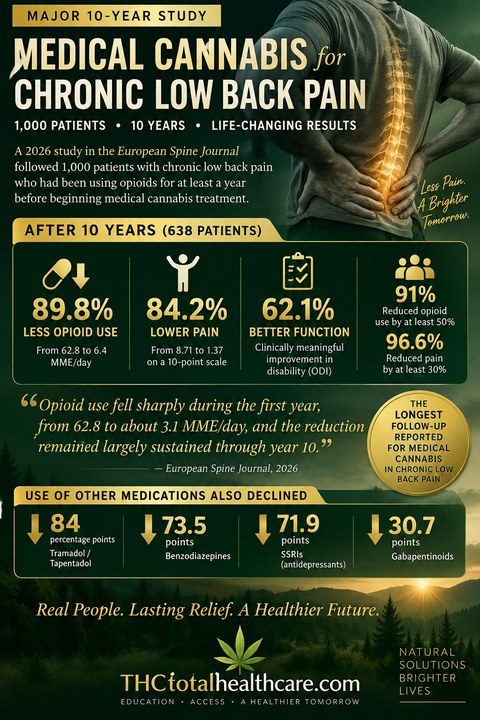
A 2026 study published in the European Spine Journal followed 1,000 patients with chronic low back pain who had been using opioids for at least a year before beginning medical cannabis treatment. Researchers tracked changes in opioid use, pain, disability, and other medications over as long as 10 years.

Among the 638 patients who completed the full 10-year follow-up, average opioid use fell by 89.8%, while pain scores dropped by 84.2%. More than 91% of patients achieved at least a 50% reduction in opioid use, and 96.6% achieved at least a 30% reduction in pain. Disability scores also improved substantially over the study period.

The reductions were not limited to opioids. Use of benzodiazepines, gabapentinoids, antidepressants, and other pain medications also declined. With a decade of follow-up, this study provides unusually long-term evidence that medical cannabis may play an important role in reducing pain, improving function, and decreasing dependence on multiple medications in people living with chronic low back pain.

“Purpose: To evaluate 10-year outcomes of medical cannabis therapy on opioid use, pain intensity, functional disability, concomitant medication use, and adverse events in cannabis-naïve chronic low back pain (CLBP) patients, with particular attention to clinically meaningful outcomes defined by established minimal clinically important difference (MCID) thresholds.

Methods: Single-center longitudinal observational study of 1,000 consecutive cannabis-naïve CLBP patients from a registry database (2015-2024), reported following STROBE guidelines.

Primary outcome: morphine milligram equivalents (MMEQ).

Secondary outcomes: Numeric Rating Scale (NRS) for pain intensity, Oswestry Disability Index (ODI) for functional disability, cannabis dosing patterns, adverse events, and concomitant medication use. Pre-specified MCID thresholds: ≥50% MMEQ reduction, ≥ 30% NRS reduction, ≥ 10-point ODI improvement. Statistical analyses included paired t-tests for completers and linear mixed-effects models for sensitivity analyses.

Results: Of 1,000 enrolled patients, 638 (63.8%) completed 10-year follow-up. Among completers, MMEQ decreased from 62.8 ± 35.7 to 6.4 ± 7.1 mg/day (- 89.8%, p < 0.001); NRS from 8.71 ± 1.23 to 1.37 ± 1.71 (- 84.2%, p < 0.001); ODI from 52.9 ± 11.9% to 36.8 ± 14.9% (16.1-point reduction, – 30.4%, p < 0.001). MCID responders: 91.2% for MMEQ, 96.6% for NRS, 62.1% for ODI. Substantial polypharmacy reductions occurred: tramadol/tapentadol – 84.0% points (pp), benzodiazepines – 73.5 pp, SSRIs – 71.9 pp, gabapentinoids – 30.7 pp. True tolerability adverse events occurred in 11.4% of visits; serious psychiatric events in 0.02%.

Conclusions: In this uncontrolled observational study, medical cannabis therapy was associated with reductions in opioid use, pain intensity, and functional disability over 10 years, accompanied by polypharmacy reduction and acceptable tolerability. Effect sizes substantially exceeded RCT benchmarks (e.g., – 0.6 NRS difference vs. placebo in a recent phase 3 trial), suggesting observational biases contribute to these findings. These hypothesis-generating data warrant validation in randomized controlled trials.”

https://pubmed.ncbi.nlm.nih.gov/42734834

“In this 10-year single-arm observational study, medical cannabis therapy was associated with reductions in opioid use (− 89.8%), pain intensity (− 84.2%), and functional disability (− 30.4%), with high proportions of patients achieving pre-specified MCID thresholds. Substantial polypharmacy reductions and acceptable tolerability were observed.”

https://link.springer.com/article/10.1007/s00586-026-10290-y
UK Medical Cannabis Registry: An Updated Analysis of Inflammatory Arthritis

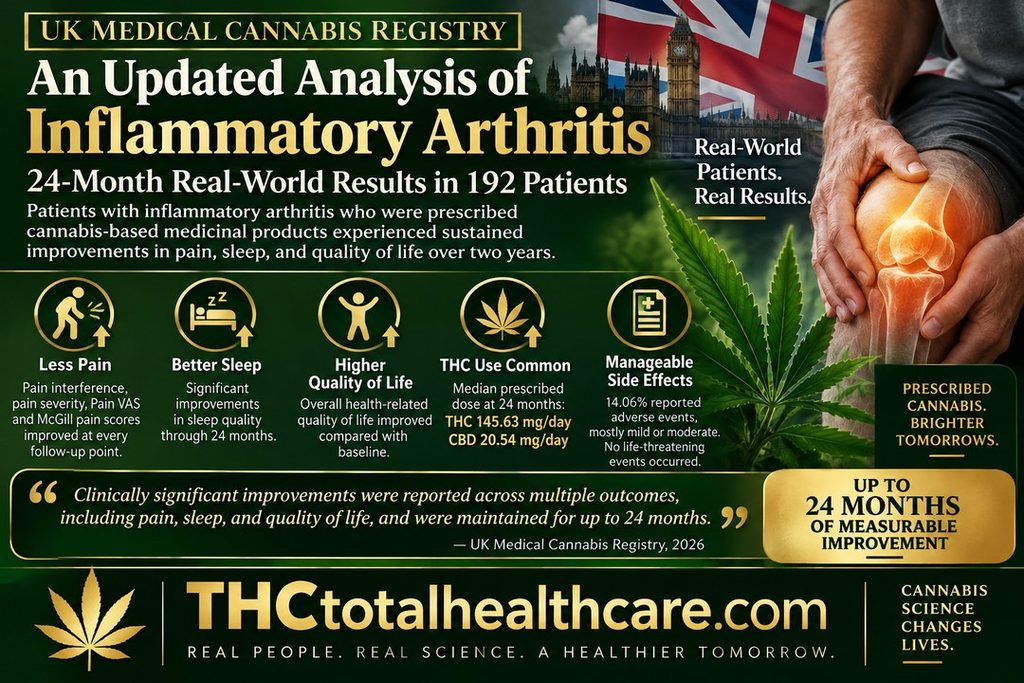
A new analysis from the UK Medical Cannabis Registry reports sustained improvements in pain, sleep, and health-related quality of life among patients with inflammatory arthritis who were prescribed cannabis-based medicinal products.

The study followed 192 patients for up to 24 months. Improvements were reported across multiple pain measures at every follow-up point, including pain severity, pain interference, and overall pain scores. Sleep quality and general quality of life also improved compared with baseline.

Notably, many patients were prescribed THC-containing products, including dried cannabis flower and oils. The findings add long-term real-world evidence that prescribed cannabis medicines may help some people living with inflammatory arthritis.

“Aim: Cannabis-based medicinal products (CBMPs) are an emerging therapeutic option for pain in inflammatory arthritis, yet clinical evidence remains limited. This study aimed to evaluate changes in pain-specific and general health-related outcomes in patients with inflammatory arthritis treated with CBMPs and to characterize the safety profile by examining the incidence and nature of adverse events.

Methods: Patients treated with CBMPs for inflammatory arthritis-associated pain for ⩾24 months were identified from the UK Medical Cannabis Registry. Primary outcomes included changes in patient-reported measures: Brief Pain Inventory (BPI), Pain Visual Analogue Scale (Pain VAS), Short-Form McGill Pain Questionnaire 2 (SF-MPQ-2), EuroQol 5-dimension 5-level (EQ-5D-5L), Generalized Anxiety Disorder-7 (GAD-7), and Single-Item Sleep Quality Scale (SQS) at 1, 3, 6, 12, 18, and 24 months vs baseline. Adverse events were recorded and analysed. Statistical significance was set at P < .050.

Results: A total of 192 patients met inclusion criteria. The CBMP initiation was associated with improvements in BPI Interference, BPI Severity, Pain VAS, SF-MPQ-2, SQS, and EQ-5D-5L index values at all follow-up time points (P < .010) and in GAD-7 scores up to 3 months (P < .001). Twenty-seven patients (14.06%) reported 296 adverse events: 126 (42.57%) mild, 132 (44.59%) moderate, and 38 (12.84%) severe. No life-threatening events occurred.

Conclusion: The CBMP therapy was associated with reductions in pain and improvements in health-related quality of life among individuals with inflammatory arthritis. Although causality cannot be inferred from this observational design, these findings support the need for randomized controlled trials to determine the efficacy of CBMPs for inflammatory arthritis-related pain.”

https://pubmed.ncbi.nlm.nih.gov/42724108

“Overall, results of this study demonstrate reductions in pain severity and improvements in HRQoL for patients receiving CBMP treatment for chronic pain linked to inflammatory arthritis over a period of 24 months of follow-up. The CBMPs were generally well-tolerated, although the risk of AE and individual responses should be considered before commencing CBMP treatment.”

https://journals.sagepub.com/doi/10.1177/11795441261480709

Health Outcomes among Adults Initiating Medical Cannabis for Chronic Pain: A 3-month Prospective Study Incorporating Ecological Momentary Assessment (EMA)

“In response to the need of more rigorous data on medical cannabis and chronic pain, we conducted a 3-month prospective study incorporating ecological momentary assessment (EMA) to examine the effects of medical cannabis on pain, anxiety/depression, sleep, and quality of life.

Data were collected from 46 adults (Mean age=55.7±11.9, 52.2% male) newly initiating medical cannabis treatment for chronic pain. Participants completed a baseline survey, EMA for approximately 1 week pre- and up to 3 weeks post- medical cannabis treatment, and a 3-month follow-up survey.

The self-reported EMA data (2535 random and 705 daily assessments) indicated significant reductions in momentary pain intensity (b = -16.5, p < .001, 16.5 points reduction on 0-100 visual analog) and anxiety (b = -0.89, p < .05), and significant increase in daily sleep duration (b = 0.34, p < .01) and sleep quality (b = 0.32, p <.001) after participants initiated medical cannabis for a few weeks.

At 3 months, self-reported survey data showed significantly lower levels of worst pain (t = -2.38, p < .05), pain interference (t = -3.82, p < .05), and depression (t = -3.43, p < .01), as well as increased sleep duration (t = 3.95, p < .001), sleep quality (t = -3.04, p < .01), and quality of life (t = 4.48, p < .001) compared to baseline.

In our sample of primarily middle-aged and older adults with chronic pain, medical cannabis was associated with reduced pain intensity/inference, lower anxiety/depression, and improved sleep and quality of life.”

https://pubmed.ncbi.nlm.nih.gov/34671723/

https://publications.sciences.ucf.edu/cannabis/index.php/Cannabis/article/view/97

Analgesic Potential of Terpenes Derived from Cannabis sativa

Pharmacological Reviews“Pain prevalence among adults in the United States has increased 25% over the past two decades, resulting in high health-care costs and impacts to patient quality of life. In the last 30 years, our understanding of pain circuits and (intra)cellular mechanisms has grown exponentially, but this understanding has not yet resulted in improved therapies. Options for pain management are limited. Many analgesics have poor efficacy and are accompanied by severe side effects such as addiction, resulting in a devastating opioid abuse and overdose epidemic. These problems have encouraged scientists to identify novel molecular targets and develop alternative pain therapeutics.

Increasing preclinical and clinical evidence suggests that cannabis has several beneficial pharmacological activities, including pain relief.

Cannabis sativa contains more than 500 chemical compounds, with two principle phytocannabinoids, Δ9-tetrahydrocannabinol (Δ9-THC) and cannabidiol (CBD). Beyond phytocannabinoids, more than 150 terpenes have been identified in different cannabis chemovars. Although the predominant cannabinoids, Δ9-THC and CBD, are thought to be the primary medicinal compounds, terpenes including the monoterpenes β-myrcene, α-pinene, limonene, and linalool, as well as the sesquiterpenes β-caryophyllene and α-humulene may contribute to many pharmacological properties of cannabis, including anti-inflammatory and antinociceptive effects.

The aim of this review is to summarize our current knowledge about terpene compounds in cannabis and to analyze the available scientific evidence for a role of cannabis-derived terpenes in modern pain management.

SIGNIFICANCE STATEMENT: Decades of research have improved our knowledge of cannabis polypharmacy and contributing phytochemicals, including terpenes. Reform of the legal status for cannabis possession and increased availability (medicinal and recreational) have resulted in cannabis use to combat the increasing prevalence of pain and may help to address the opioid crisis. Better understanding of the pharmacological effects of cannabis and its active components, including terpenes, may assist in identifying new therapeutic approaches and optimizing the use of cannabis and/or terpenes as analgesic agents.”

https://pubmed.ncbi.nlm.nih.gov/34663685/

“Cannabis sativa has been used for medical, recreational, and spiritual purposes for thousands of years. Modern scientific studies have provided increasing amounts of preclinical and clinical evidence about its beneficial pharmacological effects, including pain relief. Recent changes in the legislation of cannabis usage and possession have resulted in cannabis-based products becoming widely used alternatives in fighting against many different illnesses. Medical marijuana has been applied to treat a host of indications, but the most frequent, and evidence-backed indication, is pain. Overall, cannabis terpenes have a high potential for pain management, alone or as adjunctive therapeutics, and are attractive compounds for the development of terpene-based analgesics given their generally-recognized-as-safe status with low side effect and toxicity profiles.”

The Effect of Medical Cannabis on Pain Level and Quality of Sleep among Rheumatology Clinic Outpatients

logo“Introduction: Medical cannabis (MC) is becoming increasingly popular for the treatment of chronic pain conditions.

In this study, we evaluated the effect of MC treatment on pain level and quality of sleep of patients with different medical conditions at the rheumatology clinic.

Conclusions: MC had a favorable effect on pain level and quality of sleep among all spectrums of problems at the rheumatology clinic.”

https://pubmed.ncbi.nlm.nih.gov/34531934/

“MC has a favorable effect on pain level and sleep quality among nearly the entire spectrum of resistant “chronic pain syndromes” seen or referred to rheumatology clinics, including inflammatory diseases resistant to biological treatment, although the effect of MC on synovitis was relatively mild.

Cannabis should be seriously considered in every “chronic pain condition” whenever the accepted modalities of treatment are insufficient for alleviating patient’s pain and sleep problems.”

https://www.hindawi.com/journals/prm/2021/1756588/

A Review of the Potential Use of Pinene and Linalool as Terpene-Based Medicines for Brain Health: Discovering Novel Therapeutics in the Flavours and Fragrances of Cannabis

Archive of &quot;Frontiers in Psychiatry&quot;.“”Medicinal cannabis” is defined as the use of cannabis-based products for the treatment of an illness. Investigations of cannabis compounds in psychiatric and neurological illnesses primarily focus on the major cannabinoids, cannabidiol (CBD) and Δ9-tetrahydrocannabinol (Δ9-THC), which are hypothesised to benefit multiple illnesses manifesting cognitive impairment, neurodegeneration and neuro-inflammation, as well as chronic pain, epilepsy and post-traumatic stress disorder, respectively.

The cannabis plant contains >500 compounds, including terpenes responsible for the flavour and fragrance profiles of plants. Recently, research has begun providing evidence on the potential use of certain plant-derived terpenes in modern medicine, demonstrating anti-oxidant, anti-inflammatory, and neuroprotective effects of these compounds.

This review examined the effects of two key terpenes, pinene and linalool, on parameters relevant to neurological and psychiatric disorders, highlighting gaps in the literature and recommendations for future research into terpene therapeutics.

Overall, evidence is mostly limited to preclinical studies and well-designed clinical trials are lacking. Nevertheless, existing data suggests that pinene and linalool are relevant candidates for further investigation as novel medicines for illnesses, including stroke, ischemia, inflammatory and neuropathic pain (including migraine), cognitive impairment (relevant to Alzheimer’s disease and ageing), insomnia, anxiety, and depression.

Linalool and pinene influence multiple neurotransmitter, inflammatory and neurotrophic signals as well as behaviour, demonstrating psycho-activity (albeit non-intoxicating).   Optimising the phytochemical profile of cannabis chemovars to yield therapeutic levels of beneficial terpenes and cannabinoids, such as linalool, pinene and CBD, could present a unique opportunity to discover novel medicines to treat psychiatric and neurological illnesses; however, further research is needed.”

https://pubmed.ncbi.nlm.nih.gov/34512404/

“Overall, it appears that the importance of the terpene profile of plants to humans extends further than mere olfactory and gustatory delight. Rather, these compounds have the potential for use as treatments for serious chronic neurological and psychiatric illnesses.”

https://www.frontiersin.org/articles/10.3389/fpsyt.2021.583211/full

Δ 9 -Tetrahydrocannabinol promotes functional remyelination in the mouse brain

British Journal of Pharmacology“Background and purpose: Research on demyelinating disorders aims to find novel molecules that are able to induce oligodendrocyte precursor cell differentiation to promote central nervous system remyelination and functional recovery.

Δ9 -Tetrahydrocannabinol (THC), the most prominent active constituent of the hemp plant Cannabis sativa, confers neuroprotection in animal models of demyelination. However, the possible effect of THC on myelin repair has never been studied.

Experimental approach: By using oligodendroglia-specific reporter mouse lines in combination with two models of toxin-induced demyelination, we analysed the effect of THC on the processes of oligodendrocyte regeneration and functional remyelination.

Key results: We show that THC administration enhanced oligodendrocyte regeneration, white matter remyelination and motor function recovery. THC also promoted axonal remyelination in organotypic cerebellar cultures. THC remyelinating action relied on the induction of oligodendrocyte precursor differentiation upon cell cycle exit and via CB1 cannabinoid receptor activation.

Conclusions and implications: Overall, our study identifies THC administration as a promising pharmacological strategy aimed to promote functional CNS remyelination in demyelinating disorders.”

https://pubmed.ncbi.nlm.nih.gov/34216154/

“Our study provides a novel therapeutic advantage of THC-based interventions in multiple sclerosis by promoting remyelination and functional recovery. New clinical trials with improved designs on cannabinoids in people with multiple sclerosis are needed now, considering these compounds as potential remyelinating/disease-modifying drugs to try to overcome previous failures. Our work also suggests that at least part of the neuroprotective action of phytocannabinoids in multiple sclerosis animal models and potentially in patients as well may be due to an enhanced CNS remyelination. Finally, this study also identifies THC as a potent inductor of oligodendrocyte progenitor cell differentiation under demyelination in mice, opening the possibility for this molecule to become a candidate drug to promote oligodendrocyte regeneration and remyelination in the treatment of demyelinating disorders.”

https://bpspubs.onlinelibrary.wiley.com/doi/10.1111/bph.15608

Medical cannabinoids for treatment of neuropsychiatric symptoms in dementia: systematic review

SciELO - Trends in Psychiatry and Psychotherapy“Introduction: Neuropsychiatric symptoms are an integral component of the natural history of dementia, occurring from prodromal to advanced stages of the disease process and leading to increased burden and morbidity. Clinical presentations are pleomorphic, and clinical management often requires combination of pharmacological and non-pharmacological interventions. However, limited efficacy and a non-negligible incidence of adverse events of psychotropic drugs reinforce the need for novel therapeutic options.

Aims: To review the evidence supporting the use of medical cannabinoids for the treatment of neuropsychiatric symptoms of dementia (NPS).

Results: Fifteen publications with original clinical data were retrieved, being 5 controlled clinical trials, 3 open-label/observational studies, and 7 case reports. Most studies indicated that the use of medical cannabinoids engendered favorable outcomes for the treatment of neuropsychiatric symptoms related to moderate and advanced stages of dementia, particularly agitation, aggressive behavior and sleep and sexual disinhibition.

Conclusion: Medical cannabinoids represent a promising pharmacological approach for the treatment of NPS, with preliminary evidence of benefit at least in moderate to severe dementia. Controlled trials with longitudinal design and larger samples are required to examine the long-term efficacy of these drugs in different types and stages of dementia, in addition to their adverse events and risk of interactions with other drugs. Many pharmacological details are yet to be determined, such as dosing, treatment duration and concentrations of active compounds (e.g., CBD/THC ratio) in commercial preparations of medical cannabinoids.”

https://pubmed.ncbi.nlm.nih.gov/34374269/

A pilot safety, tolerability and pharmacokinetic study of an oro-buccal administered cannabidiol-dominant anti-inflammatory formulation in healthy individuals: a randomized placebo-controlled single-blinded study

SpringerLink“Background: The cannabis plant presents a complex biochemical unit of over 500 constituents of which 70 or more molecules have been classified as cannabinoids binding to cannabinoid receptors. The study aimed to investigate the safety, tolerability, and preliminary pharmacokinetics of a nanoparticle CBD formulation.

Results: The study met the primary outcomes of safety, tolerability, and preliminary pharmacokinetics of a standardized CBD-dominant anti-inflammatory extract for oro-buccal administration. Bioavailability of a 6 mg and 18 mg dose of CBD (median IQR) was 0.87 and 8.9 ng h mL-1, respectively. The maximum concentration of CBD for the low and high doses administered once per day occurred at 60 min for both concentrations. The median half-life of the 6 mg and 18 mg CBD dose was 1.23 and 5.45 h, respectively. The apparent clearance of CBD was 115 and 34 L min-1 for a 6 mg and 18 mg dose, respectively.

Conclusion: The oro-buccal nanoparticle formulation achieved plasma concentrations that were largely comparable to other commercial and investigated formulations relative to the concentrations administered. Moreover, there were no reports of adverse effects associated with unfavorable inflammatory sequalae.”

https://pubmed.ncbi.nlm.nih.gov/34357480/

https://link.springer.com/article/10.1007%2Fs10787-021-00859-y

Association Between Smoking Cannabis and Quitting Cigarettes in a Large American Cancer Society Cohort

Cancer Epidemiology, Biomarkers & Prevention“Background: Cannabis use is increasing, including among smokers, an at-risk population for cancer. Research is equivocal on whether using cannabis inhibits quitting cigarettes. The current longitudinal study investigated associations between smoking cannabis and subsequently quitting cigarettes.

Results: Adjusted cigarette quitting rates at follow-up did not differ significantly by baseline cannabis smoking status [never 36.2%, 95% confidence interval (CI), 34.5%-37.8%; former 34.1%, CI, 31.4%-37.0%; recent 33.6%, CI, 30.1%-37.3%], nor by frequency of cannabis smoking (low 31.4%, CI, 25.6%-37.3%; moderate 36.7%, CI, 30.7%-42.3%; high 34.4%, CI, 28.3%-40.2%) among recent baseline cannabis smokers. In cross-sectional analyses conducted at follow-up the proportion of cigarette smokers intending to quit smoking cigarettes in the next 30 days did not differ by cannabis smoking status (p=0.83).

Conclusions: Results do not support the hypothesis that cannabis smoking inhibits quitting cigarette smoking among adults.”

https://pubmed.ncbi.nlm.nih.gov/34348959/

“Results do not support the hypothesis that cannabis smoking inhibits quitting cigarette smoking among adults.” https://cebp.aacrjournals.org/content/early/2021/08/04/1055-9965.EPI-20-1810