Risk and benefit of cannabis prescription for chronic non-cancer pain

Taylor and Francis Online“Objectives: We investigated whether cannabis usage was associated with reduced opioid usage, and the rates of opioid and cannabis use disorders among chronic pain patients who had been prescribed medical cannabis.

Results: Of the 100 participants aged 18-70 years (compliance 67% (aged >40) and 33% (aged ≤ 40y)), 76 ever used opioids. Of them, 93% decreased or stopped opioids following cannabis initiation. Ten patients (10%), 17.4% of the ≤40 y age group, met the criteria for cannabis use disorder. Compared to those who did not meet the criteria, their lifetime depression was higher (80% vs. 43.2%, respectively, P=.042), and they were less educated (12.2 ± 0.6y vs. 13.5 ± 2.1y, p = 0.05).

Conclusions: Cannabis usage was associated with reduced opioid usage. The prevalence of cannabis use disorder was high among the younger participants who also had a lower study compliance rate, suggesting the higher actual prevalence of cannabis use disorder. While medical cannabis may help reduce opioid use in chronic non-cancer pain patients, younger age, depression, and other risk factors should be carefully evaluated before cannabis is prescribed.”

https://pubmed.ncbi.nlm.nih.gov/34338621/

“Cannabis usage was associated with reduced opioid usage.”

https://www.tandfonline.com/doi/abs/10.1080/10550887.2021.1956673?journalCode=wjad20

Combination therapy with cannabidiol and chemotherapeutics in canine urothelial carcinoma cells

“Background: Canine urothelial carcinoma is the most common form of canine bladder cancer. Treatment with chemotherapy has variable response rates leading to most dogs succumbing to their disease within a year. Cannabidiol is an emerging treatment within the field of oncology. In reported in vivo studies, cannabidiol has induced apoptosis, reduced cell migration, and acted as a chemotherapy sensitizer in various human tumor types. The aim of this study was to characterize the effects of cannabidiol on canine urothelial carcinoma cell viability and apoptosis as both a single agent and in combination with chemotherapy in vitro.

Results: Cannabidiol reduced cell viability and induced apoptosis in canine urothelial cells as determined by crystal violet viability assay and annexin V/propidium iodide flow cytometry. Furthermore, combinations of cannabidiol with mitoxantrone and vinblastine chemotherapy yielded significantly reduced cell viability and increased apoptosis compared to single agent treatment alone. The drug interactions were deemed synergistic based on combination index calculations. Conversely, the combination of cannabidiol and carboplatin did not result in decreased cell viability and increased apoptosis compared to single agent treatment. Combination index calculations suggested an antagonistic interaction between these drugs. Finally, the combination of the non-steroidal anti-inflammatory drug piroxicam with cannabidiol did not significantly affect cell viability, although, some cell lines demonstrated decreased cell viability when mitoxantrone was combined with piroxicam.

Conclusions: Cannabidiol showed promising results as a single agent or in combination with mitoxantrone and vinblastine for treatment of canine urothelial carcinoma cells. Further studies are justified to investigate whether these results are translatable in vivo.”

https://pubmed.ncbi.nlm.nih.gov/34352013/

“Cannabidiol (CBD) is a phytocannabinoid derived from the Cannabis sativa plant with well-documented analgesic, anti-inflammatory, and anxiolytic effects. This study determined that CBD treatment reduced viability and induced cell death in canine urothelial carcinoma cells in vitro. Taken together, these results suggest that CBD may be a potential treatment for use in combination with chemotherapeutic agents to improve canine UC carcinoma response rates and survival.”

https://journals.plos.org/plosone/article?id=10.1371/journal.pone.0255591


Cannabis Improves Stuttering: Case Report and Interview with the Patient

View details for Cannabis and Cannabinoid Research cover image“Introduction: Speech dysfluency, often referred to as stuttering, is a frequent speech disorder encountered in about 5% of children. Although in the majority of people affected, symptoms improve in adulthood, in some patients, stuttering persists and significantly impairs everyday functioning and quality of life. Treatment for stuttering includes speech therapy, cognitive behavioral therapy, and relaxation techniques. However, a substantial number of patients do not benefit sufficiently from these treatment strategies or are even treatment resistant. 

Methods: We present the case of a 20-year-old male with treatment-resistant stuttering, who markedly improved after treatment with medicinal cannabis. 

Results: Besides improved speech fluency as assessed by several phoniatric tests, we observed remission of (social) anxiety, improved mood, and reduced stress, resulting in an overall improvement of quality of life after cannabis therapy. The patient, in addition, reported improved attention, concentration, and sleep, increased self-confidence, and better social life. No side effects occurred. Over a time period of more than a year, treatment was equally effective. In an interview, the patient describes his personal view and the influence of cannabis-based treatment on his life. 

Conclusions: Medicinal cannabis could be effective in treatment of refractory stuttering, but these preliminary data have to be confirmed in controlled studies.”

https://pubmed.ncbi.nlm.nih.gov/34314602/

https://www.liebertpub.com/doi/10.1089/can.2021.0060

Use and caregiver-reported efficacy of medical cannabis in children and adolescents in Switzerland

SpringerLink“Evidence on the use and efficacy of medical cannabis for children is limited. We examined clinical and epidemiological characteristics of medical cannabis treatment and caregiver-reported effects in children and adolescents in Switzerland.

We collected clinical data from children and adolescents (< 18 years) who received Δ9-tetrahydrocannabinol (THC), cannabidiol (CBD), or a combination of the two between 2008 and 2019 in Switzerland. Out of 205 contacted families, 90 agreed to participate. The median age at the first prescription was 11.5 years (interquartile range (IQR) 6-16), and 32 patients were female (36%). Fifty-one (57%) patients received CBD only and 39 (43%) THC. Patients were more likely to receive THC therapy if one of the following symptoms or signs were present: spasticity, pain, lack of weight gain, vomiting, or nausea, whereas seizures were the dominant indication for CBD therapy.

Improvements were reported in 59 (66%) study participants.

The largest treatment effects were reported for pain, spasticity, and frequency of seizures in participants treated with THC, and for those treated with pure CBD, the frequency of seizures. However, 43% of caregivers reported treatment interruptions, mainly because of lack of improvement (56%), side effects (46%), the need for a gastric tube (44%), and cost considerations (23%).

Conclusions: The effects of medical cannabis in children and adolescents with chronic conditions are unknown except for rare seizure disorders, but the caregiver-reported data analysed here may justify trials of medical cannabis with standardized concentrations of THC or CBD to assess its efficacy in the young.

What is Known: • The use of medical cannabis (THC and CBD) to treat a variety of diseases among children and adolescents is increasing. • In contrast to adults, there is no evidence to support the use of medical cannabis to treat chronic pain and spasticity in children, but substantial evidence to support the use of CBD in children with rare seizure disorders.

What is New: • This study provides important insights into prescription practices, dosages, and treatment outcomes in children and adolescents using medical cannabis data from a real-life setting.

• The effects of medical cannabis in children and adolescents with chronic conditions shown in our study support trials of medical cannabis for chronic conditions.”

https://pubmed.ncbi.nlm.nih.gov/34309706/

“For two thirds of participants treated with standardized THC or CBD preparations, the caregiver reported an improvement in their condition and well-being. Medical cannabis could be a promising and useful therapy for children and adolescents with neurological conditions.”


https://link.springer.com/article/10.1007%2Fs00431-021-04202-z

Treating pain related to Ehlers-Danlos syndrome with medical cannabis

BMJ Journals“We present the case of an 18-year-old woman who suffered from complications of Ehlers-Danlos syndrome (EDS). Her pain was poorly controlled despite being on a myriad of analgesic medications at the time.

On initiating cannabinoid-based treatment, her pain was drastically reduced, immediately enhancing the patient’s quality of life. As the patient continued to self-administer, she was able to eliminate her opioid requirement.

Considering the recent legalisation, we underline the need for physicians to be educated regarding the use of cannabinoids. In this case, specifically for chronic pain stemming from hypermobile EDS. Furthermore, we review the various impediments preventing ease of access to this potentially beneficial treatment.”

https://pubmed.ncbi.nlm.nih.gov/34301703/

https://casereports.bmj.com/content/14/7/e242568

Medical marijuana utilization in gynecologic cancer patients

Gynecologic Oncology Reports“Medical marijuana (MM) use is common among cancer patients, but relatively little is known about the usage patterns and efficacy of MM used by gynecologic cancer patients.

Methods: Demographic and clinical data were collected for gynecologic cancer patients prescribed MM between May 2016 and February 2019. The electronic medical record was used to query formulation prescribed, usage patterns, length of use, symptom relief, and side effect profile. Descriptive statistics were calculated.

Results: Of 45 gynecologic cancer patients prescribed MM, 89% were receiving chemotherapy; 56% were undergoing primary treatment. MM was used for a median of 5.2 months (range 0.6-25.4). Over 70% of patients reported improvement in nausea/vomiting, compared to 36% of patients using MM for pain relief (p = 0.02). Of 41 patients with follow-up information, 71% found MM improved at least one symptom.

Conclusions: Among a small sample of gynecologic cancer patients prescribed MM for symptom management, self-reported follow-up indicated symptom relief for the majority of patients and minimal therapy-related side effects. This data can prove useful for counseling gynecologic cancer patients on the efficacy and side effects of MM.”

https://pubmed.ncbi.nlm.nih.gov/34258360/

“Among a small cohort of gynecologic cancer patients prescribed MM for symptom management, the majority reported improvement in at least one disease or treatment-related symptom and reported minimal side effects. Further larger prospective studies are needed to investigate specific formulations and indications in this patient population, but our data indicate that it is a safe and useful adjunct for symptom management among a diverse cohort of women with gynecologic cancer.”

https://www.sciencedirect.com/science/article/pii/S2352578921001247?via%3Dihub

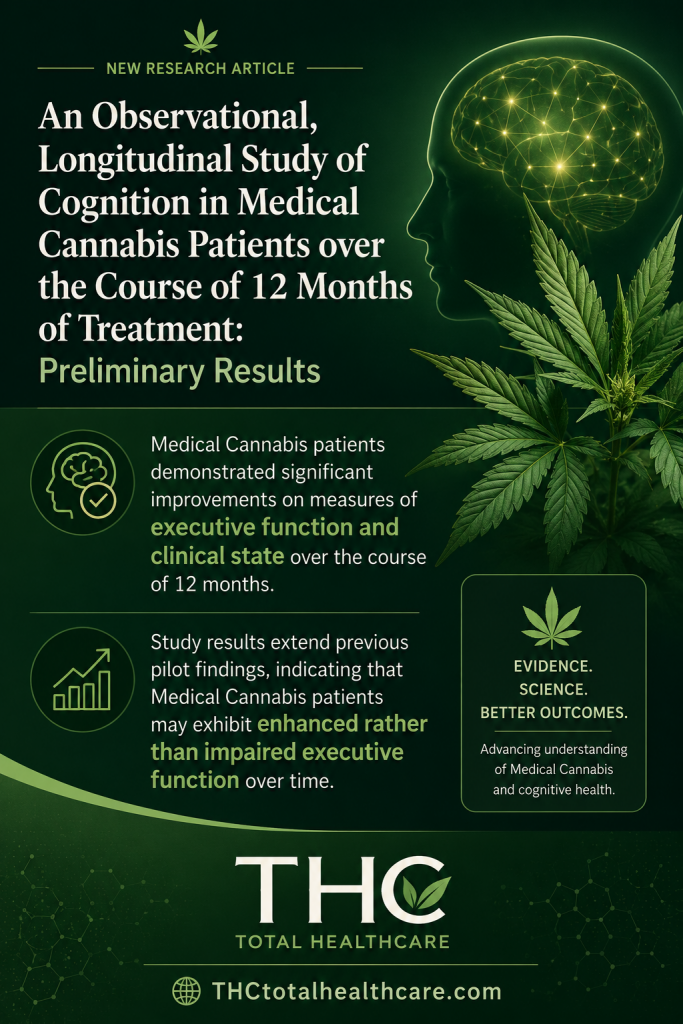
An Observational, Longitudinal Study of Cognition in Medical Cannabis Patients over the Course of 12 Months of Treatment: Preliminary Results

Journal of the International Neuropsychological Society“Cannabis use has increased dramatically across the country; however, few studies have assessed the long-term impact of medical cannabis (MC) use on cognition. Studies examining recreational cannabis users generally report cognitive decrements, particularly in those with adolescent onset. As MC patients differ from recreational consumers in motives for use, product selection, and age of onset, we assessed cognitive and clinical measures in well-characterized MC patients over 1 year. Based on previous findings, we hypothesized MC patients would not show decrements and might instead demonstrate improvements in executive function over time.

Method: As part of an ongoing study, MC patients completed a baseline visit prior to initiating MC and evaluations following 3, 6, and 12 months of treatment. At each visit, patients completed a neurocognitive battery assessing executive function, verbal learning/memory, and clinical scales assessing mood, anxiety, and sleep. Exposure to delta-9-tetrahydrocannabinol (THC) and cannabidiol (CBD) was also quantified.

Results: Relative to baseline, MC patients demonstrated significant improvements on measures of executive function and clinical state over the course of 12 months; verbal learning/memory performance generally remained stable. Improved cognitive performance was not correlated with MC use; however, clinical improvement was associated with higher CBD use. Analyses suggest cognitive improvements were associated with clinical improvement.

Conclusions: Study results extend previous pilot findings, indicating that MC patients may exhibit enhanced rather than impaired executive function over time. Future studies should examine distinctions between recreational and MC use to identify potential mechanisms related to cognitive changes and the role of clinical improvement.”

https://pubmed.ncbi.nlm.nih.gov/34261553/

https://www.cambridge.org/core/journals/journal-of-the-international-neuropsychological-society/article/abs/an-observational-longitudinal-study-of-cognition-in-medical-cannabis-patients-over-the-course-of-12-months-of-treatment-preliminary-results/369296C94054A5055552AAA8A20CA9FA

Prolonged Medical Cannabis Treatment is Associated With Quality of Life Improvement and Reduction of Analgesic Medication Consumption in Chronic Pain Patients

Frontiers in Pharmacology (@FrontPharmacol) | Twitter“Introduction: Chronic non-cancer pain (CNCP) is one of the most prevalent indications for medical cannabis (MC) treatment globally. In this study, we investigated CNCP parameters in patients during prolonged MC treatment, and assessed the interrelation between CNCP parameters and the chemical composition of MC chemovar used. 

Methods: A cross-sectional questionnaire-based study was performed in one-month intervals for the duration of six months. Subjects were adult patients licensed for MC treatment who also reported a diagnosis of CNCP by a physician. Data included self-reported questionnaires. MC treatment features included administration route, cultivator, cultivar name and monthly dose. Comparison statistics were used to evaluate differences between the abovementioned parameters and the monthly MC chemovar doses at each time point. 

Results: 429, 150, 98, 71, 77 and 82 patients reported fully on their MC treatment regimens at six one-month intervals, respectively. Although pain intensities did not change during the study period, analgesic medication consumption rates decreased from 46 to 28% (p < 0.005) and good Quality of Life (QoL) rates increased from 49 to 62% (p < 0.05). These changes overlapped with increase in rates of (-)-Δ9–trans-tetrahydrocannabinol (THC) and α-pinene high dose consumption. 

Conclusion: Even though we observed that pain intensities did not improve during the study, QoL did improve and the rate of analgesic medication consumption decreased alongside with increasing rates of high dose THC and α-pinene consumption. Understanding MC treatment composition may shed light on its long-term effects.”

https://pubmed.ncbi.nlm.nih.gov/34093173/

“In this study, although pain intensities did not change under long-term MC treatment, analgesic medication consumption rates decreased and ‘better’ QoL rates increased. These changes coincided with the increased rates of patients’ consumption of high dose THC and α pinene. These results may shed light on the long-term beneficial effects of MC on CNCP.”

https://www.frontiersin.org/articles/10.3389/fphar.2021.613805/full

Therapeutic potential of cannabinoids in combination cancer therapy

 Advances in Biological Regulation“Derivatives of the plant Cannabis sativa have been used for centuries for both medical and recreational purposes, as well as industrial. The first proof of its medicinal use comes from ancient China, although there is evidence of its earlier utilization in Europe and Asia. In the 19th century, European practitioners started to employ cannabis extracts to treat tetanus, convulsions, and mental diseases and, in 1851, cannabis made its appearance in the Pharmacopoeia of the United States as an analgesic, hypnotic and anticonvulsant. It was only in 1937 that the Marijuana Tax Act prohibited the use of this drug in the USA. The general term Cannabis is commonly used by the scientific and scholar community to indicate derivatives of the plant Cannabis sativa. The word cannabinoid is a term describing chemical compounds that are either derivate of Cannabis (phytocannabinoids) or artificial analogues (synthetic) or are produced endogenously by the body (endocannabinoids). A more casual term “marijuana” or “weed”, a compound derived from dried Cannabis flower tops and leaves, has progressively superseded the term cannabis when referred to its recreational use. The 2018 World health organisation (WHO) data suggest that nearly 2.5% of the global population (147 million) uses marijuana and some countries, such as Canada and Uruguay, have already legalised it. Due to its controversial history, the medicinal use of cannabinoids has always been a centre of debate. The isolation and characterisation of Δ9 tetrahydrocannabinol (THC), the major psychoactive component of cannabis and the detection of two human cannabinoid receptor (CBRs) molecules renewed interest in the medical use of cannabinoids, boosting research and commercial heed in this sector. Some cannabinoid-based drugs have been approved as medications, mainly as antiemetic, antianorexic, anti-seizure remedies and in cancer and multiple sclerosis patients’ palliative care. Nevertheless, due to the stigma commonly associated with these compounds, cannabinoids’ potential in the treatment of conditions such as cancer is still largely unknown and therefore underestimated.”

https://pubmed.ncbi.nlm.nih.gov/33422460/

https://www.sciencedirect.com/science/article/abs/pii/S2212492620300853?via%3Dihub

L-Theanine Prevents Long-Term Affective and Cognitive Side-Effects of Adolescent Δ-9-Tetrahydrocannabinol Exposure and Blocks Associated Molecular and Neuronal Abnormalities in the Mesocorticolimbic Circuitry

Journal of Neuroscience“Chronic adolescent exposure to Δ-9-Tetrahydrocannabinol (THC) is linked to elevated neuropsychiatric risk and induces neuronal, molecular and behavioural abnormalities resembling neuropsychiatric endophenotypes. Previous evidence has revealed that the mesocorticolimbic circuitry, including the prefrontal cortex (PFC) and mesolimbic dopamine (DA) pathway are particularly susceptible to THC-induced pathological alterations, including dysregulation of DAergic activity states, loss of PFC GABAergic inhibitory control and affective and cognitive abnormalities. There are currently limited pharmacological intervention strategies capable of preventing THC-induced neuropathological adaptations.

L-theanine is an amino acid analogue of L-glutamate and L-glutamine derived from various plant sources, including green tea leaves. L-theanine has previously been shown to modulate levels of GABA, DA and glutamate in various neural regions and to possess neuroprotective properties.

Using a pre-clinical model of adolescent THC exposure in male rats, we report that L-theanine pre-treatment prior to adolescent THC exposure is capable of preventing long-term, THC-induced dysregulation of both PFC and VTA DAergic activity states, a neuroprotective effect which persists into adulthood. In addition, pre-treatment with L-theanine blocked THC-induced downregulation of local GSK-3 and Akt signaling pathways directly in the PFC, two biomarkers previously associated with cannabis-related psychiatric risk and sub-cortical DAergic dysregulation.

Finally, L-theanine powerfully blocked the development of both affective and cognitive abnormalities commonly associated with adolescent THC exposure, further demonstrating functional and long-term neuroprotective effects of L-theanine in the mesocorticolimbic system.

SIGNIFICANCE STATEMENT With the increasing trend of cannabis legalization and consumption during adolescence, it is essential to expand knowledge on the potential effects of adolescent cannabis exposure on brain development and identify potential pharmacological strategies to minimize THC-induced neuropathology. Previous evidence demonstrates that adolescent THC exposure induces long-lasting affective and cognitive abnormalities, mesocorticolimbic dysregulation and schizophrenia-like molecular biomarkers that persist into adulthood.

We demonstrate for the first time that L-theanine, an amino acid analogue of L-glutamate and L-glutamine, is capable of preventing long-term THC side-effects. L-theanine prevented development of THC-induced behavioral aberrations, blocked cortical downregulation of local GSK-3 and Akt signaling pathways and normalized dysregulation of both PFC and VTA DAergic activity, demonstrating powerful and functional neuroprotective effects against THC-induced developmental neuropathology.”

https://pubmed.ncbi.nlm.nih.gov/33268546/

https://www.jneurosci.org/content/early/2020/11/24/JNEUROSCI.1050-20.2020