
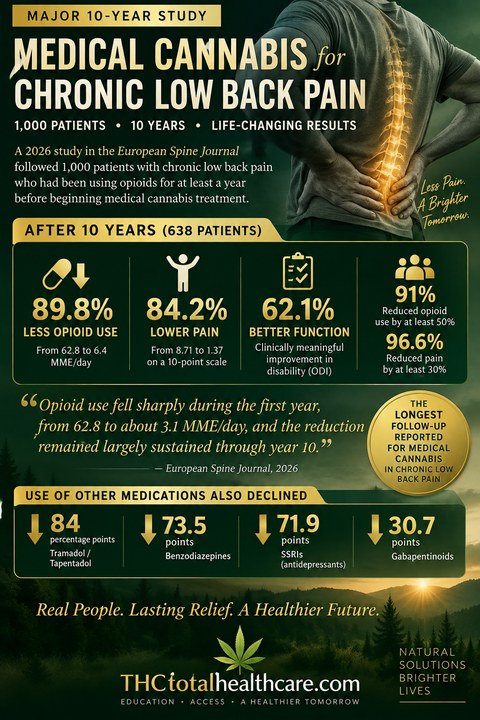
A 2026 study published in the European Spine Journal followed 1,000 patients with chronic low back pain who had been using opioids for at least a year before beginning medical cannabis treatment. Researchers tracked changes in opioid use, pain, disability, and other medications over as long as 10 years.
Among the 638 patients who completed the full 10-year follow-up, average opioid use fell by 89.8%, while pain scores dropped by 84.2%. More than 91% of patients achieved at least a 50% reduction in opioid use, and 96.6% achieved at least a 30% reduction in pain. Disability scores also improved substantially over the study period.
The reductions were not limited to opioids. Use of benzodiazepines, gabapentinoids, antidepressants, and other pain medications also declined. With a decade of follow-up, this study provides unusually long-term evidence that medical cannabis may play an important role in reducing pain, improving function, and decreasing dependence on multiple medications in people living with chronic low back pain.
“Purpose: To evaluate 10-year outcomes of medical cannabis therapy on opioid use, pain intensity, functional disability, concomitant medication use, and adverse events in cannabis-naïve chronic low back pain (CLBP) patients, with particular attention to clinically meaningful outcomes defined by established minimal clinically important difference (MCID) thresholds.
Methods: Single-center longitudinal observational study of 1,000 consecutive cannabis-naïve CLBP patients from a registry database (2015-2024), reported following STROBE guidelines.
Primary outcome: morphine milligram equivalents (MMEQ).
Secondary outcomes: Numeric Rating Scale (NRS) for pain intensity, Oswestry Disability Index (ODI) for functional disability, cannabis dosing patterns, adverse events, and concomitant medication use. Pre-specified MCID thresholds: ≥50% MMEQ reduction, ≥ 30% NRS reduction, ≥ 10-point ODI improvement. Statistical analyses included paired t-tests for completers and linear mixed-effects models for sensitivity analyses.
Results: Of 1,000 enrolled patients, 638 (63.8%) completed 10-year follow-up. Among completers, MMEQ decreased from 62.8 ± 35.7 to 6.4 ± 7.1 mg/day (- 89.8%, p < 0.001); NRS from 8.71 ± 1.23 to 1.37 ± 1.71 (- 84.2%, p < 0.001); ODI from 52.9 ± 11.9% to 36.8 ± 14.9% (16.1-point reduction, – 30.4%, p < 0.001). MCID responders: 91.2% for MMEQ, 96.6% for NRS, 62.1% for ODI. Substantial polypharmacy reductions occurred: tramadol/tapentadol – 84.0% points (pp), benzodiazepines – 73.5 pp, SSRIs – 71.9 pp, gabapentinoids – 30.7 pp. True tolerability adverse events occurred in 11.4% of visits; serious psychiatric events in 0.02%.
Conclusions: In this uncontrolled observational study, medical cannabis therapy was associated with reductions in opioid use, pain intensity, and functional disability over 10 years, accompanied by polypharmacy reduction and acceptable tolerability. Effect sizes substantially exceeded RCT benchmarks (e.g., – 0.6 NRS difference vs. placebo in a recent phase 3 trial), suggesting observational biases contribute to these findings. These hypothesis-generating data warrant validation in randomized controlled trials.”
https://pubmed.ncbi.nlm.nih.gov/42734834
“In this 10-year single-arm observational study, medical cannabis therapy was associated with reductions in opioid use (− 89.8%), pain intensity (− 84.2%), and functional disability (− 30.4%), with high proportions of patients achieving pre-specified MCID thresholds. Substantial polypharmacy reductions and acceptable tolerability were observed.”
https://link.springer.com/article/10.1007/s00586-026-10290-y