
Dose Response Relationship of Medical Cannabis and Symptom Control in Patients With Pancreatic Cancer: An Analysis of the CANPAN Trial

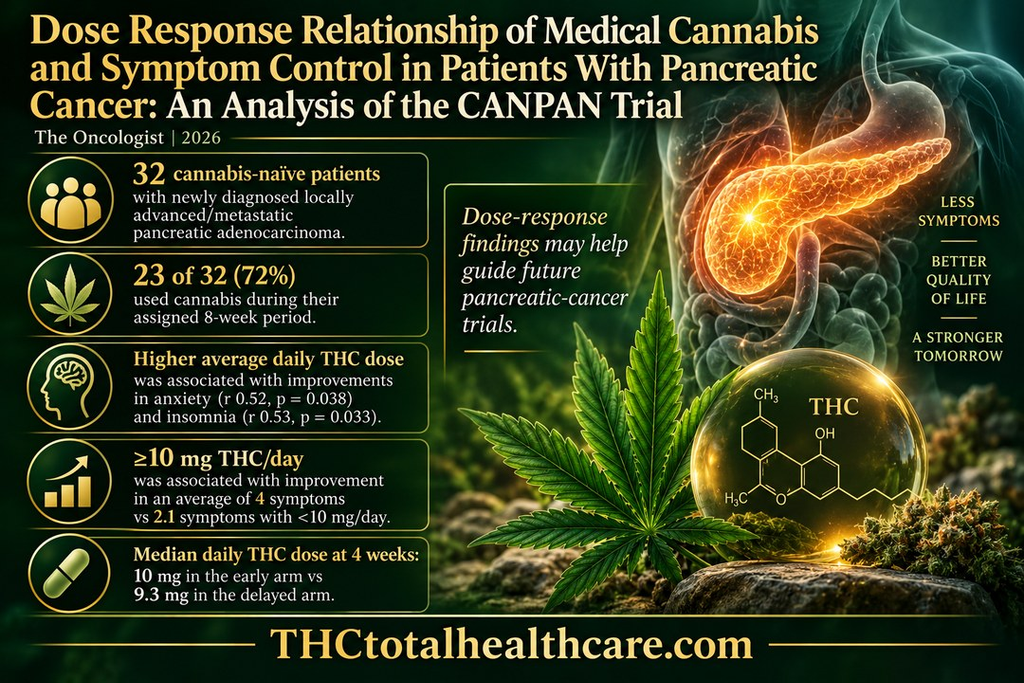
A new analysis of the CANPAN trial found a clear dose-response relationship between THC and symptom improvement in patients with pancreatic cancer. The trial enrolled 32 cannabis-naïve patients with newly diagnosed locally advanced or metastatic pancreatic adenocarcinoma, and 23 used medical cannabis during their assigned eight-week treatment period.

Higher average daily THC doses were significantly associated with greater improvements in anxiety and insomnia. Patients receiving at least 10 mg of THC per day improved in an average of four symptoms, compared with 2.1 symptoms among patients receiving less than 10 mg per day.

The authors say these findings provide important dose-response information for future pancreatic-cancer trials, particularly for psychological symptoms and multi-symptom control. The results add to evidence from the CANPAN trial that personalized medical cannabis may have a role in managing symptoms experienced by people undergoing treatment for pancreatic cancer.

“Background: In a pilot waitlist-control randomized trial, a personalized medical cannabis intervention improved certain symptoms among patients with pancreatic cancer over 8 weeks. Longer-term and dose-response data can guide future trial design.

Methods: CANPAN enrolled 32 cannabis-naïve patients with newly diagnosed locally advanced/metastatic pancreatic adenocarcinoma (NCT06605430). Patients were randomized to early (0-8 weeks) or delayed (9-16 weeks) cannabis intervention. Primary efficacy results over the first 8 weeks were previously reported. We investigated cannabis use and patient-reported outcome (PRO) completion over 9-16 weeks, and the relationship between tetrahydrocannabinol (THC) dose and symptom efficacy.

Results: Among 32 participants, 23 (72%) used cannabis during their assigned 8-week period (12/16 in early arm and 11/16 in delayed arm). Of these, 16 (50%) had both pre-cannabis and 8-week post-cannabis initiation PRO data available. At the end of the 16-week study period, PRO data were available for 16 (50%) participants (9/16 early arm, 7/16 delayed arm). Median daily THC dose 4 weeks after starting cannabis was similar in early vs delayed arms (10 mg vs 9.3 mg). A higher average daily THC dose was associated with improvements in anxiety (r 0.52, p = 0.038) and insomnia (r 0.53, p = 0.033). A ≥ 10 mg daily THC dose (vs < 10 mg) was associated with mean improvement in 4 vs 2.1 symptoms.

Conclusions: The 50% complete data availability at 16 weeks, dose-response relationship with psychological symptoms, and threshold dose for multi-symptom efficacy will guide future trials. Similar cannabis use patterns across arms raise confidence in the waitlist-control design.”

https://pubmed.ncbi.nlm.nih.gov/42767994

https://academic.oup.com/oncolo/advance-article/doi/10.1093/oncolo/oyag374/8826188
Evaluating the impact of cannabinoid extracts on chronic pain and quality of life in endometriosis patients – a pilot study

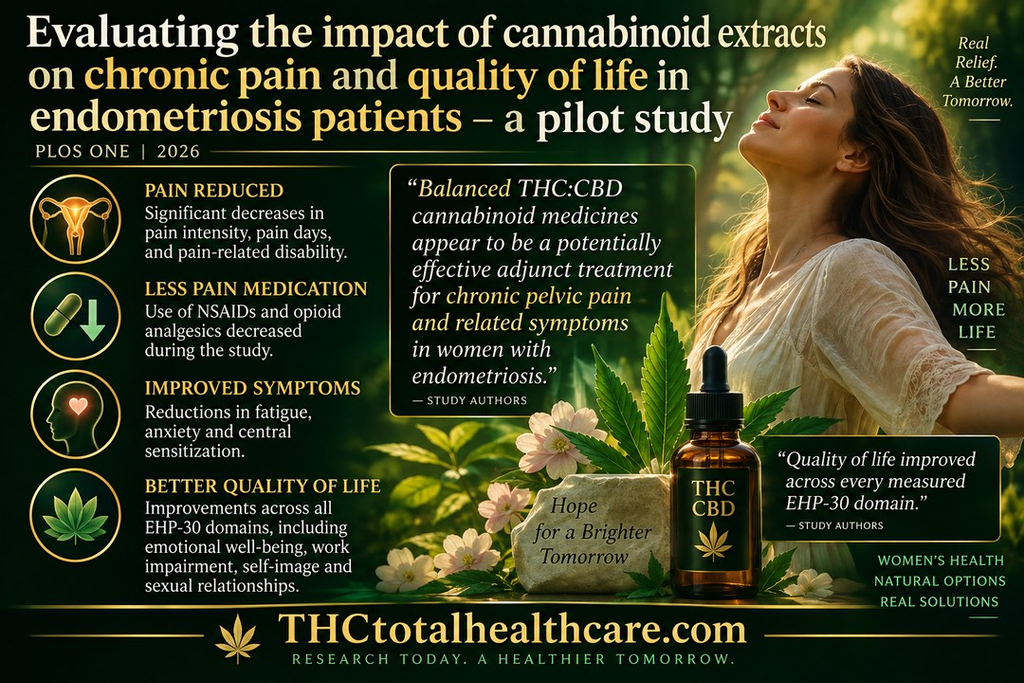
Women with endometriosis and chronic pelvic pain experienced significant improvements after adding a balanced oral THC cannabis extract to their existing treatment. In this prospective pilot study, 27 women completed three months of treatment, with benefits appearing within the first month and continuing through the study period.

Pain intensity fell significantly, along with the number of pain days and the need for conventional pain medicines. Use of both NSAIDs and opioid analgesics decreased, while fatigue, anxiety, central sensitization and pain-related disability also improved.

Quality of life improved across every measured EHP-30 domain, including pain, emotional well-being, work impairment, self-image and sexual relationships. The authors concluded that balanced THC cannabinoid medicines appear to be a potentially effective adjunct treatment for chronic pelvic pain and related symptoms in women with endometriosis.

“Endometriosis is a chronic gynecological disorder characterized by persistent pain and impaired quality of life, with limited effective treatment options. Emerging evidence indicates that cannabinoids may provide analgesic and symptom-relieving effects in chronic pain conditions.

This prospective single-center cohort study investigated the effects of standardized oral cannabis extracts (cannabinoid-based medicinal products, CBMPs) on pain and quality of life in women with endometriosis.

Thirty premenopausal women aged 18-45 years with confirmed endometriosis and chronic pelvic pain were enrolled; 27 completed the 3-month treatment period. Participants received oral CBMPs containing a balanced THC: CBD ratio. Pain intensity, frequency of pain episodes, analgesic use, fatigue, anxiety, central sensitization, disability, and quality of life were assessed using validated questionnaires (VAS, EHP-30, PDI, CFS, GAD-7, CSI).

Significant improvements were observed after one month of treatment, with continued benefit over three months. Pain intensity decreased markedly (p = 0.0004), accompanied by reductions in the number of pain days and analgesic use, including both NSAIDs (e.g., ibuprofen, diclofenac) and opioid analgesics (e.g., tramadol, tilidin, oxycodone) (p < 0.001). Fatigue (p = 0.0013), anxiety (p < 0.0001), central sensitization (p < 0.0001), disability (p < 0.0001), and overall quality of life (EHP-30) improved significantly.

Treatment was well tolerated; side effects were predominantly mild (severity score 1 on a 0-3 scale) and transient, occurring mainly during the titration phase and declining thereafter. Although limited by its single-center design, lack of placebo control, and short follow-up, this study provides preliminary evidence that oral CBMPs may represent a safe and effective adjunct therapy for managing pain and related symptoms in women with endometriosis. Larger randomized controlled trials are warranted to confirm these findings and establish optimal dosing strategies.”

https://pubmed.ncbi.nlm.nih.gov/42771648

“In conclusion, oral CBMPs with balanced THC: CBD ratios seem to be a safe and potentially effective adjunct therapy for chronic pelvic pain and related symptoms in women with endometriosis. By targeting both nociceptive and neuropsychological aspects of the condition, CBMPs can supplement existing pharmacological and lifestyle strategies, providing a more comprehensive approach to symptom management. These findings establish a basis for future controlled studies to refine dosing, investigate mechanisms, and assess long-term outcomes in this complex patient group.”

https://journals.plos.org/plosone/article?id=10.1371/journal.pone.0356768

Cannabinoid CB1 receptors in the dorsal hippocampus and prelimbic medial prefrontal cortex modulate anxiety-like behavior in rats: additional evidence.

“Endocannabinoids (ECBs) such as anandamide (AEA) act by activating cannabinoid type 1 (CB1) or 2 (CB2) receptors. The anxiolytic effect of drugs that facilitate ECB effects is associated with increase in AEA levels in several encephalic areas, including the prefrontal cortex (PFC).

Activation of CB1 receptors by CB1 agonists injected directly into these areas is usually anxiolytic.

However, depending on the encephalic region being investigated and on the stressful experiences, opposite effects were observed, as reported in the ventral HIP. In addition, contradictory results have been reported after CB1 activation in the dorsal HIP (dHIP).

Therefore, in the present paper we have attempted to verify if directly interfering with ECB metabolism/reuptake in the prelimbic (PL) portion of the medial PFC (MPFC) and dHIP would produce different effects in two conceptually distinct animal models: the elevated plus maze (EPM) and the Vogel conflict test (VCT).

We observed drugs which interfere with ECB reuptake/metabolism in both the PL and in the dentate gyrus of the dHIP induced anxiolytic-like effect, in both the EPM and in the VCT via CB1 receptors, suggesting CB1 signaling in these brain regions modulate defensive responses to both innate and learned threatening stimuli.

This data further strengthens previous results indicating modulation of hippocampal and MPFC activity via CB1 by ECBs, which could be therapeutically targeted to treat anxiety disorders.”

http://www.ncbi.nlm.nih.gov/pubmed/25595265

http://www.thctotalhealthcare.com/category/anxiety-2/

Cannabinoids and anxiety.

“The term cannabinoids encompasses compounds produced by the plant Cannabis sativa, such as delta9-tetrahydrocannabinol, and synthetic counterparts. Their actions occur mainly through activation of cannabinoid type 1 (CB1) receptors. Arachidonoyl ethanolamide (anandamide) and 2-arachidonoyl glycerol (2-AG) serve as major endogenous ligands (endocannabinoids) of CB1 receptors. Hence, the cannabinoid receptors, the endocannabinoids, and their metabolizing enzymes comprise the endocannabinoid system. Cannabinoids induce diverse responses on anxiety- and fear-related behaviors. Generally, low doses tend to induce anxiolytic-like effects, whereas high doses often cause the opposite. Inhibition of endocannabinoid degradation seems to circumvent these biphasic effects by enhancing CB1 receptor signaling in a temporarily and spatially restricted manner, thus reducing anxiety-like behaviors. Pharmacological blockade or genetic deletion of CB1 receptors, in turn, primarily exerts anxiogenic-like effects and impairments in extinction of aversive memories. Interestingly, pharmacological blockade of Transient Receptor Potential Vanilloid Type-1 (TRPV1) channel, which can be activated by anandamide as well, has diametrically opposite consequences. This book chapter summarizes and conceptualizes our current knowledge about the role of (endo)cannabinoids in fear and anxiety and outlines implications for an exploitation of the endocannabinoid system as a target for new anxiolytic drugs.”

http://www.ncbi.nlm.nih.gov/pubmed/21309120

The endocannabinoid system in anxiety, fear memory and habituation.

“Evidence for the involvement of the endocannabinoid system (ECS) in anxiety and fear has been accumulated, providing leads for novel therapeutic approaches. In anxiety, a bidirectional influence of the ECS has been reported, whereby anxiolytic and anxiogenic responses have been obtained after both increases and decreases of the endocannabinoid tone. The recently developed genetic tools have revealed different but complementary roles for the cannabinoid type 1 (CB1) receptor on GABAergic and glutamatergic neuronal populations. This dual functionality, together with the plasticity of CB1 receptor expression, particularly on GABAergic neurons, as induced by stressful and rewarding experiences, gives the ECS a unique regulatory capacity for maintaining emotional homeostasis. However, the promiscuity of the endogenous ligands of the CB1 receptor complicates the interpretation of experimental data concerning ECS and anxiety. In fear memory paradigms, the ECS is mostly involved in the two opposing processes of reconsolidation and extinction of the fear memory. Whereas ECS activation deteriorates reconsolidation, proper extinction depends on intact CB1 receptor signalling. Thus, both for anxiety and fear memory processing, endocannabinoid signalling may ensure an appropriate reaction to stressful events. Therefore, the ECS can be considered as a regulatory buffer system for emotional responses.”

http://www.ncbi.nlm.nih.gov/pmc/articles/PMC3267552/

Pharmacological Evaluation of Cannabinoid Receptor Ligands in a Mouse Model of Anxiety: Further Evidence for an Anxiolytic Role for Endogenous Cannabinoid Signaling

“Extracts of Cannabis sativa have been used for their calming and sedative effects for centuries. Recent developments in drug discovery have suggested that modulation of neuronal endogenous cannabinoid signaling systems could represent a novel approach to the treatment of anxiety-related disorders while minimizing the adverse effects of direct acting cannabinoid receptor agonists. In this study, we evaluated the effects of direct cannabinoid receptor agonists and antagonists and endocannabinoid-modulating drugs on anxiety-like behavior in mice using the elevated-plus maze.

These data indicate that activation of CB1 cannabinoid receptors reduces anxiety-like behaviors in mice and further support an anxiolytic role for endogenous cannabinoid signaling. These results suggest that pharmacological modulation of this system could represent a new approach to the treatment of anxiety-related psychiatric disorders.

Marijuana is widely used throughout the world for recreational and therapeutic purposes. A common reason given for continued marijuana use in certain populations is reduction in anxiety and relaxation; however, adverse reactions, including heightened anxiety and panic, are common and widely cited reasons for discontinuation of marijuana use. The adverse effects of marijuana are more pronounced during novel or stressful environmental conditions, after consumption of large doses of cannabis, and in naive users…”

http://jpet.aspetjournals.org/content/318/1/304.long

Role of endocannabinoid system in the ventral hippocampus of rats in the modulation of anxiety-like behaviours.

“The effects of unilateral intra-ventral hippocampus injection of URB597, a fatty acid amid hydrolase inhibitor, and AM251, a selective CB(1) receptor antagonist, on anxiety-related behaviours using elevated plus-maze test of anxiety were evaluated in the present study. Possible involvement of GABAergic system in those effects of URB597 was also evaluated. Injection of URB597 at the doses of 0.01, 0.1 and 1 microg/rat showed significant anxiogenic-like effects at 0.1 and 1 microg/rat. However, intra-ventral hippocampus injection of AM251 at the doses of 0.001, 0.01 and 0.1 microg/rat did not produce any significant effect in the elevated plus-maze. The ineffective doses of selective GABA(A) receptor antagonist, bicuculline (2 microg/rat) and selective GABA(B) receptor antagonist, phaclofen (1 microg/rat) on anxiety-related behaviours were also injected with URB597 (0.1 microg/rat). The present data showed that neither bicuculline nor phaclofen affected the anxiogenic-like effects of URB597. The results showed that injection of URB597 into the ventral hippocampus may be anxiogenic and GABAergic system may not be involved in its anxiogenic-like effects.”

http://www.ncbi.nlm.nih.gov/pubmed/19614892

An Endocannabinoid Signaling System Modulates Anxiety-like Behavior in Male Syrian Hamsters

“An endocannabinoid signaling system has not been identified in hamsters.

We examined the existence of an endocannabinioid signaling system in Syrian hamsters using neuroanatomical, biochemical and behavioral pharmacological approaches.

The distribution of cannabinoid receptors was mapped and membrane fatty-acid amide hydrolase (FAAH) activity and levels of fatty-acid amides were measured in hamster brain. The impact of cannabinoid CB1 receptor blockade and inhibition of FAAH was evaluated in the elevated plus maze, rota-rod test and models of unconditioned and conditioned social defeat.

Results

A characteristic heterogeneous distribution of cannabinoid receptors was detected in hamster brain..

Endocannabinoids engage functional CB1 receptors in hamster brain to suppress anxiety-like behavior and undergo enzymatic hydrolysis catalyzed by FAAH. Our results further suggest that neither unconditioned nor conditioned social defeat in the Syrian hamster is dependent upon cannabinoid CB1 receptor activation.”

http://www.ncbi.nlm.nih.gov/pmc/articles/PMC2694060/

Effects of cannabinoids on the anxiety-like response in mice.

“Several pieces of anatomical, biochemical and pharmacological evidence indicate that the endocannabinoid system via CB1 receptors is implicated in the control of emotional behavior. However, previous studies have reported unclear and contradictory results concerning the role of cannabinoids in anxiety. The aim of the present study was to examine the influence of the cannabinoid agonist WIN 55,212-2, the CB1 antagonist AM 281, the inhibitor of anandamide hydrolysis AACOCF3  and the inhibitor of anandamide transporter AM404 on the anxiety-like response in mice in the light/dark box test…

  These results support the hypothesis that the endocannabinoid system is involved in the regulation of anxiety-like behavior, and also suggest that the inhibitors of anandamide hydrolysis might be potential anxiolytic drugs.”

http://www.ncbi.nlm.nih.gov/pubmed/16702621

Facilitation of endocannabinoid effects in the ventral hippocampus modulates anxiety-like behaviors depending on previous stress experience.

“Although several pieces of evidence indicate that the endocannabinoid system modulates anxiety-like behaviors and stress adaptation, few studies have investigated the brain sites of these effects. The ventral hippocampus (VHC) has been related to anxiety behaviors and has a high expression of cannabinoid-1 (CB1) receptors. Moreover, endocannabinoid signaling in the hippocampus is proposed to regulate stress adaptation. In the present study we investigated the role of previous stressful experience on the effects of AM404, an anandamide uptake inhibitor, microinjected into the VHC of rats submitted to the elevated plus maze (EPM), a widely used animal model of anxiety…

These results suggest that facilitation of endocannabinoid system neurotransmission in the ventral hippocampus modulates anxiety-like behaviors and that this effect depends on previous stress experience.”

http://www.ncbi.nlm.nih.gov/pubmed/20167262