
Enhancing Anti-Cancer Efficacy in Colorectal Cancer Through Cannabinoid and Sodium Pentaborate Co-Therapy

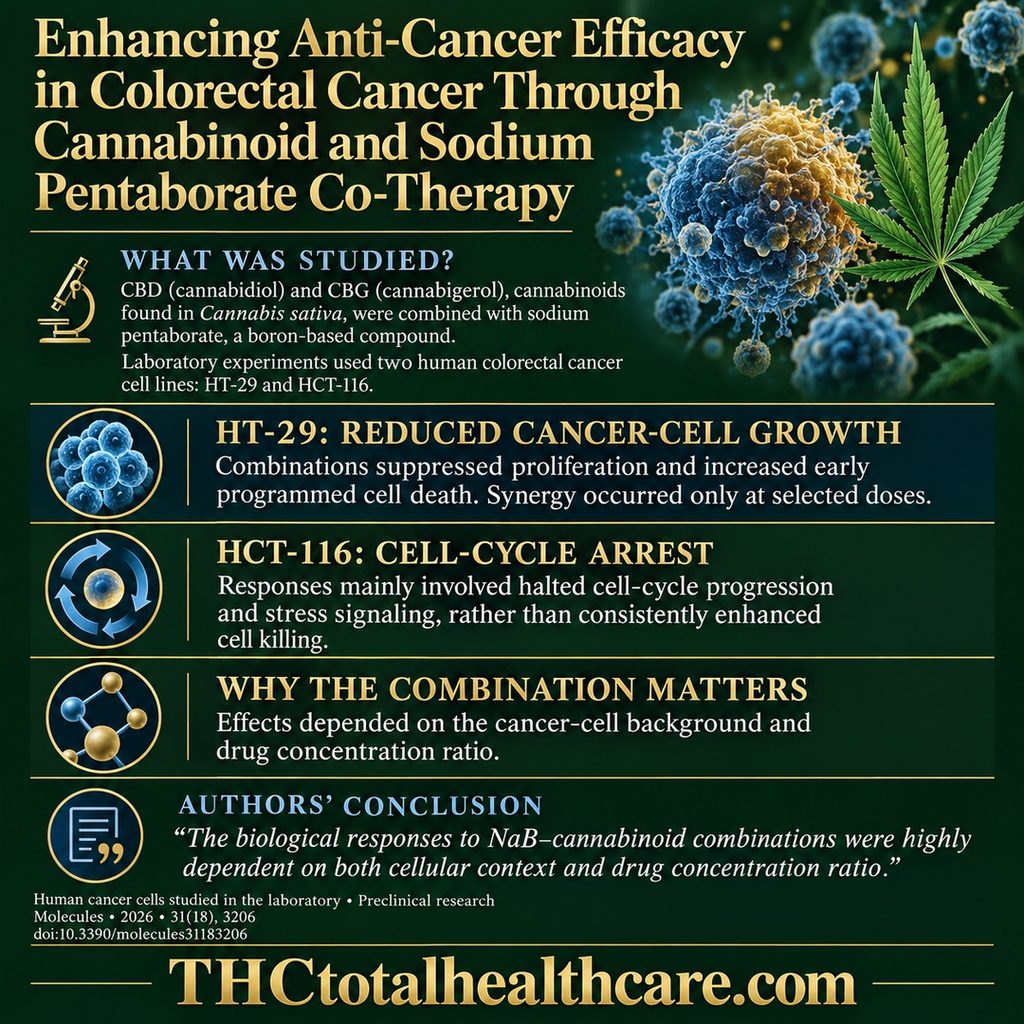
Cannabidiol (CBD) and cannabigerol (CBG), naturally occurring cannabinoids found in the Cannabis sativa plant, enhanced growth-suppressing effects at selected doses when combined with sodium pentaborate, a boron-based compound, in laboratory-grown human colorectal cancer cells. Researchers tested two cell lines, HT-29 and HCT-116, and found that responses depended strongly on the cancer cells’ characteristics and the combination used.

In HT-29 cells, the combinations reduced cell proliferation and increased early apoptosis—programmed cell death—with synergistic effects occurring only at certain dose combinations. HCT-116 cells responded mainly by arresting the cell cycle and activating stress-response pathways, rather than showing consistently enhanced cell killing.

The treatments also altered genes involved in oxidative balance and iron metabolism, processes associated with ferroptosis, an iron-dependent form of cell death. These findings support further investigation of boron–cannabinoid combinations tailored to tumor biology, with validation in three-dimensional tumor models and animal studies identified as the next steps.

“Background: Colorectal cancer (CRC) is characterized by pronounced genetic and phenotypic heterogeneity, which substantially influences therapeutic response and limits the efficacy of uniform treatment strategies. Cannabinoid-derived phytochemicals and boron-based compounds have independently been reported to modulate cancer cell proliferation, survival, and redox balance. However, the extent to which these agents interact at the cellular level and whether such interactions are dependent on tumor-specific molecular contexts remains poorly defined.

Methods: Sodium pentaborate (NaB) was combined with non-cytotoxic concentrations of cannabidiol (CBD) or cannabigerol (CBG) and evaluated in HCT-116 and HT-29 colorectal cancer cell lines. Cell viability and drug interactions were assessed by MTS and combination index analyses. Apoptotic responses were examined by Annexin V/PI staining, caspase-3/7 activity assays, and transcriptional profiling of apoptosis-related genes. Cell cycle dynamics and proliferation-associated markers were analyzed by flow cytometry and quantitative PCR. In parallel, ferroptosis-associated gene expression patterns were investigated to evaluate alterations in redox and iron metabolism pathways.

Results: NaB-cannabinoid combinations produced divergent biological outcomes depending on cellular background. HT-29 cells exhibited dose-dependent antiproliferative responses to NaB + CBD and NaB + CBG, with synergistic interactions observed only at selected dose combinations accompanied by increased early apoptosis. In contrast, HCT-116 cells primarily responded with cell cycle arrest and transcriptional stress signaling rather than enhanced cytotoxicity. Modulation of ferroptosis-related gene expression further indicated differential redox adaptation between the two cell models.

Conclusions: NaB-cannabinoid combinations elicit distinct biological outcomes in colorectal cancer cells that are strongly determined by cellular context. While HT-29 cells are selectively sensitized to combination dose level, HCT-116 cells predominantly respond through cell cycle arrest and adaptive stress-response pathway activation. These findings emphasize the necessity of context-aware combination strategies and provide a mechanistic framework for the further development of boron-cannabinoid-based therapeutic approaches in colorectal cancer.”

https://pubmed.ncbi.nlm.nih.gov/42796493

“In conclusion, our findings indicate that co-treatment with NaB and phytocannabinoids provides a cell line-specific therapeutic strategy in colorectal cancer.”
https://www.mdpi.com/1420-3049/31/18/3206

Cannabinoids in Cancer: Molecular Mechanisms of Tumor Cell Death and Translational Opportunities

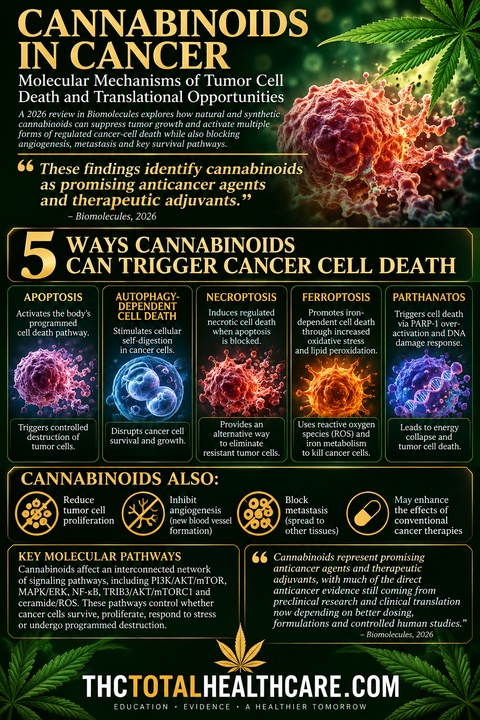
Cannabinoids can attack cancer cells through far more than a single mechanism. This 2026 review describes how natural and synthetic cannabinoids can suppress tumor-cell growth, angiogenesis and metastasis while activating multiple forms of regulated cancer-cell death, including apoptosis, autophagy-dependent cell death, necroptosis, ferroptosis and parthanatos.

The researchers detail an interconnected network of molecular pathways affected by cannabinoids, including PI3K/AKT/mTOR, MAPK/ERK, NF-κB, TRIB3/AKT/mTORC1 and ceramide/ROS signaling. These pathways control whether cancer cells survive, proliferate, respond to stress or undergo programmed destruction, giving cannabinoids multiple potential points of attack against malignant cells.

The review also finds that cannabinoids may enhance conventional anticancer treatments by engaging complementary cell-death pathways. The authors conclude that cannabinoids represent promising anticancer agents and therapeutic adjuvants, with much of the direct anticancer evidence still coming from preclinical research and clinical translation now depending on better dosing, formulations and controlled human studies.

“Cannabinoids are terpenophenolic compounds derived from Cannabis sativa L. that exert a broad range of biological and pharmacological activities. Increasing evidence highlights their potential as modulators of cancer progression specifically through the suppression of tumor cell growth, angiogenesis, and metastasis across multiple tumor models.

This review provides a comprehensive overview of the molecular mechanisms by which natural and synthetic cannabinoids induce regulated cancer cell death.

Current evidence demonstrates that cannabinoids regulate multiple forms of cancer cell death, including apoptosis, autophagy-dependent cell death, necroptosis, ferroptosis, and parthanatos. These effects are mediated through complex and interconnected signaling pathways such as TRIB3/AKT/mTORC1, PI3K/AKT/mTOR, MAPK/ERK, NF-κB, ERK/JNK/p38-MAPK, and ceramide/Raf1/ERK/ROS.

In addition to their direct antitumor effects, cannabinoids can enhance the efficacy of conventional anticancer therapies through the coordinated regulation of complementary cell death pathways. They also provide clinically relevant supportive benefits in palliative care, alleviating chemotherapy-induced nausea, cachexia, and mood or sleep disturbances.

Collectively, these findings identify cannabinoids as promising anticancer agents and therapeutic adjuvants, predominantly in the preclinical setting. However, significant challenges remain regarding their safety, optimal dosing, formulation, and clinical efficacy. Further mechanistic studies, rigorous preclinical research, and well-designed clinical trials are required to establish the translation of cannabinoid-based therapies into precision oncology.”

https://pubmed.ncbi.nlm.nih.gov/42793092

“The cannabis plant, a member of the Cannabaceae family, has been traditionally utilized for centuries for spiritual and remedial healing.”

“The anticancer activity of cannabinoids was discovered in 1975 by Munson et al.. Cannabinoids suppress cancer cell proliferation, angiogenesis, tumor invasion, metastasis, and stemness while inducing different modes of cell death pathways.”

“In summary, this review highlights the growing body of evidence supporting the ability of cannabinoids to induce multiple forms of cell death across a broad spectrum of cancer types. Through the modulation of diverse molecular and signaling pathways, cannabinoids have emerged as promising anticancer agents, mostly in preclinical models, with the potential to target tumor growth, survival, and progression, ultimately triggering diverse cell death mechanisms.”

https://www.mdpi.com/2218-273X/16/9/1260