
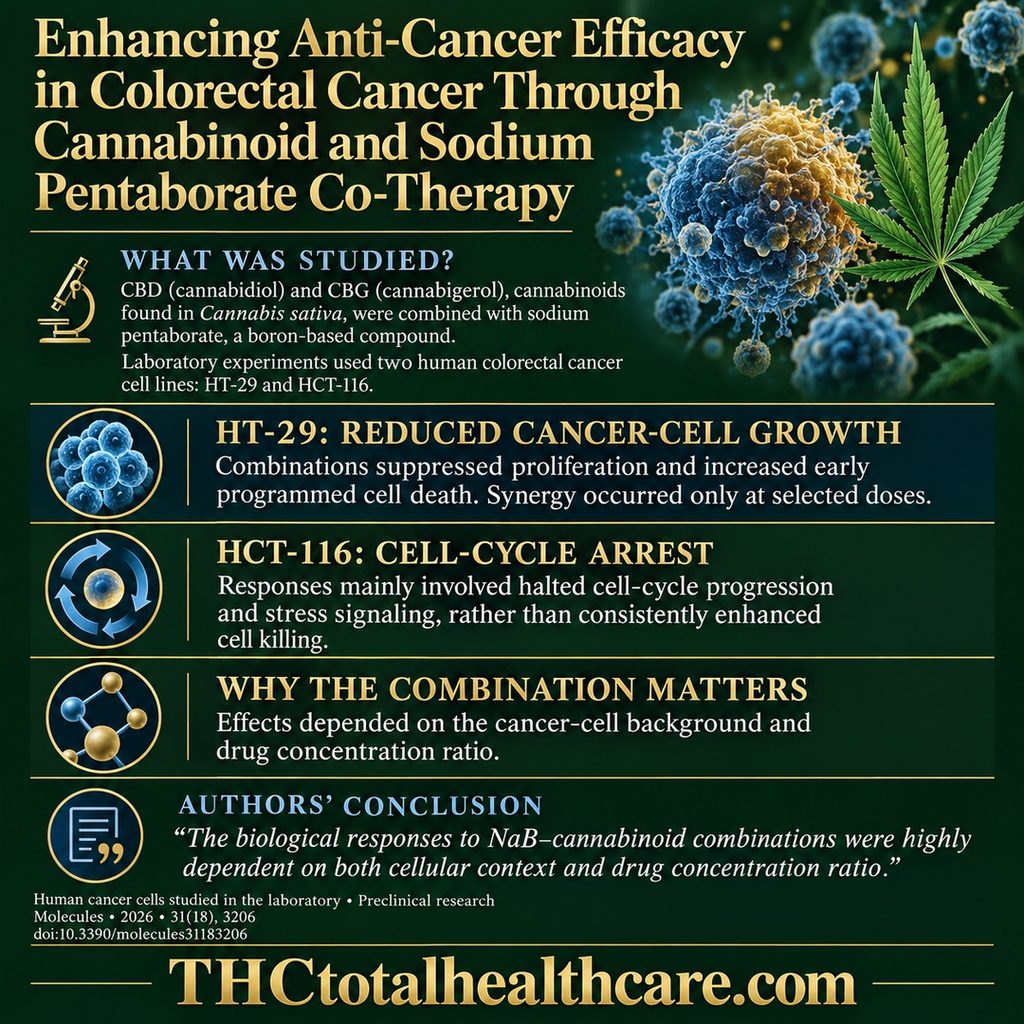
Cannabidiol (CBD) and cannabigerol (CBG), naturally occurring cannabinoids found in the Cannabis sativa plant, enhanced growth-suppressing effects at selected doses when combined with sodium pentaborate, a boron-based compound, in laboratory-grown human colorectal cancer cells. Researchers tested two cell lines, HT-29 and HCT-116, and found that responses depended strongly on the cancer cells’ characteristics and the combination used.
In HT-29 cells, the combinations reduced cell proliferation and increased early apoptosis—programmed cell death—with synergistic effects occurring only at certain dose combinations. HCT-116 cells responded mainly by arresting the cell cycle and activating stress-response pathways, rather than showing consistently enhanced cell killing.
The treatments also altered genes involved in oxidative balance and iron metabolism, processes associated with ferroptosis, an iron-dependent form of cell death. These findings support further investigation of boron–cannabinoid combinations tailored to tumor biology, with validation in three-dimensional tumor models and animal studies identified as the next steps.
“Background: Colorectal cancer (CRC) is characterized by pronounced genetic and phenotypic heterogeneity, which substantially influences therapeutic response and limits the efficacy of uniform treatment strategies. Cannabinoid-derived phytochemicals and boron-based compounds have independently been reported to modulate cancer cell proliferation, survival, and redox balance. However, the extent to which these agents interact at the cellular level and whether such interactions are dependent on tumor-specific molecular contexts remains poorly defined.
Methods: Sodium pentaborate (NaB) was combined with non-cytotoxic concentrations of cannabidiol (CBD) or cannabigerol (CBG) and evaluated in HCT-116 and HT-29 colorectal cancer cell lines. Cell viability and drug interactions were assessed by MTS and combination index analyses. Apoptotic responses were examined by Annexin V/PI staining, caspase-3/7 activity assays, and transcriptional profiling of apoptosis-related genes. Cell cycle dynamics and proliferation-associated markers were analyzed by flow cytometry and quantitative PCR. In parallel, ferroptosis-associated gene expression patterns were investigated to evaluate alterations in redox and iron metabolism pathways.
Results: NaB-cannabinoid combinations produced divergent biological outcomes depending on cellular background. HT-29 cells exhibited dose-dependent antiproliferative responses to NaB + CBD and NaB + CBG, with synergistic interactions observed only at selected dose combinations accompanied by increased early apoptosis. In contrast, HCT-116 cells primarily responded with cell cycle arrest and transcriptional stress signaling rather than enhanced cytotoxicity. Modulation of ferroptosis-related gene expression further indicated differential redox adaptation between the two cell models.
Conclusions: NaB-cannabinoid combinations elicit distinct biological outcomes in colorectal cancer cells that are strongly determined by cellular context. While HT-29 cells are selectively sensitized to combination dose level, HCT-116 cells predominantly respond through cell cycle arrest and adaptive stress-response pathway activation. These findings emphasize the necessity of context-aware combination strategies and provide a mechanistic framework for the further development of boron-cannabinoid-based therapeutic approaches in colorectal cancer.”
https://pubmed.ncbi.nlm.nih.gov/42796493
“In conclusion, our findings indicate that co-treatment with NaB and phytocannabinoids provides a cell line-specific therapeutic strategy in colorectal cancer.”