(+)-Trans-Cannabidiol Is an Agonist at Human CB2 Receptors

A new 2026 study reports that (+)-trans-cannabidiol [(+)-CBD] acts as an agonist at human CB2 cannabinoid receptors, activating a major receptor of the endocannabinoid system involved in immune and inflammatory signaling.

Researchers found that (+)-CBD produced a strong, concentration-dependent CB2 response, reaching roughly 90% of the maximum effect produced by the reference cannabinoid agonist CP55940. Additional testing indicated that the compound acts through the receptor’s primary, or orthosteric, binding site.

The findings show that different molecular forms of cannabidiol can interact with cannabinoid receptors in very different ways. The researchers conclude that (+)-CBD may deserve further study in CB2-sensitive disease states, adding another layer to our understanding of how cannabinoid chemistry can influence the human endocannabinoid system.

“(-)-trans-Cannabidiol ((-)-CBD) is a principal phytocannabinoid from Cannabis sativa. (-)-CBD has complex pharmacology but is a relatively weak inhibitor of CB1 and CB2 receptor signaling. Cannabidiol has two chiral centres and thus four stereoisomers. (+)-trans-CBD ((+)-CBD) has a higher affinity than (-)-CBD at CB1 and CB2, but its pharmacodynamic effects at these receptors are incompletely described.

We examined the activity of (+)-CBD at human CB1 and CB2 receptors using a fluorescence-based assay of membrane potential in AtT20 cells stably expressing CB1 or CB2 receptors.

(+)-CBD produced a rapid, concentration-dependent hyperpolarization in CB2-expressing cells (pEC50 6.63 ± 0.08) with a maximal effect 90% of the response to CP55940. The CB2 response was blocked by pertussis toxin pretreatment and competitively inhibited by the CB2 antagonist AM630 (Schild slope 1.1 ± 0.1). (+)-CBD was a low-efficacy, low-potency CB1 agonist and inhibited somatostatin-receptor effects at high concentrations (10-30 μM). (+)-CBD had no effect on the membrane potential of AtT20 wild-type cells. In silico modeling of ligand interactions with CB2 indicated that (+)-CBD but not (-)-CBD formed an H-bond with Ser285, a residue crucial for agonist activation of CB2.

Our data suggests (+)-CBD acted as a CB2 agonist via the orthosteric binding site on the receptor. Synthetic CBD, including (+)-CBD, has previously been administered in clinical trials, presumably without consideration of its potential CB2 agonist activity.

Given the relative safety of (-)-CBD in people, (+)-CBD may be a useful drug to explore CB2-sensitive disease states.”

https://pubmed.ncbi.nlm.nih.gov/42745361

“This study emphasizes the importance of understanding the molecular actions of the enantiomers of chiral cannabinoids. Although the safety of (+)-CBD cannot simply be assumed to be the same as (−)-CBD, the identification of (+)-CBD as a robust CB2 agonist suggests that (+)-CBD may be worth exploring as a therapeutic agent in chronic inflammatory conditions or other diseases where CB2 activation may prove beneficial.”

https://bpspubs.onlinelibrary.wiley.com/doi/10.1002/prp2.70325
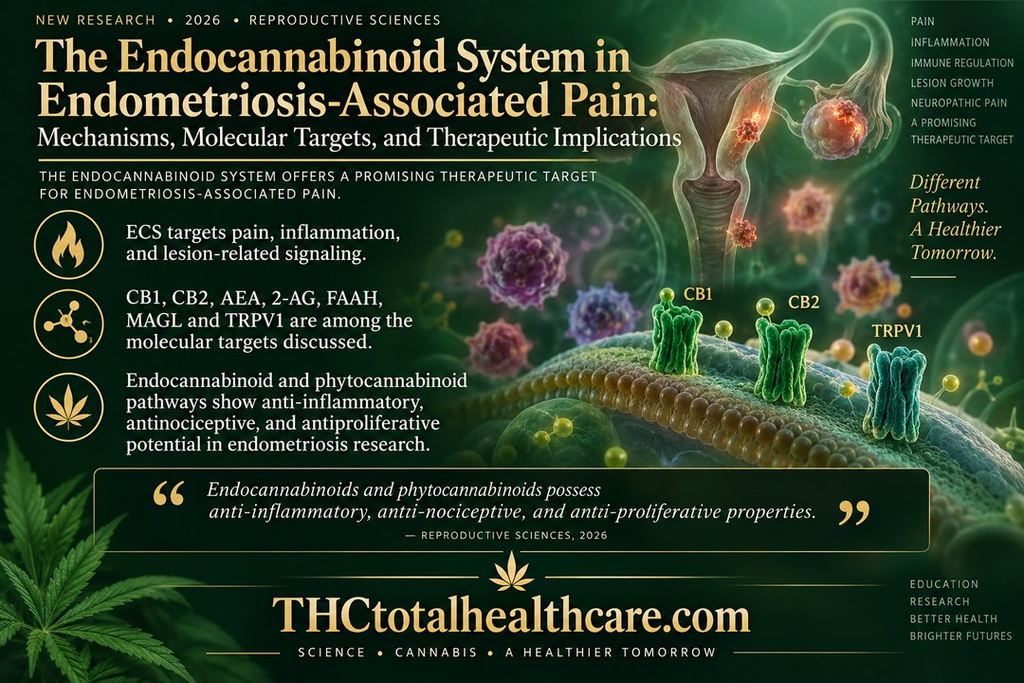
The Endocannabinoid System in Endometriosis-Associated Pain: Mechanisms, Molecular Targets, and Therapeutic Implications

A new 2026 review published in Reproductive Sciences examines the endocannabinoid system (ECS) as a therapeutic target for endometriosis-associated pain, a condition that can cause severe pelvic pain, painful menstruation, painful intercourse, and other chronic symptoms. The authors highlight the ECS because of its established roles in regulating pain, inflammation, and immune activity.

The review found that cannabinoids may influence three major mechanisms involved in endometriosis-associated pain: inflammation, pain signaling and sensitization, and the growth of endometriotic lesions. Cannabinoids interact with both cannabinoid and non-cannabinoid receptors found in endometriotic tissue, while also reducing inflammatory signaling from immune cells such as mast cells and macrophages.

The researchers conclude that the endocannabinoid system is a promising therapeutic target for endometriosis-associated pain, with cannabinoid therapies showing potential to regulate nociception, inflammation, and lesion proliferation. They call for clinical trials to further evaluate cannabinoid-based treatments for people living with endometriosis.

“Endometriosis is a chronic gynecological disorder affecting approximately 10% of reproductive-age women, characterized by the ectopic growth of endometrial tissue and severe pain, including dysmenorrhea, chronic pelvic pain, dyspareunia, dysuria, and dyschezia. Current treatments are limited in efficacy and associated with significant side effects, underscoring the urgent need for novel therapeutic strategies.

The endocannabinoid system (ECS) has emerged as a promising therapeutic target, given its well-established roles in pain modulation, inflammation, and immune regulation. Epidemiological evidence demonstrates that women with endometriosis increasingly use cannabis for symptom self-management, yet the underlying mechanisms remain poorly characterized.

This review integrates preclinical and human evidence to comprehensively evaluate the mechanistic basis of cannabinoid efficacy in endometriosis-associated pain. Evidence from in vitro studies and animal models indicates that cannabinoids target three main mechanisms of endometriosis-associated pain, including inflammation, nociceptive signaling, and lesion proliferation.

Cannabinoids suppress pain signaling and sensitization by interacting with cannabinoid and non-cannabinoid receptors expressed in endometriotic lesions. Cannabinoids attenuate endometriosis-induced inflammation by inhibiting proinflammatory cytokine signaling and reducing the release of inflammatory mediators by mast cells and peritoneal macrophages. Cannabinoids also exert antiproliferative effects in endometriosis models, thereby suppressing the growth of endometriotic lesions.

In conclusion, the ECS is a promising therapeutic target for endometriosis-associated pain, as it regulates nociception, inflammation, and proliferation. These promising findings highlight the potential therapeutic benefits of cannabinoids for endometriosis-associated pain, warranting the need for clinical trials to evaluate the safety and effectiveness of cannabinoid therapies in endometriosis.”

https://pubmed.ncbi.nlm.nih.gov/42745018

https://link.springer.com/article/10.1007/s43032-026-02201-9

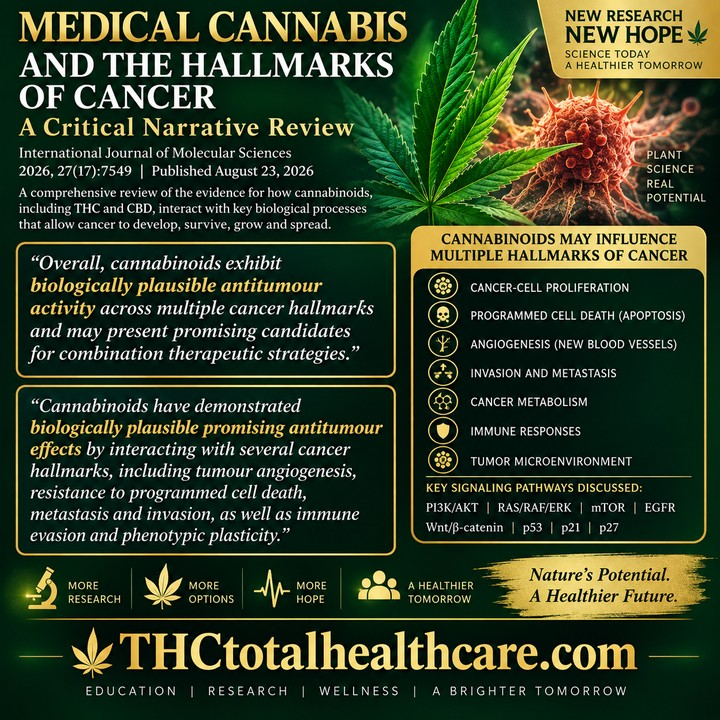
Medical Cannabis and the Hallmarks of Cancer: A Critical Narrative Review

A 2026 critical narrative review examines medical cannabis through one of the most important frameworks in cancer biology: the hallmarks of cancer. Rather than looking only at symptom relief, the authors reviewed evidence for how cannabinoids, including THC and CBD, may interact with biological processes that allow cancer to develop, survive, grow and spread.

The review discusses cannabinoid effects involving cancer-cell proliferation, programmed cell death, angiogenesis, invasion, metastasis, tumor metabolism, immune responses and the tumor microenvironment. It also examines major cancer-related signaling pathways, including PI3K/AKT, RAS/RAF/ERK, mTOR, EGFR, Wnt/β-catenin and p53.

Taken together, the research shows that cannabinoids can influence multiple hallmarks of cancer through several interconnected mechanisms. The authors describe the evidence as showing biologically plausible antitumor activity and highlight cannabinoids as an important area for continued cancer research and development.

“Cancer remains a highly complex and heterogeneous disease, causing major morbidity and mortality worldwide despite advances in diagnosis and treatment. The hallmarks of cancer enlighten the biological mechanisms supporting tumourigenesis and malignant evolution, while helping to identify potential therapeutic targets.

Medical cannabis has mostly been used in oncology for supportive care, but increasing preclinical evidence suggests interference with cancer-related signalling pathways.

This narrative review summarizes the current evidence on cannabinoids, in particular the phytocannabinoids cannabidiol (CBD) and Δ9-tetrahydrocannabinol (THC), framing their prospective anticancer effects in the hallmarks of cancer.

Preclinical studies imply that CBD exerts antiproliferative effects by modulating oncogenic signalling pathways, including EGFR, PI3K/AKT, RAS/RAF/ERK, mTOR and Wnt/β-catenin, while also influencing tumour suppressor pathways involving p53, p21 and p27, causing cell cycle arrest. CBD has additionally been shown to promote programmed cell death via mitochondrial dysfunction and autophagy, altering cancer metabolism as well. Furthermore, CBD has shown anti-invasive and antiangiogenic properties and also appears to modulate immune responses and interactions with the tumour microenvironment, including emerging links with the microbiome.

Overall, cannabinoids exhibit biologically plausible antitumour activity across multiple cancer hallmarks and may present promising candidates for combination therapeutic strategies.

Nonetheless, the current evidence remains predominantly preclinical, and robust translational studies and clinical trials are needed to clarify their pharmacokinetic and pharmacodynamic profiles, determine their clinical efficacy and safety while assessing their potential integration into multimodal cancer treatment.”

https://pubmed.ncbi.nlm.nih.gov/42737454/

“Cannabinoids have demonstrated biologically plausible promising antitumour effects by interacting with several cancer hallmarks, including tumour angiogenesis, resistance to programmed cell death, metastasis and invasion, as well as immune evasion and phenotypic plasticity.”

“Cannabinoids can interfere with several biological mechanisms involved in cancer development and progression and even though their role in oncology remains mostly supportive with predominance in symptom control, preclinical studies increasingly suggest that cannabis can also influence tumour biology.”

https://www.mdpi.com/1422-0067/27/17/7549