
(+)-Trans-Cannabidiol Is an Agonist at Human CB2 Receptors

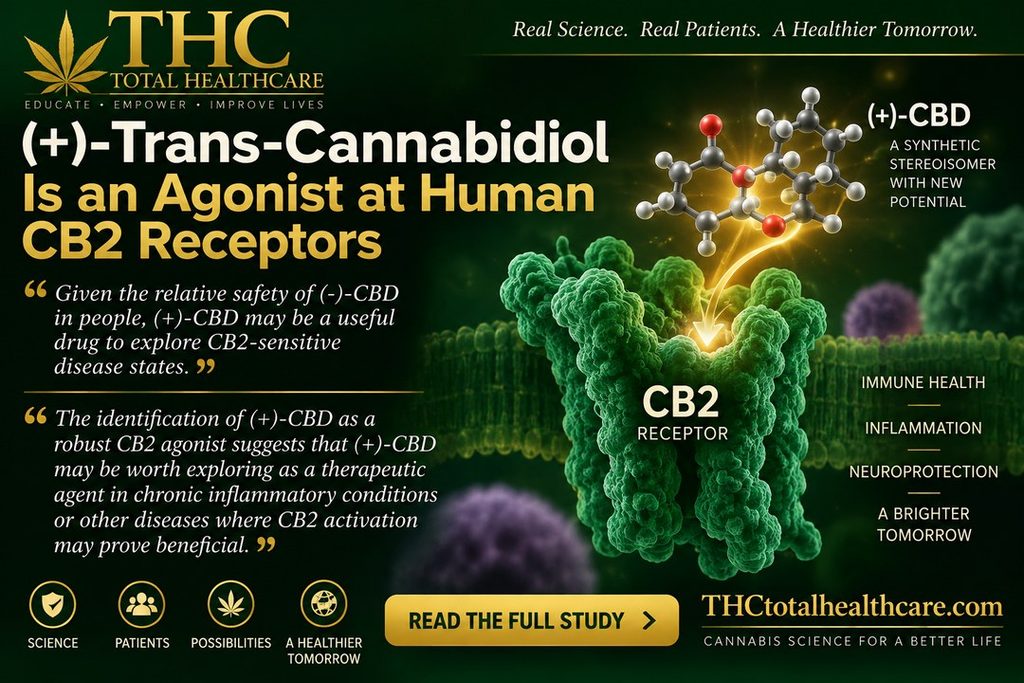
A new 2026 study reports that (+)-trans-cannabidiol [(+)-CBD] acts as an agonist at human CB2 cannabinoid receptors, activating a major receptor of the endocannabinoid system involved in immune and inflammatory signaling.

Researchers found that (+)-CBD produced a strong, concentration-dependent CB2 response, reaching roughly 90% of the maximum effect produced by the reference cannabinoid agonist CP55940. Additional testing indicated that the compound acts through the receptor’s primary, or orthosteric, binding site.

The findings show that different molecular forms of cannabidiol can interact with cannabinoid receptors in very different ways. The researchers conclude that (+)-CBD may deserve further study in CB2-sensitive disease states, adding another layer to our understanding of how cannabinoid chemistry can influence the human endocannabinoid system.

“(-)-trans-Cannabidiol ((-)-CBD) is a principal phytocannabinoid from Cannabis sativa. (-)-CBD has complex pharmacology but is a relatively weak inhibitor of CB1 and CB2 receptor signaling. Cannabidiol has two chiral centres and thus four stereoisomers. (+)-trans-CBD ((+)-CBD) has a higher affinity than (-)-CBD at CB1 and CB2, but its pharmacodynamic effects at these receptors are incompletely described.

We examined the activity of (+)-CBD at human CB1 and CB2 receptors using a fluorescence-based assay of membrane potential in AtT20 cells stably expressing CB1 or CB2 receptors.

(+)-CBD produced a rapid, concentration-dependent hyperpolarization in CB2-expressing cells (pEC50 6.63 ± 0.08) with a maximal effect 90% of the response to CP55940. The CB2 response was blocked by pertussis toxin pretreatment and competitively inhibited by the CB2 antagonist AM630 (Schild slope 1.1 ± 0.1). (+)-CBD was a low-efficacy, low-potency CB1 agonist and inhibited somatostatin-receptor effects at high concentrations (10-30 μM). (+)-CBD had no effect on the membrane potential of AtT20 wild-type cells. In silico modeling of ligand interactions with CB2 indicated that (+)-CBD but not (-)-CBD formed an H-bond with Ser285, a residue crucial for agonist activation of CB2.

Our data suggests (+)-CBD acted as a CB2 agonist via the orthosteric binding site on the receptor. Synthetic CBD, including (+)-CBD, has previously been administered in clinical trials, presumably without consideration of its potential CB2 agonist activity.

Given the relative safety of (-)-CBD in people, (+)-CBD may be a useful drug to explore CB2-sensitive disease states.”

https://pubmed.ncbi.nlm.nih.gov/42745361

“This study emphasizes the importance of understanding the molecular actions of the enantiomers of chiral cannabinoids. Although the safety of (+)-CBD cannot simply be assumed to be the same as (−)-CBD, the identification of (+)-CBD as a robust CB2 agonist suggests that (+)-CBD may be worth exploring as a therapeutic agent in chronic inflammatory conditions or other diseases where CB2 activation may prove beneficial.”

https://bpspubs.onlinelibrary.wiley.com/doi/10.1002/prp2.70325
The Endocannabinoid System is No Longer the Limiting Factor: Why Policy and Stigma Continue to Delay Cannabinoid-Based Medicine

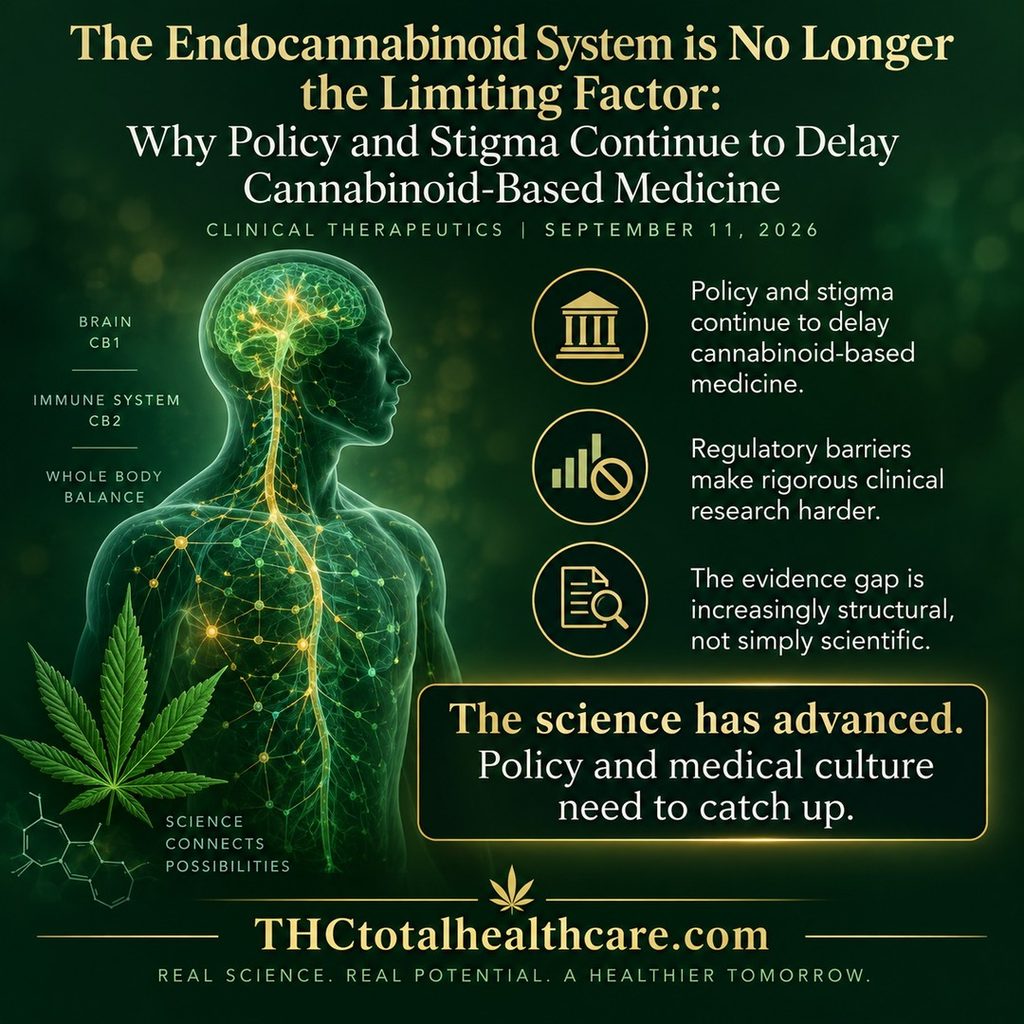
The science of the endocannabinoid system has advanced dramatically, but cannabinoid-based medicine is still being held back by forces outside the laboratory. This new Clinical Therapeutics commentary argues that the biological understanding of the endocannabinoid system is no longer the main limiting factor. The larger barriers are now policy, regulation, funding, access, and stigma.

According to the authors, restrictive and fragmented rules make cannabinoid research harder to conduct, while limited access to standardized products complicates rigorous clinical trials. At the same time, stigma within medicine can discourage research, education, prescribing, and open discussion with patients.

The message is simple: the remaining evidence gaps are not purely scientific. They are also structural. If cannabinoid-based medicine is going to move forward, policy and medical culture will have to catch up with what researchers already understand about the endocannabinoid system.

“Purpose: To examine whether the persistent gap between the extensive mechanistic knowledge of the Endocannabinoid System (ECS) and the limited number of high-quality randomized clinical trials of cannabinoid-based therapies primarily reflects scientific uncertainty or, instead, structural regulatory, economic, and social barriers.

Methods: This commentary critically synthesizes historical, regulatory, and contemporary evidence on cannabinoid research, integrating data from regulatory documents, international policy reports, clinical and observational studies, systematic reviews, and qualitative investigations. Particular emphasis is placed on barriers affecting access to standardized products, conduct of randomized clinical trials, public funding, product standardization, and healthcare professionals’ perceptions.

Findings: Although the ECS has been extensively characterized for more than three decades and cannabinoids demonstrate plausible pharmacological mechanisms across multiple therapeutic areas, clinical translation remains disproportionately limited. Persistent regulatory restrictions, inherited from prohibition policies, continue to delay access to standardized research material, increase the cost and complexity of clinical trials, and shift evidence generation toward observational designs. Regulatory fragmentation further compromises product standardization and study reproducibility, whereas persistent social and professional stigma reduces research activity, medical education, prescribing confidence, and patient disclosure, perpetuating a self-reinforcing cycle between limited evidence generation and clinical distrust.

Implications: The principal obstacle to cannabinoid-based medicine is no longer the biological understanding of the ECS but the structural environment surrounding cannabinoid research. Progress toward evidence-based clinical implementation will depend on regulatory harmonization, greater public investment in randomized clinical research, standardized pharmaceutical-quality products, and educational initiatives capable of reducing stigma among healthcare professionals. Recognizing the structural rather than scientific origin of the evidence gap is essential for informing future research priorities, editorial policies, and international regulatory strategies.”

https://pubmed.ncbi.nlm.nih.gov/42728140

“The ECS is no longer the main obstacle to cannabinoid therapeutics. Stigma and regulation continue to delay clinical translation. Standardized clinical research requires international regulatory reform. Medical education is crucial for evidence-based cannabinoid therapies.”

https://www.clinicaltherapeutics.com/article/S0149-2918(26)00317-6/fulltext