
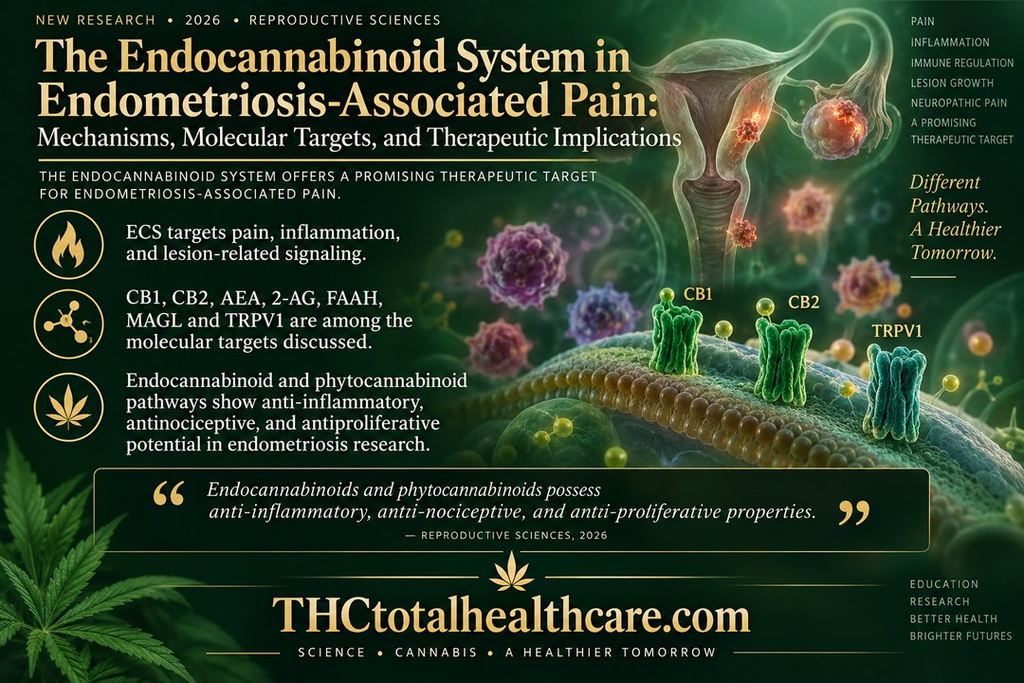
The Endocannabinoid System in Endometriosis-Associated Pain: Mechanisms, Molecular Targets, and Therapeutic Implications

A new 2026 review published in Reproductive Sciences examines the endocannabinoid system (ECS) as a therapeutic target for endometriosis-associated pain, a condition that can cause severe pelvic pain, painful menstruation, painful intercourse, and other chronic symptoms. The authors highlight the ECS because of its established roles in regulating pain, inflammation, and immune activity.

The review found that cannabinoids may influence three major mechanisms involved in endometriosis-associated pain: inflammation, pain signaling and sensitization, and the growth of endometriotic lesions. Cannabinoids interact with both cannabinoid and non-cannabinoid receptors found in endometriotic tissue, while also reducing inflammatory signaling from immune cells such as mast cells and macrophages.

The researchers conclude that the endocannabinoid system is a promising therapeutic target for endometriosis-associated pain, with cannabinoid therapies showing potential to regulate nociception, inflammation, and lesion proliferation. They call for clinical trials to further evaluate cannabinoid-based treatments for people living with endometriosis.

“Endometriosis is a chronic gynecological disorder affecting approximately 10% of reproductive-age women, characterized by the ectopic growth of endometrial tissue and severe pain, including dysmenorrhea, chronic pelvic pain, dyspareunia, dysuria, and dyschezia. Current treatments are limited in efficacy and associated with significant side effects, underscoring the urgent need for novel therapeutic strategies.

The endocannabinoid system (ECS) has emerged as a promising therapeutic target, given its well-established roles in pain modulation, inflammation, and immune regulation. Epidemiological evidence demonstrates that women with endometriosis increasingly use cannabis for symptom self-management, yet the underlying mechanisms remain poorly characterized.

This review integrates preclinical and human evidence to comprehensively evaluate the mechanistic basis of cannabinoid efficacy in endometriosis-associated pain. Evidence from in vitro studies and animal models indicates that cannabinoids target three main mechanisms of endometriosis-associated pain, including inflammation, nociceptive signaling, and lesion proliferation.

Cannabinoids suppress pain signaling and sensitization by interacting with cannabinoid and non-cannabinoid receptors expressed in endometriotic lesions. Cannabinoids attenuate endometriosis-induced inflammation by inhibiting proinflammatory cytokine signaling and reducing the release of inflammatory mediators by mast cells and peritoneal macrophages. Cannabinoids also exert antiproliferative effects in endometriosis models, thereby suppressing the growth of endometriotic lesions.

In conclusion, the ECS is a promising therapeutic target for endometriosis-associated pain, as it regulates nociception, inflammation, and proliferation. These promising findings highlight the potential therapeutic benefits of cannabinoids for endometriosis-associated pain, warranting the need for clinical trials to evaluate the safety and effectiveness of cannabinoid therapies in endometriosis.”

https://pubmed.ncbi.nlm.nih.gov/42745018

https://link.springer.com/article/10.1007/s43032-026-02201-9

Targeting the Endocannabinoid System to Treat Sepsis

“Sepsis is a complex immune disorder that can affect the function of almost all organ systems in the body. This disorder is characterised by a malfunctioning immune response to an infection that involves both pro-inflammatory and immunosuppressive mediators. This leads to severe damage and failure of vital organs, resulting in patient death. Sepsis, septic shock, and systemic inflammatory response syndrome are the leading causes of mortality in surgical intensive care unit patients internationally. The current lack of viable therapeutic treatment options for sepsis underscores our insufficient understanding of this complex disease. The endocannabinoid system, a key regulator of essential physiological functions including the immune system, has recently emerged as a potential therapeutic target for sepsis treatment. The endocannabinoid system acquires its name from the plant Cannabis Sativa, which has been used medically to treat a variety of ailments, as well as recreationally for centuries. Cannabis Sativa contains more than 60 active phytocannabinoids with the primary phytocannabinoid Δ9-tetrahydrocannabinol (THC), (6) activating both endogenous endocannabinoid receptors. The endocannabinoid system represents a potential therapeutic target in sepsis due to the presence of cannabinoid receptors (CB2) on immune cells. In this review we discuss how various targets within the endocannabinoid system can be manipulated to treat the immune consequences of sepsis. One of the targets outlined are the endocannabinoid receptors and modulation of their activity through pharmacological agonists and antagonists. Another therapeutic target covered in this review is the modulation of the endocannabinoid degradative enzyme’s activity. Modulation of degradative enzyme activity can change the levels of endogenous cannabinoids thereby altering immune activity. Overall, activation of the CB2 receptors causes immunosuppression and can be beneficial during the hyperactivated immune state of sepsis, while suppression of the CB2 receptors may be beneficial during a hypoimmune septic state. The endocannabinoid system modulates the immune response in experimental sepsis. Manipulating the endocannabinoid system may have potential therapeutic benefit in clinical sepsis where immune and inflammatory dysfunction can be detrimental. Multiple targets exist within the endocannabinoid system, e.g. the system can be targeted at the level of receptors by administration of synthetic compounds, similar to the endocannabinoids, which either increase or inhibit receptor activation to provide the desired therapeutic effect. Alternatively, the endogenous enzymes that degrade endocannabinoids or cannabinoid-like lipids can also be targeted in order to manipulate the levels of endocannabinoids. Proper identification of the septic stage is crucial to determine the adequate therapeutic response that will be most beneficial. Due to the biphasic nature of sepsis immunopathology, immune suppression through endocannabinoid modulation can help mitigate the hyper-immune response during the early septic state, while immune activation may be beneficial in later stages.” http://www.signavitae.com/2013/05/targeting-the-endocannabinoid-system-to-treat-sepsis/ http://www.signavitae.com/2013/05/targeting-the-endocannabinoid-system-to-treat-sepsis/]]>