
By David M. Worrell
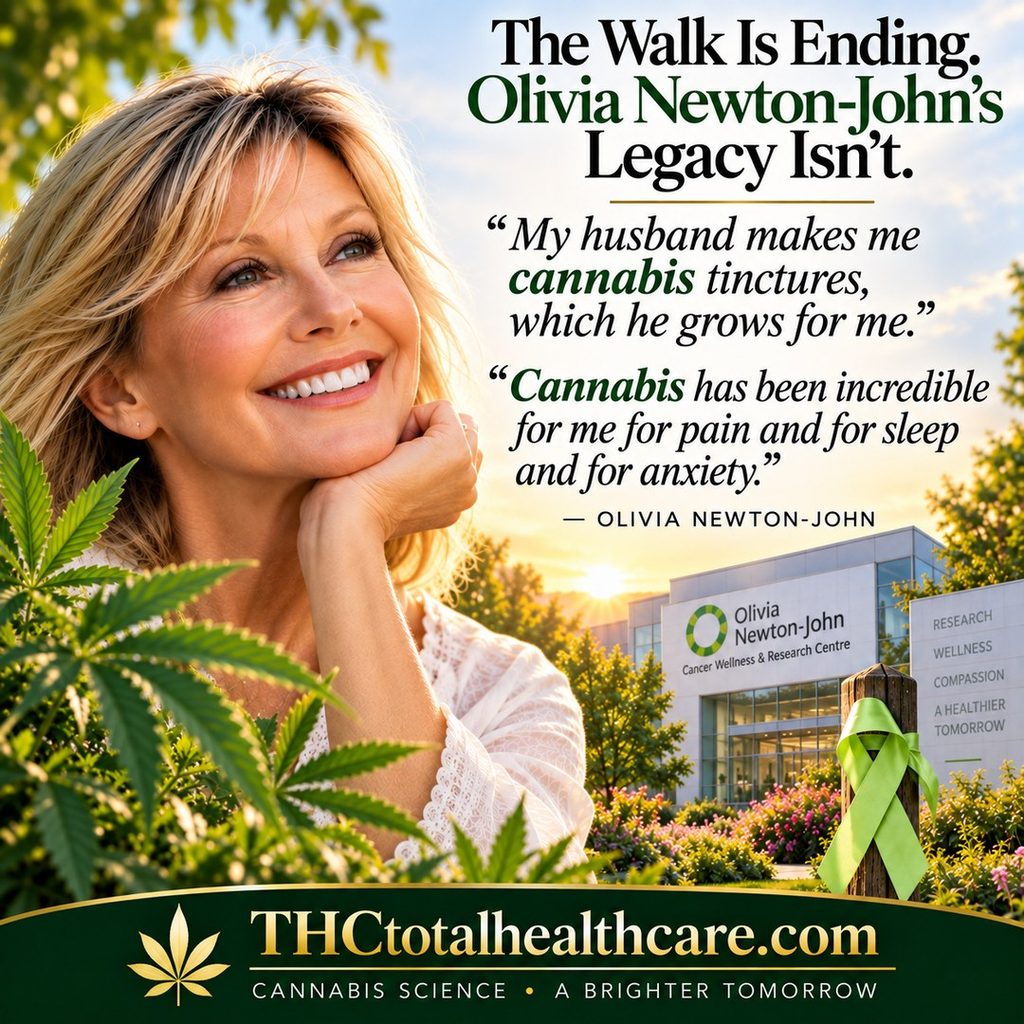
The first time I heard Olivia Newton-John’s voice on the radio, I thought she might be an angel.
Decades later, when I heard that same voice on the news championing a controversial cause close to my heart, I felt I had been right.
In May 2017, before I knew her breast cancer had returned, I received an instant message from someone claiming to be Olivia Newton-John. The message encouraged me to keep doing what I was doing — sharing science — and echoed a phrase I had been posting for years:
“Thank you for sharing.”
I remember what happened next because I watched it unfold in real time.
Later, the world learned that Olivia Newton-John’s breast cancer had returned and metastasized to her sacrum. By June, I was reading reports that she was using cannabis oil. By September, she was talking about cannabis openly.
And not timidly.
In an Australian 60 Minutes interview, Olivia called cannabis a “magical, miracle plant.” Days later, on American television, she called it “a healing plant.”
She said it helped her pain. She discussed inflammation. Over the following years, she would talk about cannabis helping her sleep and anxiety. She credited her husband, John Easterling, with growing cannabis and preparing tinctures specifically for her. She later said cannabis helped her wean herself off morphine.
“I couldn’t have got through this time without it,” she said in 2019.
Yet I remember watching another story develop alongside hers.
Olivia was telling the public how well she was doing, how important cannabis had become to her and how determined she was to live.
Much of the news coverage, however, increasingly felt like a countdown toward her death.
That became especially frustrating in 2018.
Olivia revealed that the cancer she had publicly disclosed in 2017 was actually her third experience with breast cancer. Her first diagnosis had come in 1992. She had experienced another recurrence in 2013 but chose to keep it private.
That was significant new information.
But it was not a new recurrence in 2018.
Nevertheless, headlines appeared announcing that Olivia Newton-John’s cancer had “returned for a third time.” To someone encountering the story casually, it could sound as though she had suffered another fresh setback.
The individual facts were technically true but the overall impression was misleading.
At the same time some headlines were emphasizing another “cancer battle,” Olivia was appearing publicly, participating in her Wellness Walk, talking about “winning over” cancer and telling interviewers she was doing well.
One source close to her pushed back against reports suggesting her condition had suddenly worsened, saying the information being reported was the same diagnosis she had disclosed the previous year.
I wanted to call attention to that disconnect then.
I did not have the ability to assemble years of interviews, headlines and contemporaneous reporting the way I can now.
But I remembered it.
And when the chronology is reconstructed, Olivia Newton-John’s story looks different.
She was never simply a celebrity who used marijuana.
Her relationship with cannabis became part of a much larger philosophy of cancer care.
Olivia had embraced complementary approaches since her first cancer diagnosis. She used conventional medicine, too. That point matters because her story is sometimes reduced to a false choice between cannabis and oncology.
Her approach was integrative.
Over the years she underwent surgery, chemotherapy, radiation, hormone therapy and other medical treatments while also using meditation, herbs, supplements, homeopathy, acupuncture, cannabis and other wellness practices.
She described treatment decisions as deeply personal.
Her husband, John Easterling, added another dimension.
Long before cannabis became central to their public story, Easterling had spent years studying plants and working with botanical medicine. Newton-John called him her “plant medicine man.”
The two seemed almost destined to find each other: a woman already drawn to holistic healing and a man who had devoted much of his life to medicinal plants.
By the time Newton-John was living with metastatic disease, Easterling was cultivating different cannabis strains at their California home and making tinctures for her.
Olivia said she did not like feeling intoxicated.
What she repeatedly emphasized was relief.
“If I don’t take the cannabis, I can feel the pain so I know it’s working,” she told 60 Minutes reporter Liz Hayes.
She called herself “incredibly pro cannabis.”
Her advocacy eventually moved beyond her own use.
“My dream is that it will be available to all the cancer patients or people going through cancer or any kind of disease that causes pain,” she said.
She talked about parents facing prosecution while seeking cannabis for children with epilepsy. She challenged the stigma surrounding the plant. She argued that patients deserved the right to try it.
And sometimes she went further than cautious symptom language.
She talked about cannabis and healing. She said research was examining the plant “not just for pain but to cure things.” She said she believed medicinal cannabis could play a major role in defeating cancer.
Those statements should be understood for what they were: the beliefs and hopes of a patient and advocate, not the results of a randomized clinical trial.
But that is precisely where her story becomes particularly important.
She did not stop at belief.
She wanted research.
That may be the part of her cannabis legacy most worth remembering.
Olivia spent years raising money and lending her name to what became the Olivia Newton-John Cancer Wellness & Research Centre in Melbourne, Australia. She insisted that “wellness” be part of the institution because she believed cancer care should treat the whole person, not merely the tumor.
Her later foundation explicitly sought to fund research into plant medicine.
And today, that idea is becoming reality.
The RESONANCE trial is studying medicinal cannabis in people with advanced cancer, examining symptoms, quality of life, tolerability and adverse effects.
The research represents something Olivia repeatedly called for: move beyond stigma, beyond anecdotes and beyond political arguments, and actually study what cannabis can and cannot do for patients.
That is why the timing of this story matters.
Olivia Newton-John would have turned 78 on September 26.
The medicinal-cannabis trial her advocacy helped inspire is actively recruiting.
October is Breast Cancer Awareness Month.
And on October 4, supporters will gather for the final Olivia’s Walk for Wellness.
The walk is ending.
The research is not.
Neither should our examination of the story Olivia Newton-John was trying to tell us.
For years, Olivia told interviewers that cannabis helped her through severe pain, improved her sleep, aided her quality of life and changed the way she thought about a plant she once approached nervously.
Then she used her celebrity to ask why other patients could not have the same opportunity.
Finally, she tried to move the conversation from testimony to action.
I watched her journey unfold online.
What frustrated me then was seeing a woman talking about healing, hope and the wonderful things she believed this plant was doing for her, while the public narrative so often seemed fixated on how close she was to dying.
What strikes me now that she is gone is what she left behind.
The headlines eventually stopped.
The interviews remain.
The cancer center remains.
The science continues.
Can cannabis fight cancer?
She believed it could.
Decades of laboratory and preclinical research have given scientists reason to keep asking the question Olivia Newton-John wanted answered.
The research she called for is being done.
Perhaps that is the most fitting way to remember her as her birthday approaches, as supporters prepare for the final Walk for Wellness.
Not merely as a celebrity who had cancer and used cannabis.
But as someone who turned what she learned from living with it for 30 years into a legacy that will walk on.
© 2026 David M. Worrell. Originally published by THCtotalhealthcare.com. Republication inquiries welcome.