
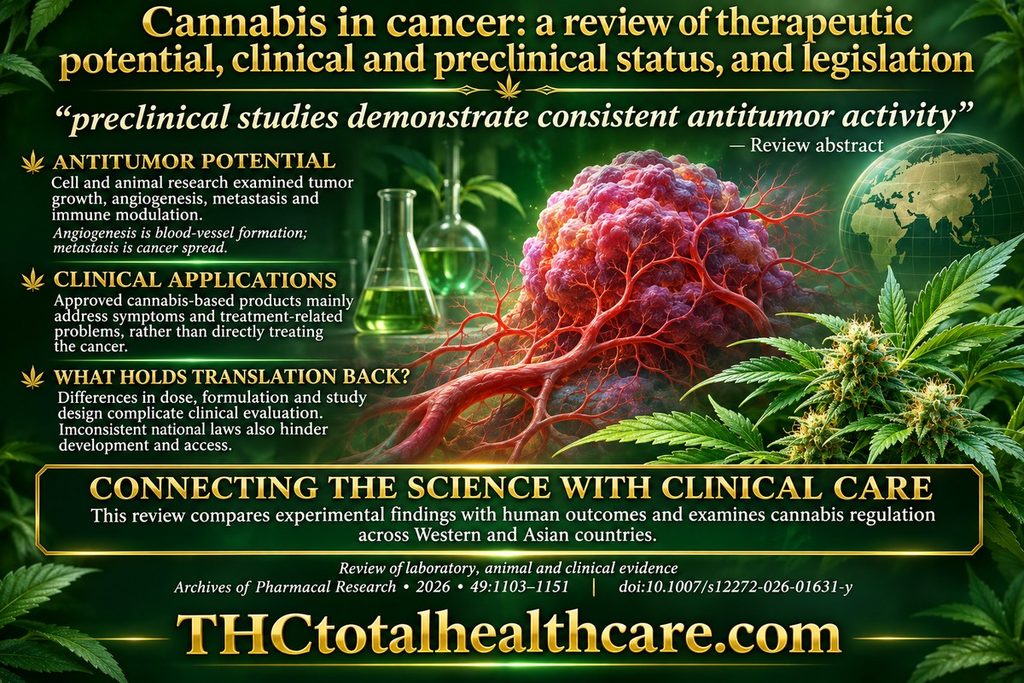
Cannabis in cancer: a review of therapeutic potential, clinical and preclinical status, and legislation

Cannabinoids show consistent antitumor activity in cell and animal studies, according to this review examining cannabis in cancer care. The authors assess effects on tumor growth, blood-vessel formation, cancer spread, and immune regulation, alongside findings from human clinical studies.

The review highlights a gap between experimental results and established clinical applications. Approved cannabis-based medicines primarily address symptoms and treatment-related problems, including chemotherapy-associated nausea and vomiting, while their potential to directly control cancer requires further clinical evaluation.

Differences in dosing, formulations, study methods, and national laws complicate the development of cannabinoid therapies. By examining both the science and legislation across Western and Asian countries, the review identifies more consistent research practices and coordinated regulation as important steps toward translating promising findings into clinical care.

“The involvement of cannabis and cannabinoid-based products in the inhibition or progression of cancer has been reported in previous studies. However, only a limited number of cannabis-based products have been approved for specific clinical indications.

This review critically evaluates the therapeutic potential of cannabis and cannabinoid-based products in cancer, with particular emphasis on the consistency between preclinical evidence and clinical outcomes. Cannabinoids were systematically evaluated across available cell-based and animal model studies, as well as clinical studies to assess their regulatory effects on tumor growth, angiogenesis, metastasis, and immune modulation.

Although preclinical studies demonstrate consistent antitumor activity, currently approved cannabis-based products are largely restricted to palliative indications, such as pain relief and management of chemotherapy-related symptoms, rather than disease-modifying cancer therapies. Furthermore, substantial variability in study design, dosing, formulation, and regulatory constraints hampers the translation of experimental findings into clinical practice.

This review provides a comprehensive clinical assessment of cannabis and cannabinoid-based products in the treatment of various cancers and examines the regulatory and legal frameworks governing their use in Western and Asian countries.

Despite the increasing global trend toward the legalization of medical cannabis, the lack of legislative harmonization remains a major barrier to the development, distribution, and clinical implementation of cannabis-based products.”

https://pubmed.ncbi.nlm.nih.gov/42836893

https://link.springer.com/article/10.1007/s12272-026-01631-y
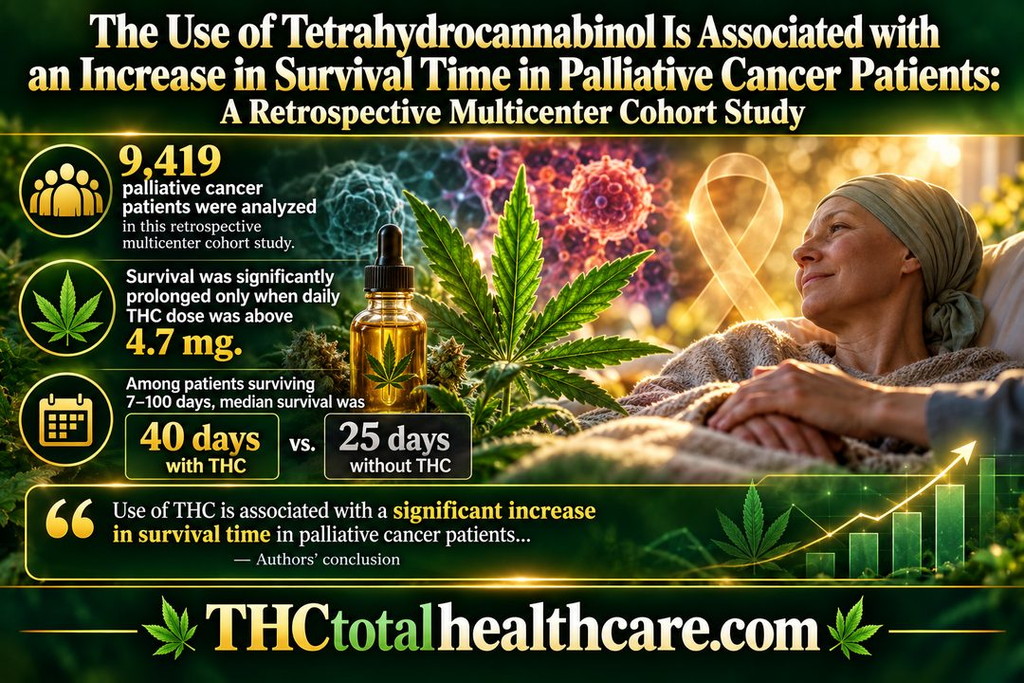
The Use of Tetrahydrocannabinol Is Associated with an Increase in Survival Time in Palliative Cancer Patients: A Retrospective Multicenter Cohort Study

A large retrospective multicenter study of 9,419 palliative cancer patients found that THC use was associated with longer survival. The researchers reported the strongest association among patients receiving more than 4.7 mg of THC per day.

In patients who survived between 7 and 100 days, median survival was 40 days in the THC group compared with 25 days in patients who did not receive THC. The study also examined THC alongside palliative-care treatment rather than as a replacement for standard care.

These findings add an important human-data signal to the growing research on cannabinoids in cancer care. While the study was observational, the association between THC use and longer survival makes this a significant finding for palliative oncology and cannabinoid research.

“Introduction: Tetrahydrocannabinol (THC) is often prescribed for ambulatory palliative patients to improve sleep quality and appetite and to reduce anxiety, stress, and pain. However, it is not known if THC has also an effect on the mortality of these patients.

Method: The objective was the impact of THC on mortality of ambulatory palliative patients. For this purpose, data from the palliative treatment documentation from 5 ambulatory palliative care teams in Brandenburg, Germany were used for this analysis. Survival time was calculated for 3 groups of patients: (1) without THC; (2) with THC in a low dosage (≤4.7 mg per day); and (3) THC in higher doses (≥4.7 mg per day). The analysis was done for 2 cohorts of patients. Cohort 1: all patients with a survival time of at least 7 days after inclusion in specialized ambulatory palliative care (SAPC) and cohort 2: a subgroup of patients with a survival time between 7 and 100 days. Kaplan-Meier curves were created, and multivariate analysis was done to investigate the impact of THC on mortality.

Results: A total of 9,419 patients with a survival time of at least 7 days after inclusion in SAPC were included in the analysis (cohort 1). 7,085 among them had a survival time between 7 and 100 days (cohort 2). In both cohorts, survival time was significantly prolonged by THC, but only when the daily THC dose was above the median of 4.7 mg. Survival time was 15 days longer in cohort 2 (40 vs. 25 days), when more than 4.7 mg THC were prescribed per day.

Conclusion: Use of THC is associated with a significant increase in survival time in ambulatory palliative patients which survive longer than 7 days the initiation of THC prescription and which use of THC >4.7 mg/day.”

https://pubmed.ncbi.nlm.nih.gov/38655402/

“Thus, in view of its significant prolongation of patient survival time, THC therapy should be included as part of the first-line therapy for ambulatory palliative patients.”

https://karger.com/mca/article/7/1/59/896816/The-Use-of-Tetrahydrocannabinol-Is-Associated-with

Need this THC study explained? thcXplained.com