
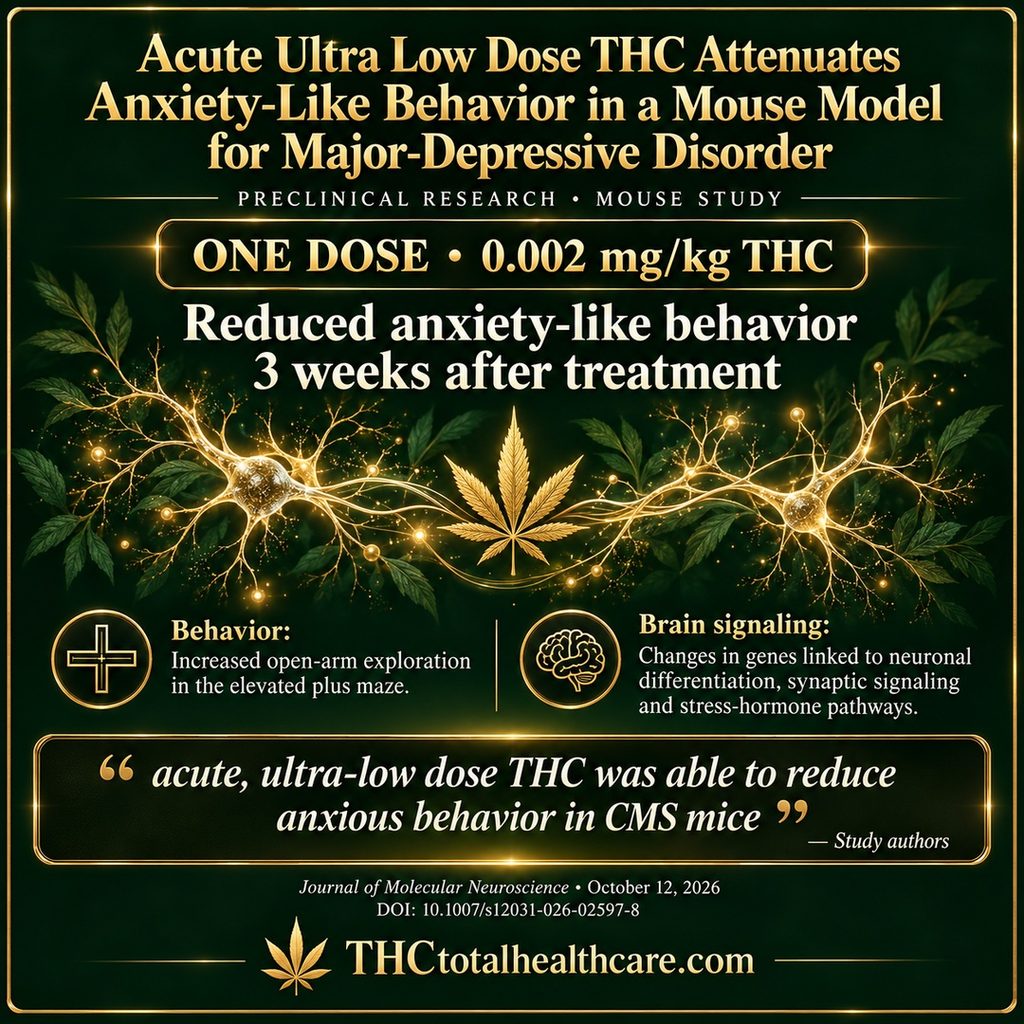
Acute Ultra Low Dose THC Attenuates Anxiety-Like Behavior in a Mouse Model for Major-Depressive Disorder

A single ultra-low dose of THC reduced anxiety-like behavior in mice exposed to chronic mild stress, a model used to study major depressive disorder. Researchers administered 0.002 mg/kg of THC and observed behavioral benefits three weeks later, after THC had cleared from the animals’ systems.

THC-treated stressed mice explored the open arms of an elevated plus maze more frequently than untreated stressed mice, indicating reduced anxiety-like behavior. A separate open-field test showed a trend toward improvement. Brain analysis also identified changes in gene expression associated with neuronal differentiation, communication between nerve cells, and stress-hormone signaling.

These findings support further investigation of ultra-low-dose THC for anxiety associated with depression. Changes involving Elmod1 and other stress-related genes offer clues to how a single treatment could produce lasting effects in this mouse model.

“Major depressive disorder (MDD) is a prevalent psychiatric disorder, and is a leading cause of disability worldwide. Current treatments for MDD entail many side effects, and include a lag until the onset of therapeutic effects. The current hypotheses as for the etiology of MDD revolve around the monoamine hypothesis and the plasticity and neurodegeneration hypothesis.

According to the latter, employing a neuroprotective treatment may help ameliorate depressive symptoms. Δ9-Tetrahydrocannabinol (THC) is the primary psychoactive component of the cannabis sativa plant. THC interacts with the endocannabinoid system, which was shown to be involved in the regulation of emotional states (e.g. anxiety) and stress through modulation of synaptic plasticity.

Here, we show the potential of acute, ultra-low dose (0.002 mg/kg) THC in ameliorating anxious behavior in a chronic mild stress mouse model for MDD. We utilize next generation sequencing techniques to show the treatment’s effect on neuronal differentiation and synaptic plasticity-related mRNAs, and specify Elmo domain containing 1 (Elmod1) as a molecular mediator of the observed anxiolytic effects. Moreover, we show the involvement of glucocorticoids-related mRNAs in the observed anxiolytic effect of acute, ultra-low dose THC.”

https://pubmed.ncbi.nlm.nih.gov/42864498

“Acute, Ultra-Low Dose THC Reduces Anxiety in CMS Mice”

“While further studies should be made to deeply understand the molecular mechanism underlying the effects of acute, ultra-low dose THC, with emphasis on the glucocorticoid pathway and cytoskeleton stability, our results show the potential of acute, ultra-low dose THC treatment in ameliorating anxious behavior through distinct mechanisms at the mRNA level. The use of an acute, ultra-low dose holds substantial translational value for clinical adoption, as compliance may be higher when treatment is given only once.

Ultimately, this work shows that an extremely low dose of THC is sufficient to produce behavioral effects without requiring the chronic, high-dose regimens typically needed to achieve similar outcomes.”

https://link.springer.com/article/10.1007/s12031-026-02597-8

Need this THC study explained? thcXplained.com
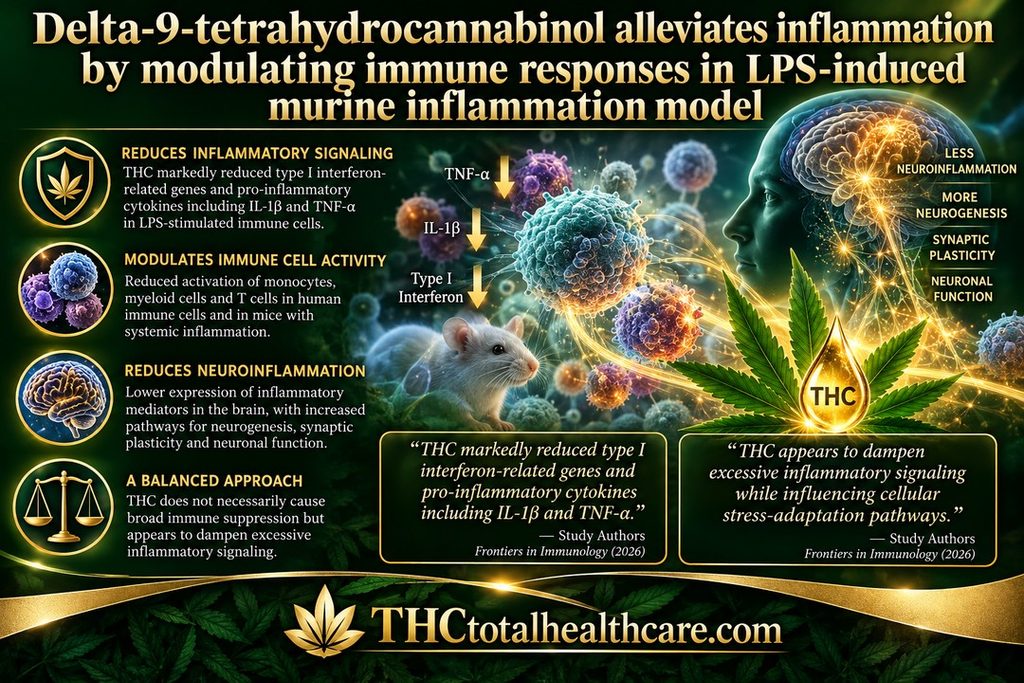
Delta-9-tetrahydrocannabinol alleviates inflammation by modulating immune responses in LPS-induced murine inflammation model

Delta-9-THC reduced inflammatory immune signaling across human immune cells and a mouse model of systemic inflammation. In LPS-stimulated cells, THC markedly suppressed type I interferon-related genes and pro-inflammatory cytokines including IL-1β and TNF-α, while also reducing immune-cell activation markers.

The effects extended beyond isolated cells. In mice exposed to systemic inflammation, THC reduced activation of splenic myeloid cells and T cells. Brain analysis also showed reduced neuroinflammatory signaling, including lower expression of inflammatory mediators, while pathways associated with neurogenesis, synaptic plasticity and neuronal function were enriched.

Importantly, the researchers describe THC’s effects as modulation rather than indiscriminate immune suppression, concluding that THC appears to dampen excessive inflammatory signaling while influencing cellular stress-adaptation pathways. They say these findings support further investigation of cannabinoid signaling in chronic inflammatory, neuroimmune and neurodegenerative disorders.

“Introduction: Δ9-Tetrahydrocannabinol (THC), the primary psychoactive component of cannabis, has been reported to modulate immune responses; however, its effects on complex innate immune signaling pathways and inflammation remain incompletely understood. Here, we investigated the immunomodulatory effects of THC on lipopolysaccharide (LPS)-induced inflammation across cellular and in vivo models.

Methods: We integrated transcriptomic, cellular, and in vivo approaches to characterize the effects of THC on innate immune activation. Human THP-1 monocytic cells were treated with THC in the presence or absence of LPS, followed by transcriptomic and gene expression analyses to evaluate inflammatory, type I interferon, unfolded protein response (UPR), and autophagy pathways. Findings were validated in primary human monocytes by assessing immune activation markers. The effects of chronic THC exposure were further evaluated in a murine model of systemic inflammation by examining splenic myeloid and T-cell activation. RNA sequencing of brain tissue was performed to assess the effects of THC on neuroinflammatory and neuronal pathways.

Results: THC induced a stress-adaptive transcriptional program in THP-1 cells, characterized by upregulation of genes associated with the UPR and autophagy pathways. In contrast, THC markedly suppressed LPS-induced type I interferon-stimulated genes (ISGs) and pro-inflammatory cytokines, including IL-1β and TNF-α. In primary human monocytes, THC significantly reduced the expression of activation markers CD80, CD83, and CD209. Consistent with these findings, chronic THC exposure attenuated the activation of splenic myeloid and T cells in mice subjected to systemic inflammation. Brain transcriptomic analysis further demonstrated reduced expression of neuroinflammatory pathways following THC exposure, accompanied by enrichment of pathways associated with neurogenesis and synaptic plasticity.

Discussion: Our findings demonstrate that THC exerts broad immunomodulatory effects characterized by suppression of inflammatory and type I interferon responses while promoting cellular stress-adaptation pathways. These effects were observed across human monocytic cells, primary monocytes, and peripheral immune populations in vivo, and were accompanied by reduced neuroinflammatory signaling and increased neuronal plasticity-associated pathways in the brain. Together, these findings provide mechanistic insight into the immunomodulatory actions of THC and support further investigation of cannabinoid signaling as a potential regulator of chronic inflammatory and neuroimmune disorders.”

https://pubmed.ncbi.nlm.nih.gov/42818626

“Chronic THC exposure reduces LPS-induced immune activation in vivo.”

https://www.frontiersin.org/journals/immunology/articles/10.3389/fimmu.2026.1856131/full

Need this THC study explained? thcXplained.com